
READINGS IN EARLY MORMON HISTORY
(Newspapers of California)

|
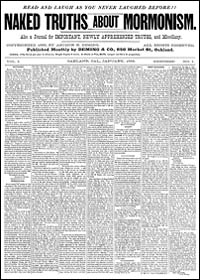
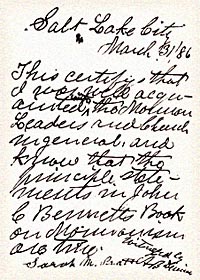
Arthur B. Deming's Naked Truths About Mormonism Oakland, California: Deming & Co., 1888 (printed on the Seventh Day Adventist Pacific Press) Pg. 1 Salutatory Intro. Apology Spalding Derby to Rice Pg. 2 MSs. Osborn Saunders Anderick Butts W. Hine Pg. 3 Alderman Bell Sayer Stafford Rev. Whitney Pg. 4 O. Whitney Oberlin MS McKinstry Briggs editorial Pg. 1 Stafford Rogers Smith Harmon Polygamy S. 132 Pg. 2 Ford Goldsmith Miller Rockafelo Granger Morley Pg. 3 Aldrich Wilson Barber Lillie Grover Sherman Pg. 4 Parrish Pratt Cowdery Smith Tinker B. Young |
|
Old Newspaper Articles Index | Misc. California Newspapers
 COPYRIGHTED 1888, BY ARTHUR B. DEMING. ALL RIGHTS RESERVED.
Published Monthly by DEMING & CO., 856 Market St., Oakland. Terms. - Fifty Cents per year in advance; Single Copies 5 cents. In Clubs of Five, $2.00; Larger numbers in proportion.  VOL. I.
OAKLAND, CAL., JANUARY, 1888.
NO. 1.
VOL. I.
OAKLAND, CAL., JANUARY, 1888.
NO. 1.
[ pg. 1 col. 1 ]
Dear Sir: Remembering the cordial reception you extended me when I called at the Historical Rooms in October, 1882, and the high compliment you bestowed upon my father, together with information obtained from Mrs. Woodruff while again visiting your Historical Rooms in April, 1886, lead me to address to yourself these lines. While visiting a former clerk of mine who had purchased a farm in Kirtland, Ohio, I learned that a debate was to be held in Kirtland, on the subject of Mormonism. I was urged to and did reluctantly become one of the Moderators. Mr. Braden, the opponent of Mormonism, was unable to satisfactorily prove some points he claimed, and he engaged a party to collect evidence to sustain his position. The party did not accomplish much and I undertook the business. I began in March, 1884, and have been engaged in it much of the time since. Owing to legal or other troubles, I suppose, Mr. Braden was unable to fulfill his agreements with me, and I determined to continue the important labor on my own account. The parties whose statements I intend to publish are, I believe, of unimpeachable character, and Mormons will be compelled to accept their testimony. I presume your Historical Society have not paid enough attention to their origin and early history. I hope to remedy the deficiency. I desire to thank your Society, through yourself, for the privilege they accorded me of making a catalogue of publications on Mormonism from your library, also for valuable extracts from the same. For want of money I have not succeeded as I might have done. I hope to derive means from the sale of my newspaper and continue the work, and with competent assistance re-edit, and present your Society with several copies of my intended book, "Naked Truths about Mormonism." I trust, as an honest man, you will carefully weigh the evidence and act accordingly. Sincerely for the truth, ARTHUR B. DEMING.
INTRODUCTION. The evening of my arrival in Salt Lake City I called on Gen. D. H. Wells, whom I had known in Illinois. I visited with part of his numerous family until 10 o'clock P.M., when he accompanied me to the Continental Hotel. We conversed on the sidewalk until 11 o'clock P.M. He said he had told me things about polygamy he had never told anyone. The hotel Manager, Mr. Davis, said everybody in the city admitted that General Wells was an honest Mormon. For the information of my readers who are not Mormons, I will state that Gen. Daniel H. Wells lived on a farm near the Mississippi River, in Hancock County, Illinois, before the Mormons settled Nauvoo. He told me their temple was built on a part of his farm. He was Justice of the Peace and was elected Coroner and my father was elected Sheriff in August, 1844. Polk was elected President on the same ticket. General Wells' first wife remained in Illinois, and he went to Utah and became a double brother-in-law to Brigham Young, and his Second Counselor. He was Mayor of Salt Lake City ten years, and had six wives and twenty-four children. I told one of his daughters that her mother loved their father more than [ pg. 1 col. 2: Introduction continued ] his other wives because her children resembled their father much more than theirs. Her reply was, "I know she does, and I wish he only had mother for his wife." The first wife's children claim to be superior to the plural wife's children. There certainly is a great difference between lawful love children, and illegal lust children. General Wells commands the Mormon Militia of Utah, and has held various other offices. One evening the General commenced to preach Mormonism to me. He began about Brother Joseph and the Hill Cummorah. I laughed and said, None of that, it would do no good. I afterward regretted I did not hear his argument. He desisted, but in a few minutes handed me the Wells genealogy, and requested me to read a statement he showed me. It read: "In 1666, at Wethersfield, Connecticut, Gov. Thaddeus Wells married Elizabeth Foot, daughter of John Deming." and then he claimed a relationship, and to make it stronger he offered me two of his daughters, before I left the city, who were own sisters, for wives, which offer I declined (no reflection intended towards the ladies, one of whom has since married and died with her first child). One of his daughters said that she was a Bob Ingersoll woman; that as soon as any of the young ladies were active in church work, the Elders were after them for plural wives. I made so many inquiries about their institution they became somewhat annoyed and another daughter inquired if I was writing a book. I replied I had no such intentions, which was true at the time One evening at a late supper with the General, one of his wives stood and waited upon us throughout the meal. I felt sorry for the lady, who was a superior woman that most any man of suitable age would be proud to claim for his wife. The supper was good, and very neatly prepared. The General told me he caused the following notice to be inserted in the Deseret News, the church paper:-- "THE SON OF AN OLD FRIEND. -- Yesterday we had the pleasure of meeting Mr. Deming, of New York, who is on a business visit to this city. He is a son of the late General Deming. mentioned in the early history of the church, and whose memory, on account of his friendly offices to the Latter-day Saints in days when they were in deep trouble, is held in respect by them. General Deming was an intimate friend of Gen. D. H. Wells."When father was Sheriff he often took me with him to Nauvoo and elsewhere. He usually stopped overnight with Orson Spencer or Brigham Young. Joseph A. Young, his oldest son, showed me the places of interest in the city and the temple. I played on the green, evenings, with Orson Spencer's children. His daughter, who is Bishop H. B. Clauson's first wife, informed me that father carried her in his buggy to Carthage, and she stayed one week at our house, and slept in the room the prophet occupied before he leaped from the window and was shot and killed. Father made a great many enemies by his efforts to protect innocent Mormons from mob violence, in Hancock County, Illinois. He lived in constant expectation of being killed. Our neighbors sometimes, evenings, would rap on our windows and tell us to pull down the shades or we would be shot, as men were prowling about with guns. [ pg. 1 col. 3: Introduction continued ] One evening I answered a loud rap at the east door and invited Mr. ___ in. He handed me a letter for my father, and told me to tell him he was wanted at the Court House immediately. He read the letter and reached for his hat to go. Mother said he must not go, they meant some evil for him. She prevailed upon him to remain indoors. The next day we were informed that Mr. Wilson, a hotel-keeper, stood near the jail with a gun, intending to kill him when he left the house. After he killed Doctor Marshall, the County Clerk, in self-defense, for the night before the doctor made a speech to a crowd, from the north door-steps of the Court House, and said either he or Deming should die the next day. Gen. D. H. Wells informed me that he saw the doctor assault father, who backed out of the County Clerk's office, and when Marshall had him by the throat, shot him with his pepperbox revolver, and killed him. Mortimor Thompson, I think his name was, who was a bitter enemy of father's, and a member of the Carthage Grays, came to the district school and informed the teacher, who was a bitter anti-Mormon, that Dr. Marshall was killed. He immediately closed the school. I started with my younger brother, for the jail. We lived in the dwelling part, which was distant two long squares after turning the corner west of the school house. When I turned the corner, I saw Lieut. Frank Worrell, of the Carthage Grays, and another of father's enemies, standing in the road near the wool-carding mill, which was half way to the jail. I surmised they intended harm to myself and brother, so we went east of the school house, and through the premises adjoining, and skulked along by the fences crossed the road leading north of the Court House on the run, unobserved by the men, and finally reached the jail through Colonel Freeman's garden. The teacher often, without sufficient cause, whipped me severely. I told father he did because he belonged to the mob party, and hated him. Father, whose profession was a teacher, always sided against me, until one day he whipped me very hard; it made me so sick and sore I ate no dinner. I plead so earnestly he permitted me to remain home that afternoon. I think he remonstrated with Price, the teacher. Father was treated as meanly as the guard of the Carthage Grays could devise. He was put in the middle dark cell, and mother, my brother and I slept on beds on the floor with him. Judge of Probate, Greenleaf, and others of father's friends saved him from mob violence. He was soon bailed for $5,000, and Murray McConnell was engaged to defend him at the trial, to be held in Peoria, but father removed his flannel during a very hot day late in August, and caught cold, which resulted in brain fever, from which he died September 10, 1845, within twenty feet of where the Mormon prophet was shot. During the sickness, when delirious, four men were required to hold him in bed; he said they were coming to kill him. His dying request to mother was to give the boys educations if able, if not, trades. The pretext for assaulting father was his selling land Marshall claimed, at Sheriff sale. The cause was Mormon politics and hatred. While father lived he had a restraining influence over the violent opponents of the Mormons. They feared he would cause their arrest and punishment. The mob did not discriminate between the Mormons who were good, industrious, and peaceable citizens, and the Danites and bad Mormons, and consequently many innocent Mormons were wronged. I admit that it was almost impossible to capture, convict and punish Mormon criminals and those who stole on Mormon credit after they reached Nauvoo. The anti-Mormons, mostly Whigs, as soon as they heard of father's death, began burning the houses and other [ pg. 1 col. 4: Introduction continued ] property of Mormons. According to Gregg;s history of the county, published in 1880, they burned September 11, 1845, Yelrome or Morley Town, named after Isaac Morley, of Kirtland, Ohio, which contained about one hundred homes. The burning continued until the Quincy Rifles and other troops were stationed in Carthage, when order was restored. Soon after this hundreds of Mormons before leaving Nauvoo and the State, visited Carthage jail to see where their prophet and his brother were killed. It was my business to show visitors through the premises and explain the circumstances connected with the event. Sometimes they gave me a picayune, or bit. Mother said the Mormons were poor and not to accept anything from them. and I did not knowingly. I write these few of many similar facts to convince all who have become Mormons since 1846, that from childhood I have been friendly to them, and I propose to continue my friendship until all honest Mormons are thoroughly convinced that they have been most wickedly and cruelly deceived. I visited Carthage, Illinois, in August, 1882, and the old jail building, Court House and old school house now used as a carpenter shop. Judge J. M. Ferris accompanied me to St. Mary's, fourteen miles southeast of Carthage, where father had purchased from the Government, about 1836, 600 acres of land. He told me, as did [High]-Sheriff Patterson, that mother sold the farm much below its value, and that several persons they knew would have been glad to have paid much more than $6,500 in 1854. The homestead tract was a lovely mound on St. Mary's Prairie, about seven miles from Plymouth on the Chicago, Burlington and Quincy. The Judge said father's friends would have prevented its being sold were it not stated it was to remain with his relatives. Another piece of property was sold for $1,000, $600 cash, endorsed note $400. The agent neglected to have the note protested, and it never was paid. Within two years the lot was sold for $2,500, after removing the house. After returning to Carthage, I visited Quincy, Illinois, where father was buried beside his brother, who was killed by lightning in 1843 or '44, in Deacon Kimball's barn near the cemetery in the eastern part of the city. Although the lots were paid for, and the city authorities were offered $13 per year for the grass, by a man who agreed to mow it, in 1881-82 they leased it to a livery stable keeper, who pastured much of the time sixteen horses in the cemetery, and he let a man pasture two or three cows in it for watering his horses, for which the city received $25 annually. I was informed that there were many prominent citizens buried there, but their relatives had moved away. O. H. Browning had relatives buried there, also Henry Asbury told me he had. Instead of purchasing another lot in some better kept cemetery, and removing my father's and uncle's remains, I have devoted my time, and all the money and aid I could earn, borrow, or beg, with scarcely any assistance, in continuing my search for the evidence needed to prove the true origin of Mormonism. Various persons have respectfully called me a fool for so doing. I offered, when seventeen, to sign off my interest in my father's estate for $500, to be used in obtaining an education. I was compelled to learn a trade I always disliked, and after serving five years' apprenticeship, never did two weeks' work at it. Had my father avoided Mormon influence, I would no doubt received a thorough education, and most probably have lived a better and much happier life, and possibly some other more competent person with abundant patriotism and means would have succeeded much better than myself in securing sufficient proof of the fraudulent origin of Mormonism to have fully satisfied the most credulous Mormons, and cause [ pg. 1 col. 5: Introduction continued, etc. ] them to voluntarily abolish the institution because they believe the truth My life has been one of strong hopes and continued disappointments. I can prove, I believe, that my father did more for the Mormons than any other man in Illinois, in defending the guilty, I regret to say, as well as the innocent. All my APOLOGY. THOMAS JEFFERSON said he was not afraid to error so long as truth was left free to combat it. The chief reason Mormonism has caused our Government so much trouble and expense is, that our authorities have used force without enough facts. The Mormons are composed of two classes, the Deceivers and the Deceived, who are by far the most numerous, and are generally honest, industrious, well-meaning people. Had the newspaper managers of 1830 been as enterprising and thorough in collecting news as they are to-day, Mormonism would have been very short-lived. A few hundred dollars judiciously expended by a competent person would have proven Rev. Sidney Rigdon's frequent visits with Jo Smith, at Manchester, New York, and elsewhere, for several years before the "Book of Mormon was published, also how he obtained and used the Spaulding "Manuscript Found." The Mormon thistle was allowed to take root and grow because but few people thought it would ever amount to anything. The following extract is taken from the Times and Seasons, of Nauvoo, Illinois, December 1, 1844, page 727, John Taylor, late President of the church, editor: -- "If Mormonism succeeds, Christianity will receive a mortifying blow. The question is. "What ought to be done?" The answer is, "Inform the people." We have looked upon it as a mere delusion, containing the seeds of its own dissolution. But there is order in this fanaticism; there is system in this imposture, and it carried with it an invisible spirit by which the learned and the unlearned are strangely overcome.' -- Baptist Register, of New York.It seems that there were those in 1844 who knew what ought to be done to oppose Mormonism, but they did it not thoroughly. WANTED. -- Valuable original information regarding the origin and early history of Mormonism, similar to what is contained in this paper, for which a fair price will be paid, if used. Correspondence solicited. Address, A. B. Deming, Oakland, Cal. [ pg. 1 col. 6 ] ABOUT SPAULDING. In 1808 or 1809 the Spaulding Brothers engaged in a land speculation in New Salem, the northeast town in Ohio, now called Conneaut, an Indian name, meaning many fish, which formerly abounded in the creek of that name, and was a great Indian resort. In digging into the mounds, which are numerous thereabouts, in search for iron ore, the workmen discovered large skeletons, and what they considered evidences of a pre-historic race. Spaulding became greatly interested and his adopted daughter, who is still living, told me she well remembered seeing her father, when sitting (she standing by his side) place one of the bones of the skeleton beside his leg, and it reached considerable above his knee. He thought it was the skeleton of a giant The anticipation of war with England, which began in 1812, deterred people from settling near the lake for fear of an attack from Canada. The Spauldings being unable to sell their land, again failed. Solomon's health was poor, and he wrote several historical stories, from the profits, when published and sold, he hoped to improve his financial condition, and pay his debts. The country at that time was sparsely settled and Spaulding spent much time visiting about, usually three or four days at a friend's. He was a great character in that section, and was welcomed everywhere because he read his writings to them. Spaulding was recommended to go to Pittsburgh to have his book published, whither he removed his family in 1812. He left his "Manuscript Found" with Patterson Bros., who were publishers and book-sellers, for examination, hoping they would publish it. The climate of Pittsburgh did not agree with him, and he again moved to Goodwill, now called Amity, in Washington County, Pa., where he kept a temperance tavern, and died in 1816. Sidney Rigdon, who was born in St. Clair Township, Alleghany County, Pa., twelve miles south of Pittsburgh, in 1793, it is said, became acquainted with Spaulding and his manuscript in Pittsburgh. His widow one year later (1817) moved to Central New York and finally married and settled in Monson, Mass, where she died. In July, 1884, Mr. Eber D. Howe, the publisher of "Mormonism Unveiled," told me about the Spaulding's manuscript story, "Conneaut Creek." He said it was a romance of Indian wars along the shores of Lake Erie, written on one or two quires of paper. He did not know what became of it, he supposed it was destroyed when the newspaper office was burned. The files of the Telegraph, Howe's paper, of 1836-7-8, were burned. Mr. Howe said they contained much about Jo Smith's bank and Mormon affairs. I advertised for numbers of those years, but received no reply. When Mr. Howe informed me about the "Conneaut Creek" Manuscript, word had not been received in America that it was in the possession of Mr. L. L. Rice, at Honolulu, S. I. [ pg. 1 col. 7 ] SPRINGFIELD, Pa., Dec. 9. 1884 After taking the above statement from Mrs. Derby, the writer returned to Conneaut on the Nickel Plate Railroad and called on Postmaster Keyes, son of General Keyes, who owned the iron furnace and requested that if he obtained any information of interest about Spaulding's history to inform me. I left the same evening and the next morning received a letter at Painesville, O., which was written by Rev. W. H. Rice, of Addison, N.Y., to the postmaster, of Conneaut, O., stating that his father had in his possession the Spaulding manuscript from which the "Book of Mormon" was made. I have not the letter with me and do not remember the exact words. He desired to know if Aaron Wright, Henry Lake and D. P. Hurlbut resided in Conneaut. I was reading the letter in the Temperance Reading room in Painesville, O., when Deacon Crane, of the Baptist Church, aged eighty-five, passed the door. I ran to him and inquired if he ever was acquainted with L. L. Rice. He replied, "He used to edit the Painesville Telegraph about 1839-40, and his sister taught school in our district." I immediately wrote the following letter, which Mr. Rice sent to his father at Honolulu, S. I., and his daughter, at my request, returned to me. PAINESVILLE, O., Dec. 10, 1884. |
|
[ pg. 2 col. 1 ] p. 2. V. I. N. 1.] HIGHLY IMPORTANT FACTS ABOUT MORMONISM. [Jan. 1888.
I wrote several letters to L. L. Rice of Honolulu, S. I., and informed him that I had taken statements from fifteen persons who had heard Hurlbut lecture on the "Origin of Mormonism," and read from the Spaulding "Manuscript Found" and the same from the "Book of Mormon." Mr. Rice did not receive my letter until he had committed himself somewhat favorably to Mormon theories, I told Mr. E. D. Howe that word had been received from the Sandwich Islands that Spaulding's manuscript from which the "Book of Mormon" was made, had been found there, without mentioning Rice's name. Mr. Howe trembled and became greatly excited. I told a clergyman in the town that he could not have been much more so if the Sheriff had read his death warrant. A few days later he said he was failing and wanted to die. I finally read to him W. H. Rice's letter and that relieved his fears, for he said Rice used to edit the Telegraph and he probably [had] Conneaut story, which proved to be correct. I have not the slightest doubt but that Howe and Hurlbut sold to the Mormon leaders the copy of "Manuscript Found" which Hurlbut had when he lectured on "Mormonism," that the Mormons agreed to pay a [large] amount for it by installments and obtained possession of the "Manuscript Found" and probably destroyed it; [and] they never paid but the first installment, and that was the reason Howe was so bitter against them, and they called him the Mormon eater. Mr. Howe was a man of superior mind and intelligence and universally respected by those who knew him. He would converse with the utmost freedom on all subjects but Mormonism, when he became guarded in his expressions and refused to talk on the subject. He told me his sister Harriet was a Mormon and stock in the ledger of Jo Smith's bank stands in her name. [Mrs.] Howe was originally a Baptist and followed Rigdon (whom she greatly admired) into Disciple doctrine and [then] Mormonism. Mr. Howe said after prophet Jo Smith's back-house scrape, she lost confidence in him and in Mormonism. I was at Mr. Howe's [some] fifty or sixty times from five minutes to six hours each time and became much attached to himself and [her?]. I inquired if the Mormons did not try to prevent the publication of "Mormonism Unveiled." He said W. W. Phelps, who formerly published an anti-Masonic paper at Canandaigua, N. Y., called, but that he looked at him pretty sharp and he did not stay long. Howe's paper was anti-Masonic. I shall have more to say of Mr. Howe when I take notice of his book and Hurlbut.
SEVERAL COPIES OF "MANUSCRIPT FOUND"
S. S. OSBORN'S STATEMENT. Mr. A, B. Deming, Esq. -- Dear Sir:According to your request I hand you a statement of my recollections of the Mormons, and of the "Manuscript" I saw in Vermont. When the Mormons came to Kirtland, Ohio, I was residing in Chardon, the county seat of Geauga County, Ohio, and Kirtland was then in the same county. I knew Sydney Rigdon while a Baptist, and also after he became a Disciple or Campbellite preacher. I visited Kirtland to satisfy my curiosity, found the Mormons living in improvised quarters and having all things in common. So far as I could gauge they seemed, with a few exceptions, ignorant, credulous and superstitous. I procured a copy of their "Book of Mormon." and read it enough to satisfy me as of its character. A notice was sometime afterwards posted up that one of them would preach at the Court House in Chardon. The town was small then, and with a book in my hand I visited most, if not all, of the Gentiles in the village, the result being that the Mormon preacher had no hearers. That I believe was the only attempt ever made by any of them to preach there, I afterward moved to Painesville, then in the same county, and which by division became the County town of Lake County, and Kirtland also became part of Lake; it was about the same distance from [ pg. 2 col. 2: Salmon S. Osborn continued, etc. ] Painesville as from Chardon. I knew the Smiths, Joseph Jr., his father, and his brother Hyrum slightly, and many of the Mormons; but having satisfied myself as to their pretensions, had little to do with them excepting in efforts to collect debts from them.I withhold his residence for the following reasons: -- Mr. Osborn is eighty-three years of age and unusually active for his years. His social standing is excellent. He strongly objected to making a statement. I called at his home five or six times and when I informed him I had obtained statements from Senator Payne, of Ohio, Lawyer Tinker and many other of his old friends, also Hon. E. B. Washburnes, he reluctantly produced the above statement. When I called for it, and his daughter learned that he had given me one, she demanded it in such a determined manner, I feared I would be compelled to surrender it to her. I hesitated and she turned to her father with earnest remonstrance. I skipped the length of the hall, grasped my hat, overcoat and Arctics, and ran nearly a block before putting them on, so she could not call me back, and have not called since. Wealthy and aristocratic people usually refuse to aid our Government to suppress its enemies, when it requires signed statements as to what they know about Mormonism. There are many people who are prominent in every relation in life whose parents were once Mormons, and they very much dislike to admit the fact. A retired Government officer could make a valuable statement but has refused to. I called on a man in Southern California who was a well-to-do business man in London, England. In 1852 be became a Mormon and intrusted most of his property to Mormon Elders and could not regain possession. He finally left Salt Lake City for Southern California and acquired much property. He said he would not for the world have his neighbors know that he had been a Mormon. He said he considered it a stain upon a man that could not be effaced. CAREER OF SIDNEY RIGDON. [ pg. 2 col. 3 ] House of Pittsburgh until the summer of 1824. Engaged in tanning in the fall of 1823, and sent his family to Warren in the fall of 1825. He joined them in the winter. Moved to Bainbridge, Ohio, April 1826. Preached Rev. W. Goodall's funeral sermon in MNentor in August, 1826. Was hired by the Baptist Church of Mentor and Kirtland, and removed to Mentor in the spring of 1827. Was seen by Lorenzo Saunders at the Smith's in Manchester, N. Y., in the spring of 1827, and again in the fall of 1827. Preached Mormonism in Rochester, N. Y., in the spring of 1830. Was connected to the Mormons November, 1830. Moved to Kirtland in the fall of 1830, November. Again visited Smiths' at Manchester, N. Y., December, 1830. HARVEY BALDWIN, of Aurora, Portage County, Ohio, says that over thirty years ago he heard his father say that he belonged to the Baptist Church in Bainbridge, Portage County, Ohio, when Sidney Rigdon preached there, and that several times when he called to see Rigdon he found him in a room by himself, and that he each time hurriedly put away books and papers he had as though he did not wish him to see them. Deacon Clapp, of the church Garfield attended in Mentor, says he was eighteen years old when Rigdon came to Mentor to live, and that he had a large chair with a leaf on the arm to write on with a drawer underneath with a lock and key. The chair was covered with spots of ink. Rigdon told him he had much use for it.
STATEMENT OF H. H. LUSE. I was born in Green County, Pa., March 13, 1810. In 1814 my parents moved to the town of Howland, near Warren, Ohio. I attended the Baptist Church, of which my mother was aÊmember. I occasionally heard Sidney Rigdon preach. I moved his household goods from his father-in-law's, Deacon Brook's house in Warren, with an ox-team, to a brick house in Mentor, Ohio, in March, 1828. Rigdon and his wife rode in a one-horse wagon. I heard Rigdon preach a very pompous sermon at the Austintown yearly meeting in 1829, I think. The audience generally expressed their disgust. Alex Campbell and Scott were present. I moved in October, 1835, to Parkman, Geauga County, Ohio, about twenty five miles from Kirtland. It was generally believed at that time that Sidney Rigdon was the author of Mormonism. The first moment I saw and heard Kalloch preach in Union Hall, I thought of Sidney Rigdon, whom he strongly resembles in every respect.It is quite probable Rigdon obtained additional household goods from Deacon Brook's family, his wife's parents, in Warren Ohio, which Mr. Luse moved; for Rigdon certainly moved from Bainbridge to Mentor in the spring of 1827.
Statement of Lorenzo Saunders.
HILLSDALE COUNTY, State of Michigan. [ pg. 2 col. 4: L. Saunders continued] Cowdery writing, I suppose the "Book of Mormon" with books and manuscript laying on the table before him; that I went to school to said Oliver Cowdery and knew him well. That in the summer of 1830, I heard Sydney Rigdon preach a sermon on Mormonism. This was after the "Book of Mormon" had been published, which took about three years from the time that Joseph Smith claimed to have had his revelation. MRS. S. F. ANDERICK'S STATEMENT. Williard Chase, a Methodist who lived about two miles from uncle's, while digging a well, found a gray smooth stone about the size and shape of an egg. Sallie, Williard's sister, also a Methodist, told me several times that young Jo Smith, who became the Mormon prophet, often came to inquire of her where to dig for treasures. She told me she would place the stone in a hat and hold it to her face, and claimed things would be brought to her view. Sallie let me have it several times, but I never could see anything in or through it. I heard that Jo obtained it and called it a peep-stone, which he used in the place of the witch hazel. Uncle refused to let Jo dig on his farm. I have seen many holes where he dug on other farms. When Jo joined the Presbyterian Church, in Palmyra village, it caused much talk and surprise, as he claimed to receive revelations from the Lord. He also claimed he found some gold plates with characters on them, in a hill between uncle's and father's, which I often crossed. Several times I saw what he claimed were the plates, which were covered with a cloth. They appeared to be six or eight inches square. He frequently carried them with him. I heard they kept them under the brick hearth. He was from home much summers. Sometimes he said he had been to Broome County, New York, and Pennsylvania. Several times while I was visiting Sophronia Smith at old Jo's house, she told me that a stranger who I saw there several times in warm weather and several months apart, was Mr. Rigdon. At other times the Smith children told me that Mr. Rigdon was at their house when I did not see him. I did not read much in the "Book of Mormon" because I had no confidence in Jo. Palmyra people claimed that Jo did not know enough to be the author of the "Book of Mormon," and believed that Rigdon was its author. I was acquainted with most of the people about us, and with Martin Harris. [ pg. 2 col. 5: Sarah Fowler Anderick continued, etc. ] On my way to California I stopped in Salt Lake City from July, 1852, until March, 1853. I received much attention from Mormon ladies because I was acquainted, and had danced with their prophet. [Signed.] MRS. S. F. ANDERICK. [Seal] Witnessed by: MRS. I. A. ROGERS (Daughter) OSCAR G. ROGERS (Grandson). Subscribed and sworn before F. S. Baker, Notary Public for Monterey County, California, June 24, 1887. SAN FRANCISCO, Cal. | Dec. 21, 1887. | A. B. DEMING, Esq., Oakland, Cal. -- Dear Sir: Mrs. S.F. Anderick, of whom you inquire, is a member of my church. She is a most estimable Christian woman, and is possessed of more than average intellectual ability and culture. She is careful in her speech and reliable in judgement; sound inmind and of unimpeachable veracity. Her testimony would be first-class in any court of justice upon any subject with which she might be conversant. Respectfully, G.W. IZER, Pastor Simpson Memorial Methodist Episcopal Church, San Francisco, Cal. C. H. FOWLER, Bishop of the M. E. Church.
ISAAC BUTTS [Signed.] ISAAC BUTTS. South Newbury, Geauga Co, O.
W. R. HINE'S STATEMENT. My nephew now owns the land he dug on. Asa Stowel furnished the means for Jo to dig for silver ore, on Monument Hill. He dug over one year without success. Jo dug next for Kidd's money, on the west bank of the Susquehanna, half a mile from the river, and three miles from his salt wells. He dug for a cannon the Indians had buried, until driven away by the owner of the land. He dug for many things and many parties, I never knew him to find anything of value. He and his workmen lived in a shanty while digging for salt. When it rained hard, my wife has often made beds for them on the floor in our house. Jo became known all over New York and Pennsylvania. Sometimes his brothers were with him. Isaac Hale, a good Methodist, lived seven miles below me on the river. I often stopped with him [ pg. 2 col. 6: William Riley Hine continued ] when rafting. I have attended many prayer-meetings at his house, evenings. Emma was fine looking, smart, a good singer, and she often got the power. Jo stole his wife, Sunday, while Hale was at church. My wife and I saw him on an old horse with Emma on behind as they passed our house on their way to Bainbridge, N.Y., where they were married. [ pg. 2 col. 7: William Riley Hine continued, etc. ] few of the large ones which came from Russell's quarry. Prophet Jo and his father frequently talked over with me their experience along the Susquehanna. Jo could scarcely read or write when he lived in New York. He had a private teacher in Kirtland and obtained a fair education. While the temple was building the workmen lived in temporary buildings. Prayer meetings were held mornings by the workmen for the success of the work before beginning their labors. One day while I was at the Flats, a meeting was held in which the Spiritual Wife Doctrine was discussed. Rigdon said if he had got to go into it he might as well begin. He put Emma, Jo Smith's wife, on the bed and got on himself. Jo became angry. It was in everybody's mouth for miles about Kirtland.Mr. W. R. Hine resided on his farm in Munson, Geauga County, Ohio, forty years and all his neighbors know him to an honest man. His wife having died he lives with his daughter, Mrs. Parker, at Chester Cross Roads seven miles south of the Mormon temple in Kirtland, Ohio. His right arm is paralyzed and he was compelled to sign with an X His mind is strong and memory very good. In the statement at Chicago, he stated that the Kelley's, Mormon elders from Kirtland, called on him the day of the Ohio State election in Oct., 1884, and asked him questions and he replied. They wrote down something; but did not read it to him and he does not know that it is correct. |
p. 4. V. I. N. 1.] HIGHLY IMPORTANT FACTS ABOUT MORMONISM. [Jan. 1888.
He said he had been much persecuted by Mormons, but more by their sympathisers, and he feared them. He said it would be just like them to burn his barns. He said Prophet Jo Smith's private secretary, after he left them, told him that they would kill any man who knew the secrets of Mormonism, if they thought he would expose them. He much feared his life would be taken. He no doubt kept quiet, for his daughter wrote me she did not know that her father, who became a Baptist minister, ever was a Mormon. I have secured one interesting statement he made, by diligent search I told Mr. Whitney that nearly all persons who knew about the early history of Mormonism were dead, and it was of the greatest importance that he should make a sworn statement of what he knew. I used various arguments and after inquired, what reply he would make when the Master demanded his reasons for not doing his duty, at the great Judgment. He then consented. I spent two days and evenings asking him questions, hearing his replies and conversation, and taking notes, and then wrote out his statement. He was disappointed in not obtaining one of two men he had engaged to rake and put his hay in the barn, so I pitched on and off several loads for him. Mr. Whitney, who weighed near three hundred pounds, had recently fallen and broken several ribs, and walked with crutches. He told me when he was commander of a vessel, while unloading scrap iron, two of his men would make hard work carrying one bundle weighing 200 pounds. To shame them he carried three bundles weighing 600 pounds several rods on shore, and laid them down. When in his prime he had no fears of personal violence from the Mormons. He stated that one of the party who tarred and feathered Sydney Rigdon and Jo Smith at John Johnson's, in Hiram, O., informed him that Rigdon said to their assailants he presumed they were gentlemen, but Jo Smith fought until overpowered. A doctor present offered to castrate Jo and said he would warrant him to live. It was not done. Several of Johnson's sons were of the party. They were angry because their father was urged by Jo and Rigdon to let them have his property. He finally did give them some of it, and moved to Kirtland and kept tavern, and his son Luke became one of the first Mormon Twelve Apostles. He left them and said it was the fault of the Mormons that they were driven from Missouri. Rev. S. F. Whitney was in the Methodist ministry over fifty years, and voted for Douglas for President in 1860.
SALT LAKE CITY CORPORATION TREASURER'S OFFICE, I was informed by a creditable party while last in Salt Lake City that Bishop N. K. Whitney's second wife confessed on her death bed to Bishop Tuttle, of the Episcopal Church, that Bishop Whitney's first wife gave him poison in a whisky sling she made for him. The first time it made him very sick and the next evening she gave him another, which caused his death. She made three each time, for herself and the second wife without poison. The above letter was written by the City Treasurer, Bishop Whitney, who is a grandson of the Bishop, whose first wife poisoned him. Persons as well born as Treasurer Whitney, who is an unusually bright and attractive gentleman, ought not to be engaged in promulgating a religion which caused his grandfather's death [ pg. 4 col. 2 ] without cause. In May I received a letter from Rev. S. F. Whitney's widow, informing me that he died March 22 in the triumph of a living faith. I have concluded to publish the letter and send it to the executor, together with sufficient copies of my paper to supply each of the relatives and friends named in the Treasurer's letter.
Statement of Mrs. Sophia Munson. My parents settled on Mentor Road, four miles west of Painesville, Ohio, in 1810, when I was six weeks old. I well remember when Elder Rigdon came and lived opposite our house in 1827. He was very poor, and when he had much company would send his children to he neighbors to borrow knives, forks, dishes and also for provisions. Father kept his horse and cow gratis.
FUTURE ARTICLES. Jo Smith said he established the Kirtland Safety Society Anti-Banking Co.,by direct revelation from Jesus Christ, and it would eventually swallow up all other banks. Capital, $4,000,000. Brigham Young was credited with $7.00 paid for $100,000 stock which stood in his name. The stock ledger was secreted from 1837 till 1884, when I purchased it. A list of the principal stockholders, together with its history will be given; the killing of Jo and Hyrum Smith, in Carthage jail, who commanded the 150 men; the names of some of the leaders who are now dead; the oaths taken and particulars by one of the party who stood within 50 feet of the jail and saw the Mormon prophet shot and counted the bullet holes in him; Mormonism in Missouri and Illinois, and the Danites. When I treat on Utah affairs, the facts will be more naked and startling than any that have been puvlished, except the Mountain Meadow Massacre. I may publish a partial diary of the travels and circumstances attending the collection of my evidence, which probably would be very interesting, amusing and entertaining to most readers, which would contain many facts that I did not include in statements signed by the parties. The complete history of the acts of the Mormons never can be written, so many who best knew its history are dead, and many are ashamed of their connection with it, and others for fear of being persecuted or killed, dare not tell what they know about Mormonism. An old acquaintance abd personal friend of Brigham Young told me that Brigham said to him in Salt Lake City, in 1852, to show him a man from Clay County, Mo., and he would show him his head in twelve hours. He had a man who would do it. My informant said Brigham was responsible for the Mountain Meadow Massacre, that it was for plunder, and Brigham had and used some of it. He said he knew of lots of things they did. He said he was well acquainted with Joe Smith, the Mormon prophet, in Ohio, and that he was a d----d thief. He refused to sign a statement, as he did not want to be hunted down by them. Mrs. Stenhouse, who is now in England, told me that she did not tell it all, her husband would not let her. He struck out much she had written. She said there were many things about Mormonism which could not be written, or much less spoken. [ pg. 4 col. 3 ]
MORMON FORGERY
Joseph Smith . . . . . . Editor. W. W. Blair . . . Associate Editor. Lamoni, Iowa, April 3. 1886. We publish the following letter from Mr. L. L. Rice, who in the providence of God, unknowingly held the notorious "Manuscript Found" for nearly fifty years just as it came into his hands, with the printing office he purchased from the Mormon-eater, E. D. Howe. It will be seen he indorses the printed copy as being correct, "and well preserving the character of the original." His views in respect to the labors of President Joseph Smith in Utah and Idaho last year are just and sensible.Mrs. Irvine is a daughter of Rev. John Winter, a Baptist minister, who was well acquainted with Sidney Rigdon. Her sister is a wife of Justice Miller, of the United States Supreme Court.
[ pg. 4 col. 4 ]
WASHINGTON, D. C., Oct. 31, 1887, The following letter is from R. Patterson, editor of the Presbyterian Banner, of Pittsburgh, Pa., with whose father Rev. Solomon Spaulding left his "Manuscript Found" for examination and publication in 1812. I left the pamphlet alluded to in Chicago: -- November 18, 1887.
HON. JAS. A. BRIGGS' STATEMENT. The manuscript came in the possession of Mr. Rice legitimately being among the effects of the Painsville Telegraph, bought by him of its former owner, Mr. E. D. Howe, who published, in 1834, a book "Mormonism Unveiled." Now, Mr. Joseph Smith of Lamoni, Iowa, you assume altogether too much when you say the newly found missing link completes the chain of evidence which proves that the "Manuscript Found" never was, and never could be made the occasion, cause or germ of the "Book of Mormon." I have just read the Manuscript Story you sent me a few days ago, by request of my old and much valued friend, Mr. L. L. Rice, of Honolulu, and in my opinion it settles nothing, save that the author of the story was a very weak brother, and if written by Rev. Solomon Spaulding, he was a man of indigent talents, and the money paid for his college expenses was wasted. Allow me to doubt if he wrote it. You must get some better and more positive link in the chain of evidence than this story, recently printed, to convince the world that the original "Manuscript Found," written by Solomon Spaulding, was not the basis for the historical portion of your Mormon Bible. Let me state some stubborn facts, not only from my own memory, but substantiated by witnesses; from Oct., 1832, until the first of April, 1834, I lived in the village of Willoughby, some two and one-half miles from the village of Kirtland, where your first Mormon temple was built, and yet stands. I heard much of Mormonism, heard its most eloquent champion, Rev. Sidney Rigdon, preach. In the winter of 1833-34, or in the early spring of 1834, a number of gentlemen in Willoughby who felt an interest in the Mormon question appointed themselves a committee to look into the matter. They were Judge Nehemiah Allen, who had been an associate Judge of the county of Cuyahoga, a representative in the Legislature; Dr. George W. Card, an intelligent physician, Samuel Wilson, an active and energetic business man; Jonathan Lapham, a lawyer of many years at the bar, and myself, a very young lawyer. We met at the house of Mr. W. Corning, in Mentor, now the Garfield place, a well-to-do and independent farmer. Dr. P. Hurlbut also met with us. He lived in Kirtland and during the winter and spring had given much time in looking [ pg. 4 col. 5: Briggs continued ] up evidence and documents to prove that Mormonism was a delusion. He had much of the evidence that he had collected with him. Now I am very sure he had the identical story that you have printed with him. I remember about the ancient fort at Conneaut Creek, the mound, and the statement of finding the manuscript about the Indians. I have no doubt that Hurlbut, as he says, gave the story to Mr. E. D. Howe. But I believe he had also with him, and we had before us in that investigation, the original "Manuscript Found" written by Rev. Solomon Spaulding. I have said and believed for more than fifty years that I have seen and had in my hands the original "Manuscript Found" from which the Mormon Bible was made . [ pg. 4 col. 6: James A. Briggs continued, etc. ] "This conversation of Brother Bentley with Rigdon was in my presence, Rigdon observing at the same time that in the plates due up in New York there was not only an account of the aborigines of the country, but also it was stated that the Christian religion had been preached in this country during the first century, just as we were preaching it on the Western Reserve." These sentiments conect Rigdon with a knowledge of Spaulding's "Manuscript Found."
Oscar D. O'Brien's Statement. OSCAR D. O'BRIEN, Cleveland, O., April 6, 1885.
MORMON BLASPHEMY. [ pg. 4 col. 7 ]
TO WHOM IT MAY CONCERN. On my return to Chicago, I [placed] my evidence in the store room of [Bennett's] Restaurant, 164 East Main Street. It occurred to me about [--] weeks later someone might bribe the help and obtain it from them. [I left] the restaurant through the kitchen [by] the rear alley, and down Fifth Ave. and left the bag containing my evidence, letters, memorandum, books and [miscellaneous] papers on heredity and other subjects, in a store where consent was most heartily accorded. I certainly must have been followed, for when I called for my baggage the evidence was missing. The manager, who granted me permission to leave them, disclaimed all knowledge of what had become of them. If my paper receives the patronage it justly deserves, I will [gladly] pay $200 for all the papers, letters, manuscripts, etc., when returned, provided I have the privilege of examining them. No questions will be asked and no prrosecution, honor bright. [If] the terms are not satisfactory, will negotiate. It will save me another trip to Washington and elsewhere, [and I] can afford to buy it under the circumstances. I will say further that I try to [keep] my originals in fire-proof safes, [at] duplicate and separate places, should enterprising Mormons [----] with my services, others can [-------] I would honestly recommend such [---] Mormons to renounce Mormonism, repent and accept Christ experimentally.
PRACTICAL REFORM.
Warning
Special Notice for the Press. Oakland, Cal., J an. 10, 1888. SEVERAL very interesting and amusing statements could not be included in this number; they will appear in the next. May be obtained through any news dealer. Single copies five cents. The clerk's certificate to Lorenzo Saunders' statement, by oversight, we omitted in making up the first page. ==> This Paper is stereotyped and any number can be supplied.
HIGHLY IMPORTANT. Terms, 50 cents per year in advance; 5 copies, $2.00; 2-c. postage stamps will be received in payment. Address, Deming & Co., 856 Market St., Oakland, Cal. |
|
COPYRIGHTED 1888, BY ARTHUR B. DEMING. ALL RIGHTS RESERVED. Published Monthly by DEMING & CO., 856 Market St., Oakland. TERMS. -- Fifty Cents per year in advance; Single Copies 5 cents. In Clubs of Five, $2.00; Larger numbers in proportion.
VOL. I.
OAKLAND, CAL., APRIL, 1888.
NO. 2.
[ pg. 1 col. 1 ] MORMON PROPHET. J o s e p h S m i t h ' s DECEPTION TRICKERY, Fraud, Villainy and D E S P O T I S M. His Witch-Hazel Rod, Peep Stone and Money-Digging, M I R A C L E S. Walking on the Water, Healing the Sick, Raising T H E D E A D. Talking in Unknown Tongues and Humbuggery in General. HUNDREDS OF MURDERS. Committed by Mormon Church Orders in Nauvoo, Ill., and THOUSANDS IN UTAH. Including Many Emigrants to California Traveling in Small Parties. C. M. STAFFORD'S STATEMENT. I was born in Manchester, Ontario Co., N.Y., May 26, 1808. I well remember about 1820, when old Jo Smith and family settled on one hundred acres one mile north of our house. The north line of his farm was the boundary line between Manchester, Ontario Co., and Palmyra, Wayne Co.; N.Y. The village of Palmyra was about two miles north of Jo's house. Old Jo claimed to be a cooper but worked very little at anything. He was intemperate. Hyrum worked at cooperage. Alvin was the oldest son and worked the farm and was the stay of the family. He died a few years after they came. I exchanged work with Jo but more with his brother Harrison, who was a good, industrous boy. I did not enjoy my meals at the Smith's, they were so filthy. Jo got drunk while we were haying for my uncle, Wm. Stafford; also at a husking at our house, and stayed overnight. I have often seen him drunk. Jo was the laziest one of the family, and a dull scholar, as were all the Smiths except Harrison and Catherine. I attended school with them, also Bill and Carlos. [ pg. 1 col. 2: Stafford continued ] claimed to find the plates. I have been in it. Some people surmised it was intended for counterfeiting. Jo was away much of the time summers. He claimed to have a revelation that Manchester, N.Y., was to be destroyed and all the Mormons must leave for Kirkland, O. Orrin Rockwell and wife wanted my wife, their daughter, to go to Missouri. We came to Auburn, Geauga Co., O., Dec. 2, 1831, and have since resided here.
JOSEPH ROGERS' STATEMENT I had the affidavits of six creditable farmers who lived in Manchester, N.Y., that Jo Smith, who became the Mormon prophet, stole their chickens and sheep. I lost them moving. Farmers said he was a terror to the neighborhood and that he would either have to go to State prison, be hung, or leave the county, or he would be killed. Jo contrived in every way to obtain money without work. The farmers claimed that not a week passed without Jo stole something. I knew at least one hundred farmers in the towns of Phelps, Manchester and Palmyra, N.Y., who would make oath that Jo Smith the Mormon prophet was a liar, intemperate and a base imposter. His father, old Jo, was called a devil. He was very intemperate, profane and vulgar in conversation. Jo, the prophet, said much about his troubles with the devil and that he, the devil, got the better of him much of the time. Jo traveled about the country considerable and was well known. [ pg. 1 col. 3: Rogers continued ] While visiting my uncle, Jacob Wiggins, in Western, Oneida Co., N.Y., I attended a Mormon meeting in a schoolhouse about three miles north of Rome, N.Y. The preacher spoke about twenty minutes and then introduced a woman who would speak in the unknown tongue. She said, "Feel of me low, feel of me lee, feel of me li." A man by the door got up and said, "By --- I can interpret it: Feel of my toe, feel of my knee, feel of my thigh. That is what she means," and left the room. He was under the influence of liquor. It caused so much laughter it stopped the meeting. My uncle always laughed when I asked him about the unknown tongue. My uncle knew the interpreter. I was informed by three or four creditable parties who were at a public house in the town of Pittsford, Ontario Co., N.Y., that a stranger stayed over night and died as was supposed. A doctor was called and another stranger soon came. He said he was a Mormon and could bring the dead to life. The hotel keeper requested him to restore the man to life. The doctor inquired if he could if the man's head was cut off. The Mormon replied he could. The doctor took an ax and said he would cut off his head. The pretended dead man rose up and said, "For God's sake don't cut off my head." I have no doubt the above is true, knowing the persons well who informed me. But few persons about Palmyra and Manchester became Mormons. Jo, the prophet, pretended to tell fortunes for pay. He could read the character of men readily and could tell who he could dupe.Mr. Rogers formerly lived at Ann Arbor, Michigan. Judge White, his son-in-law, is attorney for the Northern Pacific Railroad at Duluth. His son, W. H. Rogers, is a shipping merchant at 411 California Street, San Francisco.
MRS. M. C. R. SMITH'S STATEMENT I was born in Belchertown, Mass., May 1, 1812. When I was five or six years old my parents moved to Manchester, N.Y., one mile from the Mormon Smith family, and I attended school with their children. There was considerable digging for money in our neighborhood by men, women and children. I never knew of their finding any. I saw a large hole dug on Nathaniel Smith's farm, which was sandy. I saw Joshua Stafford's peep-stone which looked like white marble and had a hole through the center. Sallie Chase, a Methodist, had one and people would go for her to find lost and hidden or stolen things. My mother was one of the first Mormon converts. Father copied the "Book of Mormon" for the printer, or part of it. I heard Martin Harris say that the first part of the "Book of Mormon" was stolen and that he thought his wife took it and it was not printed in the "Book of Mormon." Father joined the Mormons after my parents went West. Catherine Smith, sister of the prophet, showed me in their house a chest with lock where the plates were kept, but they feared they would be stolen, and then she took up four bricks in the hearth and said they had been buried there. Jo Smith's mother doctored many persons in Palmyra. My sister, with whom mother died in California, was opposed to her being a Mormon. I hope sometime it will be known whether Mormonism is true or not. My brother, Orrin Porter Rockwell, made me a visit in 1844 or '45. When ten years old he broke his leg [ pg. 1 col. 4: Smith continued ] and a young doctor in Palmyra set it so one leg was shorter than the other and it always troubled him so he could not work at farming.
MRS. SYLVIA WALKER'S STATEMENT [Signed] MRS. SYLVIA WALKER. Witnessed by: MRS. ALBERT PHINNEY (Daughter). MISS LULA PHINNEY (Granddaughter). Chester, Ohio, March 20, 1885. REUBEN P. HARMON [ pg. 1 col. 5: Harmon continued ] at Isaac Morley's. Order was observed until they got the power and began to talk in unknown tongues. Some called it talking Injun. The women were usually laid on the beds. Lucy Stanton was a leader in the power business. I saw Warner Doty, a young man of fine physique, when lying on the floor on his back, spring up 7 feet and catch hold of the beams overhead. Black Pete a low cunning illiterate negro used to get the power and writhe around in various contortions on the floor. At times he would run over the hills and say he saw holes of fire. White women would chase him about. Mormon preachers often quoted from the prophet Joel: "The young men shall see visions and the old men dream dreams." It was announced that on a certain Sunday in the summer of 1832, they would heal the sick and lame and revive the dead. Thousands came, many from a distance. I attended, and heard Rigdon say there would be no preaching to-day. He dismissed an audience of several thousand on the hill back of the house, who were greatly disappointed and expressed much indignation. I then went to see the dead child in the house now occupied by Mrs. Carroll. It was lying on a bed. I felt of its face and hands which were warm and pliable. I thought it was under the influence of opium. It did not breathe. It was about two years old and belonged to Mr. Gould, who had lately come from the East. I heard it was buried the following Wednesday. I was well acquainted with Martin Harris, who was often at my house for days at a time. I have questioned him much about the plates from which the "Book of Mormon" purports to have been translated. He never claimed to have seen them with his natural eyes, only spiritual vision. He said it was impossible for the prophet Joseph to get up the "Book of Mormon," for he could not spell the word Sarah. He had him repeat the letters of the word. He was a very illiterate man. He claimed he would be one of the 144,000 mentioned in Revelation and would not die but would be translated. He often urged me to be baptized and become one of them. I have heard Mormons talk in unknown tongues and Jo Smith interpret. It was of no importance. N. K. Whitney's wife was a vehement exhorter. My wife was employed by Newel several years to ornament chairs, and boarded in his family. Newel first introduced Jethro Wood's iron plows in Northern Ohio. He was a very enterprising business man. My father was made a stockholder in the Mormon bank without his knowledge. After it failed I paid to have his name changed to Harrison to avoid litigation. I was one of the appraisers of the Temple in Kirtland about 1856. It was sold to satisfy a judgment held by Newell. Kirtland, Dec. 16, 1884.Mr. Harmon is one of Kirtland's most intelligent and substantial citizens, owns over 500 acres of land in the town and is well known as an auctioneer in several counties. His statement will not be doubted by those who know him. He was a friend and correspondent of Garfield.
A P O L O G Y. [ pg. 1 col. 6 ]
THE He promised me that if I would come to Richmons, Mo., when he was there he would show it to me and I could compare it with the revelation of July 12, 1843, printed in the Utah Doctrines and Covenants. I had twenty or more interviews with Mr. Van Cleve and obtained from him much information of great value on Mormonism. Mr. Van Cleve said he obtained consent of John Whitmer's daughters to remove the papers he had selected and that he placed them under some apples in the wagon, when the mean were away, and brought them to Richmond, Mo. He said he purchased a safe in Chicago and sent it to Richmond and it was placed in the bank and contained [ pg. 1 col. 7: polygamy continued] the original manuscript of the "Book of Mormon," five volumes of manuscript Mormon history, the revelation about polygamy in Joseph Smith's handwriting, and other papers on Mormonism, he had been collecting. He had a good likeness of Rigdon taken about 1835, which cost him considerable, also of other Mormon leaders, which he intended to use in his proposed book.
JOSEPH SMITH'S CELEBRATED.
Revelation on Eternity of the Marriage Covenant, including the Plurality of Wives. Given through Joseph Smith the Seer, in Nauvoo, Hancock County, Illinois, July 12, 1843, |
[Apr. 1888.] HIGHLY IMPORTANT FACTS ABOUT MORMONISM. [V. I. N. 2. p. 3.
ISAAC ALDRICH. I was born Jan. 9, 1805, in Lebanon, Grafton Co., N.H. I became a Mormon in 1832. The Mormon elders preached only Bible doctrine in New England and were called the most strict Christians of any sect, but were not so in Kirtland. I came to Kirtland in June, 1838. N. K. Whitney told me before the big camp left for Missouri in the summer of 1838, that nothing left outdoors nights was safe. Benj. K. Hall from the Town of B-----, Maine, gave Jo Smith all his money, $300 and suffered much. Jo Smith, who fared sunptuously every day, and had five cows, finally gave them one. Joseph Wilder gave Jo $1,2000 and many others did the same and suffered for the common wants of life. My brother, Hazen Aldrich, who was president of the Seventies, told me when the Temple was dedicated a barrel of wine was used and they had a drunken "pow-wow." When any vomited they would sing to drown the noise. I believe the Mormons are guilty of every crime in the decalogue. John Carroll, the architect of the Temple, whose family lived West, said Jo Smith told him there were plenty of women in Kirtland who would accomodate him. He declined. James Brain's wife who came to Kirtland with the first company of Mormon emigrants, said that Elder Tulley lodged with two women on the passage over. Others of the company made the same statement. Samuel Phelps, who came from Canada, told me Brigham Young ordered Hodges killed, whose two brothers had killed Miller and Leicy in Iowa. Brigham said any person who undertook to ferret it out ought to be served the same way. One of Jo Smith's best friends, who had many relatives living about here, told me the Mormons were trying to organize a club to steal from the Gentiles, and Mr. Story was to drive the load to the Ohio River. They were also to steal cows. I was solicited to join them, but I refused.
G. S. PELTON'S STATEMENT. He finally paid me four dollars in bank of Monroe, Michigan, which was below par. I said to Rigdon, "What about that woman Jo resurrected?" Rigdon replied, "We buried her once too many times." I said, "Where is she now?" He pointed to where she was buried. There was much talk in Kirtland about the woman being buried alive. A Mormon to whom I sold sash told me he had two women. I saw them. There was no secret about Mormons having plural wives in Kirtland. There were empty glass boxes with some specie on top on shelves in the bank. My brother's wife was a most beautiful woman. He told me that Jo Smith had a revelation in Nauvoo that his wife, with others, was to be sealed in ten days as a spiritual wife for one of the Mormon leaders. His neighbors moved his family, pretending they were going on a visit, and he left by night another way, to join them and they traveled three days and nights on their way to Michigan. [Signed] G. S. PELTON. Witnessed by: F. G. SCOTT. Sworn and subscribed in my presence this day, March 21, 1885. A. R. GARDNER, Justice of the Peace, Chagrin Falls, Cuyahoga County, Ohio. A PARTY whose statement I have, told me he many times heard that a woman consented to be buried alive in Kirtland, and Jo Smith was ro resurrect her. It was said pipes were connected with the coffin through which to furnish her air and food. The Gentiles watched the grave and she was not resurrected. He said he would include it his statement provided I obtained a similar statement from another party.
WARREN SMITH'S STATEMENT. My parents became Mormons in Bolton, New York. Father sold one of his farms and fortunately could not sell the other at the time. Our family started for Missouri with four good horses, two wagons. On our arrival in Kirtland, Prophet Jo Smith told father he had a revelation from Jesus Christ that he must stay in Kirtland and build up Zion. He said, "Money I [want and] money I must have." Father [ pg. 3 col. 2: Smith continued ] paid him about all he had and took a building lot near the Temple as part payment, and began to collect material and build a dwelling. He asked Jo for a deed and found the prophet had bought the land on contract, and had not made his payments, and could not give father a deed, and so he lost it. Jo swindled many others as he did father.
MRS. H. W. WILSON'S STATEMENT. [Signed] MRS. H. W. WILSON. Witnessed by: A. B. DEMING. Concord, Lake Co., Ohio. April 23, 1885.
STEPHEN H. HART'S STATEMENT. [ pg. 3 col. 3: Hart continued ] Morley's farm and claimed to have all things in common. I attended Rigdon's preaching and heard him urge the church to put their property in the common fund and have all things common. I have heard Mrs. Mann and other members of Rigdon's church say that weeks before he joined the Mormons, he took the Bible and slapped it down on the desk and said that in a short time it would be of no more account than an old almanac; that there was to be a new Bible, a new Revelation, which would entirely do away with this. It caused the church to distrust him and but few followed him into Mormonism. It was said that Jo and Rigdon ordered the poor Mormons, who had no money, to work five days on the Temple and one for their families. There was much suffering among them. It was commonly reported and believed that Jo Smith told his followers that they were the Saints and were to possess all things, and that they could take anything they chose from the Gentiles.Mr. Hart is one of Mentor's best citizens, and resides in an elegant brick house on his farm about one mile south and in full view of the Garfield place.
MRS. J. D. BARBER'S STATEMENT. I was born in North Killingworth, Conn., June 21, 1807, and was married at Otisco, N. Y., in 1835. In 1835 I moved to Mentor, O. My husband went to mill and did most of his trading in Kirtland, where on one occasion he saw a family when they drove up and inquired [for] the prophet, who [ pg. 3 col. 4: Barber continued ] was coming near by. The stranger said to Jo Smith, "I have come to enjoy the privileges of your church." Jo said, "How much money have you?" The man stated the amount. The prophet Jo placed his hand on his head a moment and said, "I have a revelation from the Lord that you must pay me $1,500 before you can have the privileges of the church." The man looked at his wife and she shook her head. He told Jo he had a revelation to go home and he immediately turned his team about and I saw him as he passed through Mentor eastward. Several families whom I had known in New York State, who owned good farms and lived comfortably, became Mormons, sold them and removed to Kirtland. They let Jo Smith have most of their money, he promising to let them have western lands in Missouri in payment. They lived in shanties about twelve feet square, one story, the doors opening outward. When they left for the West many died on the way. The survivors who had sold much personal property for less than one-tenth its value and abandoned much, kept demanding of the prophet the land he had promised them and he continued to put them off. A party wrote back that instead of obtaining the land promised they had a stump for a table and wrote the letter they sent on it.
W. A. LILLIE. [ pg. 3 col. 5 ] reading it laughed and remarked Rigdon had done pretty well. W. A. LILLIE. Witnessed by: A. B. DEMING. THOMAS B. PAGE. Sworn to and subscribed in my presence at Willoughby, Lake County, Ohio, this 7th day of March 1885. A. P. BARBER. Justice of the Peace.
CHARLES GROVER'S STATEMENT. Soon after I was witness at a lawsuit in Painesville, and again heard Hurlbut lecture. At the close Squire Holbrook read to the audience from Spaulding's "Manuscript Found;" also C. C. Paine. General King said, "Give them hell." Mr Story, a mason by trade, told me he left the Mormons because prophet Joseph Smith said, the night of the falling meteors, 1833, there would be no more stars seen in the heaven[s]. The next night the atmosphere was unusually clear, and the stars were in their usual places and shone brighter than ever. I was well acquainted with the late Squire J. C. Dowen for fifty years. He was a large, powerful and fearless man. I have often conversed with him about Mormonism. He admitted to me that the Mormons were very friendly to him and he was lenient to them. He said he was aware some of the Mormons in Kirtland practiced polygamy in violation of the law but he refused to issue warrants against them, as he did not wish any difficulty. The Disciples appointed a committee to prosecute Rigdon and expose his true character, so as to destroy his influence among the Disciples. Alvin Wait and others of the community told me Squire Dowen would not notice their complaints. Mr. Deming read to me J. C. Dowen's statement about the Mormons in Kirtland. I have many times heard him narrate the same with more details. [Signed] CHARLES GROVER. Witnessed by: DELL GROVER. Subscribed and sworn to before me, this 5th day of March, A. D. 1885. A. P. BARBER. Justice of the Peace in and for Lake County,Willoughby Township, in Ohio. Mr. Grover has been a radical Democrat all his life. He died a few months after I took his statement.
JACOB SHERMAN'S STATEMENT. I removed from Oneida County, N.Y., to Kirtland, O., and bought a farm near Squire Dowen, my brother-in-law, in 1833. Myself and wife attended Hurlbut's lecture on Mormonism at the Presbyterian Church at the Center. He said he had been to New York and obtained a copy of the fiction written by Solomon Spaulding called "Manuscript Found." He read from it and the same from the "Book of Mormon," the historical part of which he said was taken from Spaulding's "Manuscript Found." Martin Harris got up and contradicted something Hurlbut said. Another man arose and said he knew Hurlbut was right. The Mormon leaders told their followers they would rather they would steal than beg from the Gentiles. I suffered from their thefts. Mrs. Steadman told me that the Mormon preachers told her in New York that if she would come to Kirtland, she would see her dead children. She came and was greatly disappointed in not seeing them. She said the church where she came from had more religion than the whole Mormon church. Zebina Smith exchanged his farm in Monson, Geauga County, O., for building lots in Nauvoo, Ill. He failed to obtain them, then his wife died and he returned to Monson and worked as a day laborer. His neighbor, Mr. Young, who made the same exchange and could not obtain the lots he had bargained for in Nauvoo, returned and demanded his farm The man said it had passed out of his hands. Young threatened to kill him and his farm was deeded back. Mr. Wetherbee, [ pg. 3 col. 6: Sherman continued ] one of my Mormon neighbors, told me they used over a barrel of liquor at communion when the Temple was endowed, or dedicated. Mr. Deming read to me J. C. Dowen's statement. I have heard him many times speak substantially the same statements in conversation.
HENRY CARROLL'S STATEMENT. My grandfather brought from Pennsylvania Black Pete, whose parents were slaves. He was so ugly he could do nothing with him and gave him to my uncle, who succeeded no better. Pete joined the Mormons and wanted to marry a white woman. Jo Smith said he could get no revelation for him to. Pete claimed he did. He made a lantern with a gourd and a man's face on it, tied it to the tail of a kite and flew it in the night from the bluff of the river called the Hog's Back, near where the Mormons were baptizing. Many were much frightened and some of the Mormon women fainted. Pete was made much of by them. It was claimed all things were common, even to free love, among the Mormons at Kirtland. There was much pilfering done by Mormons in our neighborhood. [Signed] HENRY CARROL. Witnessed by: A. D. CARROLL. B. N. SHAW. Fowler's Mills, March 18, 1885.
MRS. S. W. HANSON'S STATEMENT. My father, Rev. E. A. Ward, a Methodist Minister, attended the funeral of Elder Warner Goodell, pastor of the Baptist Church in Mentor, in August, 1826. Sidney Rigdon preached the sermon. Father said he was greatly surprised at many strange and mysterious expressions in the sermon, conveying ideas wholly unwarrented by the Bible. Rigdon resided in Pittsburgh three years, and claimed he spent the time studying the Bible. Soon after he left Pittsburgh he preached doctrines that afterwards appeared in the "Book of Mormon." The Mentor Baptist Church, composed of well-to-do farmers and some of the Kirtland Baptists, invited Rigdon to become their pastor. He accepted, removing from Bainbridge, Ohio. The Mormons announced that on a certain day, at the house of my husband's uncle, Isaac Morley, they would raise the dead. Joseph, the prophet, made protracted efforts to restore to consciousness a child to whom they had administered a soporific, but the scheme failed because they had given an overdose, and the child died. One day I found Jo Smith driving some of my chickens from my yard into his. He claimed he had received authority from Heaven to appropriate to himself or the church any property he needed. Not believing in his divine right, I suddenly stopped the proceeding. Mr. Hanson, my husband, was Justice of the Peace and Postmaster at Kirtland Flats. Persistent application was made to the Government for the appointment of a Mormon as Postmaster. They failed in this, and he was waylaid and shot at twice when returning home at night. [Signed] MRS. S. W. HANSON. Witnessed by: A. C. WILLIAMS. Columbus, O., Feb. 23, 1885.
VALUABLE INFORMATION. [ pg. 3 col. 7 ]
JAMES THOMPSON'S STATEMENT. I was born in Whitesborough, Oneida County, New York, Nov. 14, 1804, and settled in Willoughby, Ohio, in June, 1834. I married John Gould's daughter Harriet. Her father had been thirty years a Free-will Baptist minister in New York, and knew Jo Smith there. He became a Mormon and moved to Kirtland in the spring of 1832. I have often heard my wife and her parents tell about Joseph, the prophet, attempting to restore to consciousness their child which they claimed had been drugged. The child was buried. Jo Smith advocated having spiritual wives. One night he got into a second story window, with a ladder, of a house south of the Temple. He was not well received, and it caused much talk about the town. Jo claimed he had the right to, by revelation. Father Gould told me Mr. Parish said Jo Smith bought a farm in Mentor and agreed to pay $1,000 the next day. Mr. Parish went up stairs and obtained the Mormon money, returned and handed it to Jo to put in a package for his brother Hyrum to take to Mentor in the morning. Hyrum returned and demanded $100 saying Parish gave him but $900. Parish insisted he gave Jo $1,000. Jo had some trouble with his brother Bill who was present when Parish paid Jo the $1,000. Bill said he saw Jo put $100 in his pocket. Jo's hired man said when Jo came home the night before, he told his wife he had $100 more than he thought he had. Parish made so much fuss about it Jo owned up that he took it. Jo would bargain for farms and offer more than people asked for them. He employed Amasa Bonney to buy horses with Mormon money. I saw an old farmer when he came to Kirtland with seven fine horses for Bonney, who placed them in Johnson's tavern stable. He went to the bank and obtained his pay in Mormon money. He soon learned that it was worthless and returned and demanded the horses, but was refused. He cried. Father Gould said Bonney ought to go to the penitentiary. The horses were sent East and sold for good money. Oliver and Julius Granger would do anything for money, Julius would meet immigrants coming to Kirtland and induce them to change their good money for Mormon. WANTED. -- The following publications: -- Evening and Morning Star, published at Independence, Mo., in 1832-33. Book of "The Doctrine and Covenants," Kirtland, 1835. "Howe's Book on Mormonism," "Book of Mormon," Palmyra Edition 1830. "Bennett's Book on Mormonism," The first volume of the "Saints' Herald," Kirtland money if in good condition. |
|
p. 4. V. I. N. 2.] HIGHLY IMPORTANT FACTS ABOUT MORMONISM. [Apr. 1888.
WARREN PARISH'S STATEMENT KIRTLAND, Feb. 5, 1838. To the editor of the [Painesville Republican] Sir: I have taken the liberty to send you a synopsis of the leading features of the characters of Joseph Smith, Jr., and Sidney Rigdon, who were styled leaders of the Mormon Church, and if if you are disposed and think it would be of service to the public, you are at liberty to publish it. I have for several years past been a member of the Church of Latter-day Saints, commonly called Mormon, belonging to the Quorum of Seventy High Priests, and an intimate acquaintance of Joseph Smith, Jr., and Sidney Rigdon, the modern prophets, and have had an opportunity of ascertaining, to as great an extent, perhaps, the real character of these men as any other individual. I have been Smith's private secretary, called to fill this high and responsible station by revelation, which I wrote myself as it dropped from the lips of the prophet, and although contrary to my natural inclinations, I submitted to [it] fearing to disobey or [treat] lightly the commands of the [Almighty]. I have kept his journals and, like [Baruch], the ancient scribe, have had the honor of writing the history of one of the prophets. I have attended him in the private councils, in the secret chambers, and in public exhibition. I have performed a pilgrimage with him, not to Mecca, but to Missouri, a distance of 1,000 miles, for the redemption of Zion, in company with about 100 others, called the Camp of Israel. When we arrived in Clay County, adjoining Jackson Jackson County, Mo., in which Zion was located by revelation, and from which our brethren had been driven, we were informed through the prophet that God had revealed to us that we need not cross over and fight as we had expected, but that God had accepted our sacrifice as he did that of Abraham, ours being equal to his when he offered up his son; therefore we were sealed up unto eternal life in the name of Jesus Christ as a reward for our suffering and obedience. I have sat my his side and penned down the translation of the Egyptian hieroglyphics, as he claimed to receive it by direct inspiration from Heaven. I have listened to him with feelings of kindness, when he declared that the audible voice of God instructed him to establish a Banking Anti-banking institution, which like Aaron's rod, should swallow up all other banks (the bank of Monroe, Michigan, excepted), and grow and flourish and spread from the rivers to the ends of the earth, and survive when all others should be laid in ruins. I have been astonished to hear him declare that we had $60,000 in specie in our vaults, and $600,000 at our command, when we had not to exceed [$1,000] and could not command any more; also that we had but about $10,000 of our bills in circulation, when he as the cashier of the institution, knew that there was at least $150,000. Knowing their extreme poverty when they commenced this speculation, I have been not a little surprised to hear them assert that they were worth from $100,000 to $400,000 in cash, and in less than ninety days after become insolvent without any change in their business affairs. But such has been the audacity of these boasting blasphemers, that they have assumed the authority to curse or to bless, to damn or to save not only this church but this entire generation, and that they hold their destinies in this world and that which is to come. And such has been their influence over this church in this place, that they have [filched] the moneys from their pockets and obtained their earthly substance for the purpose of establishing a bank, and various wild speculations, in order that they might aggrandize themselves and families, until they have reduced their followers to wretchedness and want. For the year past their lives have been one continued scene of lying, deception and fraud, and that to, in the name of God. But this I can account for in my own mind. Having a knowledge of their private characters and sentiments, I believe them to be confirmed infidels who have not the fear of God before their eyes, notwithstanding their high pretensions to holiness, and frequent correspondence with the angels of Heaven, and the revelations of Jesus Christ by the power of the Holy Ghost. What avails the claims of such men to holiness of heart, when their examples do violence to the system of morality, to say nothing about religion. What more favorable ideas can one entertain whose has heard them say, "Man has no more agency than a wheel-barrow, and consequently is not accountable, and in the final end of all things, no such principle will exist as sin." This language, independent of many abominations that might be named, such as the prophet's fighting four pitched battles at fisticuf, within four years, one with his own natural brother, one with his brother-in-law, one with Ezra Thair, and one with the Baptist priest, speaks volumes. Their management in this place has reduced society to a complete wreck. The recent outrage committed here, viz. the burning of the printing establishment, I have no doubt was nothing more nor less than carrying into effect Smith's and Rigdon's last revelation that they had before they took their leave of this place between two days.In fact the lying, fighting, stealing, running away, etc., that have been carried on among us are only reducing their theory to practice, and in some instances they have not only taught the theory, but have set the example themselves. [ pg. 4 col. 2: Parrish continued ] into the gloom of midnight darkness, and had it not been arrested in its mad career, would have transmitted into succeeding generations a system of hereditary tyranny and spiritual despotism unparalleled in the annals of the Christian Church, the Church of Rome excepted. But they have fled in a night; "they love darkness rather than light, because their deeds are evil; the wicked fleeth when no man pursuth." The printing establishment, book bindery, etc., was formerly the property of Smith and Rigdon; it had been sold the day previous to its being set on fire, by virtue of two executions obtained against them of $1,000 each, for issuing banking paper contrary to law. The establishment had fallen into the hands of those who have late remonstrated against the wickedness of the above-named individuals; and had it not been sacrificed upon the altar of reckless fanaticism, it would no doubt at this time have been speaking the truth, as an atonement for an ill-spent life. A well grounded conviction of this fact was evidently one reason why Smith and Rigdon obtained a revelation to abscond, and that the press must not at all hazards be suffered to be put in requisition against them; also that God would destroy this place by fire; for its wickedness against its prophets, and that his servants are swift messengers of destruction, by whose hands he avenges himself upon his enemies. This accounts for the outrage. This is but a preface to the catalogue of their iniquities that might be enumerated. But the most astonishing thing after all is, that men of common sense and common abilities should be so completely blinded to dispense entirely with the evidence of their senses and tamely submit to be led by such men, and to continue such glaring inconsistencies; and at the same time to be made to believe that they have God for their author, and the happiness and well-being of mankind for their end and aim. But the magic charm is broken at last; superstition and bigotry have begun to lose their influence and unclench their iron grasp from this devoted people who have "been led like lambs to the slaughter, and as a sheep is dumb before her shearers," so have we not dared to open our mouths. However, justice seems to be in pursuit of the workers of iniquity and sooner or later will overtake them: they will reap a just and sure retribution for their folly. This then is the conclusion of the whole matter: They lie by revelation, swindle by revelation, cheat and defraud by revelation, run away by revelation, and, if they do not mend their ways, I fear that they will at last be damned by revelation.
PARLEY P. PRATT'S LETTER. The following letter is an exact copy of the original, which is in the possession of the Lake County Historical Society at Painesville, Ohio. P. P. Pratt was a brother of Orson, and was killed in the Indian Territory in 1857 by a man whose wife he had seduced. PRES'T. J. SMITH JR. Dear Brother as it is difficult to obtain a personal interview with you at all times By reason of the multitude of Business in which you are engaged you will Excuse my saying in writing what I would otherwise say By word of mouth. Haveing Long Pondered the Path in which we as a people have been led in regard to our temporal management, I have at Length Become fully convinced that the whole scene of Speculation in which we have been Engaged is of the Devil; I allude to the covetous Extortionary Speculating Spirit which has reigned in this place for the Last vseason, which has given rise to Lying deceiving and takeing the advantage of ones Nabour and In Short to Every Eavle work: [ pg. 4 col. 3: Pratt continued ] that you had Left it to the mercy of the Bank and could not help what ever course they might take to collect it: notwithstanding the most sacred promise on your part that I should not be incured By giving these writings. I offered him the 3 lots for the writings but he wanted my house and home also; now deare Brother will take those lots and give me up the writings and pay me the seventy five dollars which I paid you on the same or will you take the advantage of your Nabour because he is in your Power if you will receive this admonition from one who Loves your Soul and repent of your Extortion and covetousness in this thing, and make restitution you have my fellowship and Esteem as far as it respects our dealings Between ourselves' But if not I Shall be under the painful necessity of prefering charges against you for Extortion, covetousness and takeing advantage of your Brother By an undue religious influence for it is this kind of influence which Led us to make such kind of trades, in this society, such as saying it was the will of God that Lands Should Bear such a price and many other Prophesyings Preachings and Statements of a like nature.
OLIVER COWDERY'S RENUNCIATION OF MORMONISM. County of Seneca, | Personally appeared before me the undersigned, a notary public within and for said county, G. J. Keen, a resident of said county, to me well known, and being sworn according to law, makes oath and says, "I was well acquainted with Oliver Cowdery who formerly resided in this city, that sometime in the year 1840 Henry Cronise, Samuel Waggoner and myself, with other Democrats of this county, determined to establish a Democratic newspaper in this city to aid in the election of Martin Van Buren to the presidency, and we authorized Henry Cronise, Esq., to go East and purchase a suitable press for that purpose. Mr. Cronise went East, purchased a press and engaged Oliver Cowdery to edit the same. Mr. Cowdery arrived in Tiffin some time before the press arrived. Some time after Mr. Cowdery's arrival in Tiffin, we became acquainted with his, Cowdery's, connection with Mormonism. We immediately called a meeting of our Democratic friends, and having the "Book of Mormon" with us, it was unanimously agreed that Mr. Cowdery could not he permitted to edit said paper. Mr. Cowdery opened a law office in Tiffin, and soon effected a partnership with Joel W. Wilson. In a few years Mr. Cowdery expressed a desire to associate himself with a Methodist Protestant church of this city. Rev. John Souder and myself were appointed a committee to wait on Mr. Cowdery and confer with him respecting his connection with Mormonism and the "Book of Mormon." We accordingly waited on Mr. Cowdery at his residence in Tiffin, and there learned his connection, from him, with that order, and his full and final renunciation thereof. We then inquired of him if he had any objection to making a public recantation. He replied that he had objections; that, in the first place, it could do no good; that he had known several to do so and they always regretted it. And, in the second place, it would have a tendency to draw public attention, invite criticism, and bring him into contempt. But, said he, nevertheless, if the church require it, I will submit to it, but I authorize and desire you and the church to publish and make known my recantation.We did not demand it, but submitted his name to the church, and he was unanimously admitted a member thereof. At that time he arose and addressed the audience present, admitted his error and implored forgiveness, and said he was sorry and ashamed of his connection with Mormonism. He continued his membership while he resided at Tiffin, and became superintendent of the Sabbath-school, and led an exemplary life while he resided with us. I have lived in this city upwards of fifty-three years, was auditor of this county, was elected to that office in 1840. I am now in my eighty-third year, and well remember the facts above related. [Signed] G. J. KEEN. Sworn to before me and subscribed in my presence, this 14th day of April, A. D. 1885. FRANK L. EMICH. Notary Public, Seneca Co., O. G. J. Keen, Esq., is one of our oldest citizens, is a respectible man and is very highly esteemed. [Signed] O. T. LOCK. Postmaster. The church by neglecting to obtain Oliver Cowdrey's sworn statement proving the fraudulant origins of Mormonism, probably committed a sin of omision that they never can rectify nor overbalance. Oliver Cowdrey's Mormon record prevented his being a candidate for office in Ohio and he removed to Wisconsin and was defeated for the Legislature there. He became broken hearted and died of consumption at Richmond, Mo., March 3, 1850. We have received numerous letters and encouragement from various subscribers in Utah and elsewhere, some of whom send us the names of liberal Mormons and their post office address, requesting us to send them sample copies of our paper. [ pg. 4 col. 4 ]
JOSEPH SMITH'S CONFESSION.
"WHO KILLED THE SMITHS?"
BY ONE OF THE PARTY, WHOSE NAME IS WITHELD FOR PRUDENTIAL REASONS. I saw the Mormons drive away my cow, horse, and hogs, also my neighbor's stock, when living in Illinois. They claimed there were the Lord's people and had the best right to it. I was a member of the Warsaw, Hancock County, Illinois, Regiment, who were called out before Jo Smith surrendered to Governor Ford. Before the Governor ordered us to disband, there had been much talk about our going to Carthage and disposing of the Smiths. All believed justice could not be obtained bt process of law. Captain John Head, who had been a Texas ranger, was the first who proposed going to Carthage; then several persons addressed the men, urging them on. About 150 started for Carthage, the county seat of Hancock County, under the leadership of Captain Head. Before we began our journey, while in camp near Warsaw, we all took an oath not to divulge the names of those engaged in the affair and to always stand together. More anti-Mormons joined us on the way and the oath was again taken. Higby, Foster and the Laws were of the party. We arrived at Carthage jail late in the afternoon, June 27, 1844. The guard of eight or ten men feigned a resistence and withdrew 100 or more yards from the jail, towards the Court House. We had been informed that they would not oppose us. Sledges were obtained from a blacksmith shop near by (Colonwl Freeman's), and the front door was battered down; some of the party rushed upstairs. I heard some firing upstairs. I was about fifty or sixty fwwt from the well, which was a few feet east of the jail. I saw Jo Smith jump from the window. He was shot before and after he jumped, while in the air. I suppose more than fifty shots were fired at him. I saw the bullet holes; some went through him. I saw a young man stab him with a butcher knife and say, "You was the cause of my father's death!" Some of the party said it was Governor Boggs' son of Missouri, whom Porter Rockwell shot on orders from Jo Smith. All was done within ten minutes from the time they commenced at the door. We advised Captain Head and other leaders of the party to disguise themselves. They hurridly left Carthage by the Warsaw road. Before we left Warsaw for Carthage, we had been informed the guard would offer only a slight resistence. We accomplished what we went for, for our country's good. [ pg. 4 col. 5: One of the Party continued ] been Mormons. (I have heard the same story from several other parties who believed it -- so do I.) Jo Smith claimed he could do anything Jesus Christ did. He refused to walk on water in the day-time because Jesus walked in the night.
A. L. TINKER'S STATEMENT. Have heard Judge Bissel relate to others, and often he has related to me, that the Mormons at Kirtland had conceived a murderous grudge against a prominent citizen then living here, who, as they supposed, had been instrumental in setting on foot criminal prosecutions against them, and therefore inspired, Jo had, as he said, a direct revelation from God to the effect that his deluded followers must, as soon as possible, put this citizen, this hated Gentile, to death. They lay in wait for him with loaded rifles but his life was saved by a sheer mistake of theirs as to his identity. This last fact has also been stated to me by him whom they thus sought to kill and who died but a few years ago. The truth of it is substantially confessed and has never to my knowledge been seriously questioned in this vicinity where the occurence took place. Some forty years ago I was acquainted with many of the professed disciples of Jo Smith and members of the Mormon Church in this section. As a rule they were a pitiful set of vulgar fanatics of the dullest, ugliest and densest ignorance, while others were the [chaff] of felony and vagabondage, and their religion, in the judgement of candid and intelligent men, a depraved, wicked and outrageous superstition. Jo Smith, the pretended founder of their religion, was a low, filthy, cogging knave, a transparent impostor and sham, very ignorant, and yet, withal gifted, or rather cursed, with a modicum of low cunning. How any rational creature could be deceived into the belief that he was divinely inspired and a prophet will, to the people here who saw and witnessed his many crimes, ever remain an unsolved wonder in this wonderfully credulous age. [Signed] A. L. TINKER. Painesville, Ohio, Dec. 5, 1884. Mr. Tinker studied law with Joshua R. Giddings and he is one of the ablest lawyers and most highly esteemed citizens in this section of Ohio, and is a brother-in-law of the late Governor Ford of Ohio.
"THE CHRISTIAN REFLECTOR." "The acts of his life exhibit a character as incongrous as it is remarkable. If we can credit his own words and the testimony of eye-witnesses, he was at the same time the vicegerent of God, and a tavern keeper; a prophet of Jehovah and a base libertine; a minister [ pg. 4 col. 6: Reflector continued ] of the religion of peace, a lieutenant general; a ruler of tens of thousands and a slave of his own base passions; a preacher of righteousness and a profane swearer; a worshipper of the God of Israel and a devotee of Bacchus; mayor of a city and a miserable bar room fiddler; a judge upon the judicial bench and an invader of the civil, social and moral relations of men; and, notwithstanding these inconsistencies of character, there are not wanting thousands who are willing to stake their soul's eternal salvation upon his veracity.
APPRECIATION AND SUBSTANTIATION. Jan. 25, 1838 | A. B. DEMING --Dear Sir: O have just received two of your papers by mail, and have perused the statements all through and can vouch for the truth of most of the persons who made the statements. Especially do I know Rev. S. F. Whitney's to be a correct account of the doings and actions of Jo Smith and Rigdon. I bought my store in Kirtland from him. I would advise you to keep Mr. Whitney's statement in print. As he was so well known far and near it will have great weight. When a boy I used to go from Mentor to Kirtland evenings to see the doings of the Mormons at their meetings, and was there disgusted at seeing their foolish actions. The father of the prophet Jo Smith was called the patriarch. -- He used to consecrate a barrel of whiskey; and then say, "Drink of it and no harm will be yours." Prophet Jo Smith used to get drunk and swear. I should think your numerous statements ought to convince all Christendom of the false doctrine of Jo and Brigham. I have a sister-in-law living in Oakland, Mrs. M. Wilson. She is a physician. Last August I received a paper from you containing a notice of my brother-in-law's death, W. H. Parks, of Marysville, Cal. [Signed] I. SHERMAN. Mr. Sherman is a descendant of Roger Sherman, of Conn., one of the signers of the Declaration of Independence; is a cousin of Gen. W. T. Sherman. He was weigher in the Custom House, San Francisco, from 1870-73. His daughter married Hon. Gen. F. Seward, formerly minister to China.
PERJURY, ARSON, MURDER.
I N C O N S I S T E N C Y. Editorial -- Who Shall be Our Next President Advertising the Claims of Prophet Joseph Smith. (From Times and Seasons, February 15, 1844.) One great reason that we have for pursuing our present course is, that at every election we have been made a political target for the filthy demagogues in the country to shoot their loathsome arrows at; and every story has been put into requisition to blast our fame from the old fabrication of "WALK ON THE WATER" down to "the murder of ex-Governor Boggs." Whatever, therefore, be the opinions of other men, our course is marked out, and our motto henceforth will be -- General Joseph Smith." STATEMENTS OF JOSEPH HARVEY AND SAMUEL ROGERS. We, the undersigned, Joseph Harvey and Samuel Rogers, attended a Mormon meeting in what was District No. 5, and heard the preacher say in his sermon that prophet Joseph Smith does perform miracles. He saw him walk on the water in Kirtland, and many others heard read, distinctly, in the air, a chapter from Isaiah. Mr. [Huntoon], who lived near the school house, said it was not done; that no man could walk on water. The preacher said: "I claim to be a man of truth; I saw him walk on the water with my own eyes before many people."[Signed] JOSEPH HARVEY, SAMUEL ROGERS. Witnessed by: A. B. DEMING. Sworn to and subscribed before me, the undersigned, by Samuel Rogers and Joseph Harvey, this 6th day of May, A. D. 1885. D. CLINTON HILL, Justice of the Peace for Painesville, Lake County, Ohio. The Mormons have appealed to the agent for the suppression of vice to prevent the circulation of NAKED TRUTHS ABOUT MORMONISM. We have omitted several valuable statements, proving Jo Smith's polygamy in Kirtland. They may appear later. [ pg. 4 col. 7 ]
BRIGHAM YOUNG I was well introduced in Utah to several persons who have been prominent in Mormon affairs and upon my assuring them I would not divulge their names, they gave me much valuable information, which, I think, has not heretofore been published, portion of which follows this article. My informers are more opposed to polygamy than are the Josephites.
THOUSANDS MURDERED.
ADULTEROUS MORMONS.
BRIGHAM CLAIMS EMMA. Emma Smith wrote to Governor Ford of Illinois and he wrote to her not to be annoyed by him. The Governor wrote to Brigham Young that he did not think it possible that they were practicing polygamy, but that if he heard any more about it he would have it investigated. Immediately after receiving Governor Ford's letter Brigham began preparations to move from Nauvoo.
MRS. MATILDA STOUT'S STATEMENT. [Signed] MRS. MATILDA STOUT. Witnessed by: E. P. C[LUFF]. A. B. DEMING. San Bernardino, Cal., May 22, 1886. |
Back to top of this page.
Uncle Dale's Articles Page | Newspaper Articles Index | Smith's History Vault
Oliver's Bookshelf Index | Spalding Studies Library | Rigdon's Mormon Classics
last updated: Jan. 1, 2006