
READINGS IN EARLY MORMON HISTORY
(Newspapers of New York)

New York City Papers of James G. Bennett
New York Herald
1850-1899 Articles
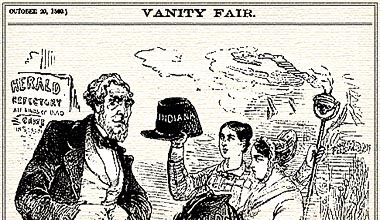
James Gordon Bennett, 1860 -- Vanity Fair
1835-1843 | 1844-1849 | 1850-1899
1850-1869
Jan 09 '50 | Jan 25 '50 | Oct 29 '50 | Jun ? '51 | Jun 07 '51 | Aug 12 '51 | Jan 04 '52
Feb 15 '52 | Mar 09 '52 | Apr 24 '52 | Jul 15 '52 | Apr 25 '53 | May 04 '55 | Jun 17 '56
Oct 19 '56 | Apr 15? '57 | Jun 11 '57 | Jul 06 '57 | Jul 27 '57 | Oct 28 '57 | Nov 08 '57
Nov 18 '57 | Nov 30 '57 | Dec 04 '57 | Jan 03 '58 | Jan 16 '58 | Jan 24 '58 | Feb 03 '58
Feb 04 '58 | May 21 '58 | Jul 02 '58 | Jan 22 '60 | Nov 04 '60 | Oct 29 '69
1870-1899
Dec 26 '72 | Sep 14 '72 | Sep 16 '72 | Sep 30 '72 | Feb 10 '73 | Aug 09 '75 | Mar 22 '77
Mar 24 '77 | Apr 11 '77 | Apr 16 '77 | May 05 '77 | May 06 '77 | May 08 '77 | May 10 '77
May 11 '77 | May 12 '77 | May 13 '77 | May 14 '77 | May 16 '77 | May 17 '77 | May 18 '77
May 19 '77 | May 20 '77 | May 22 '77 | May 23 '77 | May 24 '77 | May 28 '77 | May 30 '77
Jun 01 '77 | Jun 02 '77 | Jun 04 '77 | Jun 09 '77 | Jun 26 '77 | Jul 02 '77 | Jul 06 '77
Jul 08 '77 | Aug 30 '77 | Sep 10 '77 | Sep 23 '77 | Feb 01 '89 | Jun 25 '93
Articles Index | misc. New York City papers
 Whole No. ? New York City, Wednesday, January 9, 1850. Two Cents. 
INTERESTING FROM THE SALT LAKE.
|
|
Whole No. ? New York City, Friday, January 25, 1850. Two Cents.
THE MORMONS ON THE MOUNTAINS.
A correspondent of the Frontier (Iowa) Guardian, of the 18th ult., writing from Muddy Fork, under date of Oct. 18, says: -- "We crossed over Rocky Ridge on the second of this month, near the summit of the South Pass, with the Wind River chain of mountains on the north; towards night it began to snow and blow quite hard and fast from the northeast, weather increasing in coldness, which obliged us to encamp the best way we could (without carrell) on a branch of the Sweetwater. E. T. Benson and Capt. Richards camp some ten or twelve miles ahead on Willow Creek. We turned our cattle loose and drove them into the willows near by to do the best they could and share their fate; and such a storm of wind and snow as we experienced, we think was never superseded in Pottawatamie. For thirty-six hours, it continued to howl around us incessantly, blowing nearly a hurricane, drifting the snow in every direction, and freezing fast to whatever it touched. Being unable to keep fires, (except a few who had stoves in their wagons;) we had to be content without them, and do the best we could. Many were the mother and infant that was obliged to be in bed under their frail covering that sheltered them from the pitiless blast, to keep them from perishing, with nothing, perhaps, but a piece of dry bread, or a few crackers, to subsist upon, while the winds spent their fury upon our camp of canvass, covering it with a mass of ice, the snow drifting around us in some places to the depth of three or four feet. On the morning of the third day, the storm abated, and we turned out through the chilling blast, (from off these ever-lasting snow capped mountains, being at an altitude of about seven thousand feet,) and snow; to look for our famishing, and, as we expected, many perished cattle. As we wended our way down the stream among the willows, indeed it was, a sorrowful sight to behold our perished cattle one after another, cold and stiff, lying in the snow banks, food for wolves, ravens, catamounts, magpies, &c., that inhabit these mountainous regions in countless numbers, and live on prey. The greatest part of our cattle had made their way during the storm about five miles off to the Sweetwater, where they obtained pasture and fared quite well, not one being found perished while those that tarried behind fell a prey to hunger and the merciless storm. Upwards of sixty head of cattle perished in the three camps. Those of our cattle that survived the storm did not recover from its effects for several days; others died in consequence, and some show the effects yet although they are improving at present, as we find quite plenty of mountain grass, and that hearty and good, and able good rolling order, making from twelve to fifteen miles per day, and we hope, if we are prospered, to reach the Valley in eight or ten days from this time. Notwithstanding our loss we consider we have been blessed and prospered, considering our late start from winter quarters. The goodness and mercy of our Heavenly Parent has attended us on our Journey, and surely we have been protected and preserved beyond those that have preceded us. Not a solitary death has occurred of man, woman or child in our camp, although we have experienced storms and endured cold weather. It was so cold during the storm, and after that, chickens, pigs, &., froze to death, and men passed over the Sweetwater on the ice. |
|
Whole No. ? New York City, Tuesday, Oct. 29, 1850. Two Cents.
The Worcester Fanatics -- Progress of Socialism, Abolition, and Infidelity. It has been known ever since Fourier, Brisbane, and Greeley first promulgated their social theories, that society is all wrong. It is known also that their attempts to reform it have signally failed... |
|
Whole No. ? New York City, June ?, 1851. Two Cents. Mormonism and Its Increase. We have received by regular mail, accounts from the Great Salt Lake, Deseret, to the 19th of April, contained in the journal printed there, called the Deseret News, No. 31, published half monthly, by W. Richards. It is filled with the minutes of the General Conference of the Church of Jesus Christ, of Latter Day Saints, otherwise called Mormons; also, several epistles to the faithful -- clear accounts of the weather -- the political movements of the territory -- interspersed with articles on the value of manure and the growth of beets, advertisements, ordinations, lists of letters, notices, removals, &c., &c. -- all indicating a settled community, under a stable government, influenced by the new religion, and superintended by the general government. |
|
Whole No. ? New York City, Saturday, June 7, 1851. Two Cents.
INTERESTING FROM THE
|
|
Whole No. ? New York City, Tuesday, August 12, 1851. Two Cents.
THE MORMON COLONY,
|
|
Whole ? New York City, Sunday, January 4, 1852. 2 Cents.
HIGHLY IMPORTANT AND EXTRAORDINARY
|
|
Whole ? New York City, Sunday, February 15, 1852. 2 Cents.
INTELLIGENCE FROM UTAH.
We have received intelligence from Utah, with news to the 15th November. The Deseret News, published at Great Salt Lake City, contains an account of the present state of affairs among the Mormons at that and neighboring settlements... |
Whole No. ? New York City, Tuesday, March 9, 1852. Two Cents.
|
 Whole No. ? New York City, Saturday, April 24, 1852. Two Cents.
THE MORMON EMPIRE.
|
|
Whole ? New York City, Thursday, July 15, 1852. 2 Cents.
AFFAIRS OF THE MORMONS.
|
Whole ? New York City, Monday, April 25, 1853. 2 Cents.
Mormonism and "Spiritual Wifeism"
We had of late years entirely lost track of William Smith, brother of the prophet "Joe." In 1839 we knew him well. He was then keeping tavern in Plymouth, a small village in Hancock county, some thirty miles from Nauvoo. A goodly number of the "Saints" frequented his house, but he never had much influence with the great body of Mormons. "Bill," as he was familiarly termed by his "Gentile" acquaintances, was always regarded as one of the lesser lights. Compared with his older brother Joe, or his younger [sic] brother Hiram, he was an inferior man. He had much less capacity than the former, and far less cultivation than the latter. Yet he was by no means deficient in that peculiar shrewdness which, from the mother of the prophet down to the youngest of her children, was characteristic of the Smith family. Bill, however, lacked caution. He had not the faculty of concealment which distinguished Joe and Hiram. Perhaps this was the reason that the two latter induced him to take up his residence outside the holy city. The weakness of Bill conduced to his popularity where he lived. He obtained a reputation for frankness and candor that was denied his shrewder brothers, and when he became a candidate for legislative honors, he polled many votes outside of the Mormon organization. |
Whole ? New York City, Friday, May 4, 1855. 2 Cents. (under construction) ... [quoting Brigham Young] "You must not think, from what I say, that I am opposed to slavery. No! The negro is damned, and is to serve his master till God chooses to remove the curse of Ham." |
|
Whole No. ? New York City, Tuesday, June 17, 1856. Two Cents.
|
|
Whole No. ? New York City, Sunday, October 19, 1856. Two Cents. Our Salt Lake Correspondence.
|
Whole No. ? New York City, April 16?, 1857. Two Cents.
|
Whole No. ? New York City, Thursday, June 11, 1857. Two Cents.
The New Governor of Utah -- His Policy and
The man for Utah has been found -- so our advices from Washington state -- and Colonel Cummings will receive this week a commission from the President as successor to Brigham Young in the government of the Mormon Territory. Gen. Harney is already moving troops across the Plains to support the Governor in taking possession of his new office, should it be necessary, and vindicate the authority of the federal government. |
Whole No. ? New York City, Monday, July 6, 1857. Two Cents.
Mormon Celebration of the Forth at Norwalk.
... The Norwalk and Westport, Conn. branch of the Mormon church having invited their brethren from New York and other places to participate with them in a patriotic celebration of the Fourth of July at Norwalk, and judging that they would take that opportunity of making some public exposition of their views regarding the present critical state of affairs in Utah Territory, we despatched a reporter to attend the celebration; and it will be seen by the following report of the proceedings that we were not mistaken. The statements made on this occasion are highly interesting, and will throw much light on the complicated condition of things now existing in Salt Lake City and the Territory of Utah. ... Believing that a statement of their views will prove agreeable to our readers, we publish them in substance, as given to our reporter: -- |
Whole No. ? New York City, Monday, July 27, 1857. Two Cents.
NEWS FROM UTAH.
We have news from Salt Lake City to the 2nd of July.... we are furnished with the following papers for publication. They make grave charges against Surveyor General Burr, and will probably lead to an official investigation by the government at Washington: -- |
Whole No. 7727. New York City, Wednesday, October 28, 1857. Two Cents.
INTERESTING FROM UTAH.
We have received files of the Deseret News to the 9th of September, and by the arrival of an officer of the army at Washington, Intelligence from Great Salt Lake City to the 16th of the same month. |
Whole No. ? New York City, Sunday, November 8, 1857. Two Cents.
The Mormon Rebellion against the Authority
|
Whole No. ? N. Y., Monday, November 30, 1857. Two Cents.
NEWS FROM THE PLAINS.
We have dates from Los Angeles to the 24th of October, and from San Diego to the 17th of the same month. The news is exceedingly important. AMMUNITION FOR SALT LAKE. Mr. Honea says that in coming into San Bernardino, about fifteen miles the other side of the sink of the Mohave river, he met the mail wagon for Salt Lake City, having a large quantity of pistols and ammunition. The driver wished to purchase arms from the party, but they refused to sell.To give an idea of the fraud and extortion practiced by the Mormons on emigrants, Mr. Honea states that their company paid to interpreters, six in all the enormous sum of $1,815. The duty performed by these guides and interpreters was to conduct the company from Cedar City to Cottonwood Springs, a distance of not over three hundred miles; yet this contract was not fulfilled, although payment was made in advance.
THE MORMONS AND THE LATE MASSACRE.
Three emigrant families arrived yesterday in Sacramento, by the Carson Valley route. They report, says the Union, many sad evidences of outrage and murder at different points along the route, particularly in the vicinity of Goose Creek. Near this creek their attention was attracted by the appearance of a human foot protruding from the ground, and on examining the spot the remains of three murdered men were found buried only three or four inches below the surface. Upon another grave there lay two dogs, alive but much emaciated, and so pertinacious in retaining their lonely resting place that no effort could entice or drive them from the spot. Their master was most probably, the occupant of that grave, and their presence there, under such circumstances, was a touching exhibition of canine instinct and devotion. A few miles further on, they came upon another scene of murder, where upon the ground were strewn a few bones, and also knots of long glossy hair, torn from the head of some ill-fated women. Near by were the remains of three head of cattle, with the arrows still sticking in them. Notes: (forthcoming) |
Whole No. ? N. Y., Friday, December 4, 1857. Two Cents.
Complicity of the Mormons in the Late
The late horrible massacre of more than one hundred emigrants on the Spanish trail from Utah to California, deserves more than a passing notice at the hands of the press. The San Francisco papers give the substance of several statements, tending to show the Mormons were cognizant of the massacre and probably instigated it. The fact is undoubtedly this: The Mormons must have planned and executed it with the Indians, or it could not have occurred. The writer has spent a year in Utah, and during the spring of 1855 passed over the route from Salt Lake City to Los Angeles, California, in command of a detachment of United States troops. Previous to this march he had seen several months service among the Indians who occupy the country in the vicinity of the late massacre. These Indians have for years been under the tutelage of the Mormons. Their chiefs, Canoshe, Ammon, and others, are members of the Mormon church. Their villages are in close proximity to the Mormon towns, and their fields of grain are adjacent to those of the Mormons. Missionaries reside constantly with the Indians and control their movement. In the event of the death of a chief, his successor is always the one designated by the Mormons. The Indians are armed with rifles and have an abundance of ammunition supplied by the Mormons, and these supplies are purchased with United States money, supplied to Brigham Young in his capacity of Superintendent of Indian Affairs. The whole instruction of the Mormon missionaries has been that the Americans area weak and infirm nation compared with the Mormons, and the natural enemies of the Indian. For years past no small party of Americans has ever traveled this route without assuming the character and name of Mormons as an absolutely necessary precaution to pass through safely. The Mormon settlements stretch from Fillmore City to the Vegas river, at intervals of a few miles; and so close is the connection between the Mormon people and the Indians, that it is absolutely impossible for a train to be attacked anywhere on this route without the knowledge and consent of the Mormons. I beg leave to say that this is no charge hastily made -- no inconsiderate evidence -- but an incontestable fact; and its truth can be attested by hundreds of people in California who have traveled the route, and called themselves Mormon to avoid a fate similar to that of the hundred and eighteen men, women and children slaughtered at Mountain Meadows. |
Whole No. ? New York City, Sunday, January 3, 1858. Two Cents.
MORMONISM IN CALIFORNIA.
|
Whole No. ? New York City, Saturday, January 16, 1858. Two Cents.
INTERESTING FROM UTAH.
|
Whole No. 7814. New York City, Sunday, January 24, 1858. Two Cents.
Interesting Intelligence about Utah
Many and diversified are the opinions of the people outside of Utah on the future intentions of the Mormons in that Territory. Recommendations have been held out to Brigham to turn his attention to Sonora, and some have thought he might go north, through Oregon and Washington Territories, into the British possessions; or, what was not impossible, further on still, into Russian territory. What course the prophet may have decided on, or may yet decide upon, is as yet kept a secret front outside barbarians. While the disciples outside of Utah have been impressed with the idea that a wholesale migration was intended for some part of the world, beyond the jurisdiction of the United States government, the leading men in the Territory have reiterated, time and again, their intention of remaining; and, if put to the worst, burning up and going into the mountains, and "taking it," as one of the apostles remarks, "Indian fashion.'' In spite of the Utah discourses, which probably would be regarded as a ruse de guerre, the last despatches from the expedition indicate that Colonel Johnston was fully under the impression that Brigham was going northward in the spring, and that pioneers had already left the city in that direction -- news which was received with some degree of pleasure, as the greater portion of the inhabitants of the States would rather see the backs of the Mormons in flight, leaving our dominions forever, than learn of the terrible and prolonged warfare which is reasonably to be expected if the troops and the Mormons have to contend for supremacy at the point of the bayonet; or, what is still more perplexing, guerrilla warfare. The arrival of the California mail, bringing with it the Deseret News, furnishes again fresh grounds for believing that the Mormons mean to stand their ground and contest for supremacy. From the complexion of affairs at Salt Lake City all doubt as to their remaining seems set at rest. The apostle Amasa Lyman, recently arrived from the seat of his presidency at San Bernardino, contends, not for staying, but against the possibility of being driven by the superior power of the Gentiles. We scarcely think it possible that men of the stamp of the Utah leaders, whose influence with the brethren must be proportionate to the consistency of their speech and prophecy with their action and the fulfilment of their own words. They mean, then, to remain. |
Whole No. 7844. New York City, Monday, February 3, 1858. Two Cents. INTERESTING FROM UTAH. Arrival from Great Salt Lake City of the last Gentile Merchant -- His statement of the Morality of the Mormons -- Polygamy -- Death the Penalty of Seduction -- Treatment of Gentiles -- Federal Officers -- Charges of Murder -- Special Commissioners Expected -- No Preparations for Burning -- Mountain Retreat -- The Army of Defence -- Manufacturing Pistols and Gunpowder -- Colonel Johnson well watched -- Brigham in Business -- The Firm returns unconverted -- Great Emigration from California to Utah -- Indians Saucy and in Arms -- The Indian Chiefs on the War Question, &c. |
Whole No. 7825. New York City, Tuesday, February 4, 1858. Two Cents.
MORMON WAR.
An express arrived at Leavenworth on the 22d ult., direct from Camp Scott, near Fort Bridger... Brigham Young had delivered another warlike sermon in the Tabernacle in Salt Lake City, in which he enjoins upon the Saints to stick by him. |
|
Whole No. 7931. New York City, Friday, May 21, 1858. Two Cents.
THE UTAH NEWS.
As a matter of course great interest was felt Sunday and yesterday to ascertain whether the news of peace in Utah, which was made public on Sunday, was correct or not. Some had their doubts, who had really no personal interest in the matter; while those who had such interest were hopeful that it would turn out to to be incorrect. So the matter stood until yeasterday morning, when the telegraph brought the following dispatches for the associated press: -- |
|
Whole No. 7973. N. Y., Friday, July 2, 1858. Two Cents.
INTERESTING ABOUT THE MORMONS.
Within our recollection, Mormonism was "a speck, not bigger than a man's hand." The original Impostor, Joe Smith, came to the writer of this article, only thirty-two years ago, with the manuscript of his Mormon Bible, to be printed. He then had one follower, a respectable and wealthy farmer of the town of Macedon (Palmyra,) who offered himself as security for the printing. But after reading a few chapters, it seemed such a jumble of unintelligible absurdities, that we refused the work, advising Harris not to mortgage his farm and beggar his family. But Joe crossed over the way to our neighbor Elihu F. Marshall, and got his "Mormon Bible." -- Albany Journal. |
Whole No. ? N. Y., January 22, 1860. Two Cents. The Mormons -- Letter from Judge Cradlebaugh.
|
Whole No. ? N. Y., November 4, 1860. Two Cents.
Interesting Utah Affairs.
|
Whole No. ? N. Y., October 29, 1869. Two Cents.
SCHISM AMONG THE MORMONS. -- A serious schism is threatening the Mormons. Mr. Stenhouse, the editor of the Mormon paper, heads the opposition to Brigham Young and has been suspended from the editorship or tne church organ. At Brigham's death it is thought a revolution will be inaugurated that will sweep away polygamy. |
Whole No. 13,276. N. Y., Thur., Dec. 26, 1872. Four Cents.
PERSONAL INTELLIGENCE. Sidney Rigdon, the reputed author of Joe Smith's Mormon Bible, has been stricken with paralysis at his home in Alleghany county, N. Y. Polygamy was not permitted by Rigdon's Bible... |
Whole No. 13,173. New York City, September 14, 1872. Four Cents.
A MORMON MONSTROSITY.
SALT LAKE CITY, Sept 13, 1872. |
Whole No. 13,174. New York City, September 16, 1872. Four Cents.
U T A H..
SALT LAKE CITY, Sept 15, 1872. |
Whole No. 13,1??. New York City, September 30, 1872. Four Cents.
Mountain Meadows massacre. -- [We] deny the assertion of the Mormon organs that he is either a murderer or a perjurer. The Mormon press do not contradict the truth of the suits are about to be commenced the Mormon city... |
Whole No. 13,322. New York City, Monday, February 10, 1873. Four Cents.
THAT MORMON MASSACRE.
|
Whole No. 14,231. New York City, Monday, August 9, 1875. Three Cents.
"GOOD ENOUGH MORGAN."
TO THE EDITOR OF THE HERALD: -- A CORRECTION. The Argus correspondent, it will be seen, claims to have had personal knowledge of the matter about which he writes, and is evidently one of those who believed, and still believes the accusations against me to be true. Relying, as he evidently does, on his memory, I will not hold him severely responsible for utterly misstating every material fact in his article. The election to which he refers was not held in 1828, but in 1827, when neither General Jackson, nor Martin Van Buren nor Enos T. Throop were candidates. The affidavit which he says he read aloud at the polls at that election is a mere skeleton perversion of an affidavit which was published in handbills and freely circulated, not only at the polls referred to, but throughout the county. I preserved and still retain in my possession one of those handbills, of which the following is a literal and exact copy: --William C. Green, being duly sworn, deposeth and says that he the said Green, with others did attend the poll of election held at Haward's, in the town of Gates, in the county of Monroe, and that there Mr. Thurlow Weed did say that he the said Thurlow did pull the whiskers from the face of the body found at Oak Orchard Creek, and that John Marchant did shave the same, he the said Thurlow being one of the Morgan Committee. WILLIAM C. GREEN.This affidavit appeared in the Rochester Daily Advertiser November 7, 1827, and was circulated in handbill form at the polls the same day. I preserved one of the handbllls, from which the above is a literal copy. The affidavit is signed by William C. instead of Zephania Green. Mr. W. C. Green swears that he "heard me say thaI I did pull the whiskers from the face of the body found at Oak Orchard Creek." 'The Argus affidavit maker, "Zephania Green," swears that he "saw me pull out the whiskers," &c. Now, the fact is no such affidavit appeared or was read at the poll of the election referred to; nor, as far as I know, was there any such man in, or about Rochester as Zephania Green. But I did know William C. Green, a democratic electioneerer, by whom, it was arranged, I should be followed and importuned with questions, about Timothy Monroe's hair and whiskers. The object was to keep me so surrounded and occupied as to withdraw my attention from the electors as they came to vote. Discovering its object I determined to put an end to the by-play, and when asked by Green if I pulled out Monroe's whiskers I anwered affirmatively, and to the question "Who shaved the body," I replied "John Marchant." This turned the laugh against my opponents. Nobody, however, was misled by it for all received it as it was intended. Green's occupation was spoiled for that day. On the following morning, however, his affidavit appeared in the Daily Advertiser, and was circulated freely at the polls. Green swore to the truth, but in a manner to make truth a falsohood. All who heard me, including Green himself, knew that it was a joke. Judge Miller, the then young Justice of the Peace before whom the affidavit was made, is now a venernble citizen of New Haven, Conn. I had no reason to complain and did not complain of the use made of my jocose admission: THE OTHER ACCUSATION however, namely, of boasting that the body found at Oak Orchard Creek was a "good enough Morgan till after the election," though an utter perversion, proved serious and enduring. My action in reference to the body in question was influenced by a sincere and earnest desire for truth. I realized, in every step taken, the high responsibility of the investigation. I knew that a mistake upon a question of such exciting and absorbing interest would react powerfully. Thus impressed, I exerted myself personally to induce all who knew Morgan, whether Masons or anti-Masons, democrats or whigs, to be present at the second inquest.In looking back upon the event which occurred nearly half a century ago, with the asperities and impressions which it occasioned allayed and corrected, and in view of the embittered feeling existing between the editor and proprietor of the Rochester Daily Advertiser and myself, I am free to admit that they had provocations which, from their standpoint, excused the use of such political weapons as they found available. It was a sort of hand-to-hand conflict, in which I remember to have been unsparing. The term "Mason Jacks," freely applied to all who acted, poltically against us, was a pecuIiarly offensive one, and most especially so to the editor, and publisher of the Advertiser, neither of whom were Masons. Even now it is evident that the correspondent of the Argus has not forgotten or forgiven, that offence. In conclusion, I affirm, in the original language and in the broadest sense, that I acted in perfect good faith throughout the investigation touching the body found at Oak Orchard Creek, and that I have truthfully repeated a playful and innocent reply to a question, out of which grew the unfounded charge of boasting that it was a "good enough Morgan till after the election," under the odium of which I have rested forty-eight years. It may not be out of time or place to add that in this case it is not too late to "vindicate the truth of history." The then editor of the Rochester Daily Advertiser is now a resident of this city. He was as actively and warmly opposed as I was devoted to the cause of anti-Masonry. He was familiar with the question from the beginning to the end. I have never conversed with him upon this subject, nor do I know what his impressions are, but if he is in possession of evidence either that I mutilated the body in question, or boasted that it was a "good enough Morgan till after the election," he will, doubless, regard this a fitting occasion to produce it. T. W., August 6, 1875.
_______
As a vindication this letter is unnecessary, for long ago the public ceased to believe that Thurlow Weed had mutilated a dead body for the purpose of throwing upon the Masons the odium of murdering an apostate member of their organization. Mr. Weed himself has been too proud to attempt a refutation of the charge till now. We may, therefore, simply refer to those portions of the letter which include his personal exoneration, while we congratulate Mr. Weed upon speaking at last with such candor upon a subject, which has hardly lost any of its profound interest by the lapse of half a century. But though Mr. Weed's personal character may not require defence in respect to this affair, the light he throws upon the Morgan mystery is of historical importance. Masonry is quite as much on trial as Mr. Weed. There is no doubt that Morgan wrote a book intended to betray the secrets of Masonry, and, according to Mr. Weed's testimony, he was kidnapped and drowned in Lake Ontario. At all events, Morgan disappeared forever, and the identification of a body as his, coupled with its subsequent identification as that of one Monroe, forms one of the most puzzling chapters of the story. But whether Morgan's body was found or not Mr. Weed does not hesitate to express his belief that the man was murdered. He says that all the circumstances of the tragedy were narrated to him by John Whitney, whom we infer to have been one of the principal actors in the assassination. Disbelief in the murder of Morgan would naturally rest upon a priori grounds. Why should he be murdered for revealing a secret when no secret existed to be revealed? It may be safely assumed that the Masons have no secret which is their especial possession and privilege. Mysteries of organization they possess undoubtedly, but the Alpha and Omega of their purposes are intended in common human society. It is known that they have no secret by the fact that if they had it would have been long ago betrayed. Adequate motive for the murder of Morgan is, therefore, wanting in the constitution of the Order itself. The man had nothing to betray that would justify his murder. We cannot believe that men like Washington, Jefferson, Franklin and many other patriots and philanthropists could countenance and support a society in which fidelity to an oath was to be insured by the penalty of death, to be privately and unlawfully enforced. This is incredible, and an Order which is believed to have been founded by Solomon could hardly depart so utterly from the teaching of his wisdom. These are the reasons why many persons refuse to believe that Morgan was ever murdered at all, and why others, who believe he was killed, acquit the Masons of any responsibility for his death. The truth, probably, is that Morgan's murder was a political crime. Masonry was not merely Masonry at that time, but it was the occasion of the bitterest political strife. It was a misfortune that a secret Order should have been forced into the arena of politics, and that American citizens should have voted as Masons or anti-Masons. But this was the case in New York in 1827, and if Morgan ever was murdered he died by the hands of his political foes, who thought him a traitor to their cause. Masonry, as an ancient and honorable Order, could not have authorized an act so terrible. We may learn from this event, and the bitter feelings it caused and which have been kept alive, for generations, how dreadful it will be for America if ever the question of religion is introduced into our politics. The people who wish to put "God in the constitution" forget that, if He is omnipresent, He must be there now, and they merely scheme for a religious war. We think that the Morgan affair ought to convince every reasonable man that neither secret societies nor religious denominations should have anything to do with political parties, and in evidence of this we refer the render to the profoundly interesting letter with which Mr. Weed has replied to the accusations of half a century. Note: See The Orleans Whig of Oct. 10, 1827 and subsequent newspaper items linked to in its comments section for the original reports relating to William Morgan and Timothy Monro. |
Whole No. ? New York City, Thursday, March 22, 1877. Three Cents.
LEE'S CONFESSION
|
Whole No. ? New York City, Saturday, March 24, 1877. Three Cents.
VENGEANCE.
|
Whole No. ? New York City, Wednesday, April 11, 1877. Three Cents.
LEE'S CONFESSION.
|
Whole No. ? New York City, Monday, April 16, 1877. Three Cents.
BRIGHAM YOUNG.
|
Whole No. 14,866. New York City, Saturday, May 5, 1877. Three Cents.
MORMON UPRISING
|
Whole No. 14,867. New York City, May 6, 1877. Three Cents. INTERVIEW WITH BRIGHAM YOUNG. Cedar City, April 30 1877. -- Having received at Salt Lake on the 12th inst., a telegram from Brigham Young, saying, "If you come quick you will find me at St. George," I started early next morning on the journey leading in that direction, across the vast deserts, over the wintry divides and through canyons of Southern Utah. A second dispatch apprised me on the way that the President would leave St. George for the north before I could possibly arrive there. Cedar City, the remote little Mormon settlement from which this letter is written, was appointed as the place of meeting. Here at the foot of an enormous mountain, looking westward across a desolate plain toward the scene of the Mountain Meadow massacre and of John D. Lee's execution, I was welcomed this morning at the home of the the hispitable Mormon Bishop Henry Lunt. Late in the afternoon President Brigham Young and his party, in a train of five carriages, drawn by four mules or horses draw up at the Bishop's home. As evening descended lights shot through the windows from the broad fireplaces within, and a supper was spread in the dining room amid sounds of jollity and cheer. |
Whole No. 14,869. New York City, Tuesday, May 8, 1877. Three Cents. A Mormon Theory and Mormon Facts. The Mormon theory of the Mountain Meadows massacre is that the Indians murdered the emigrants and that the Mormons were unable to protect them, but managed to save some of the children. |
Whole No. 14,871. New York City, Thursday, May 10, 1877. Three Cents.
MORMON RASCALITY.
|
Whole No. 14,872. New York City, Friday, May 11, 1877. Three Cents.
THE REBELLIOUS MORMONS.
|
Whole No. 14,873. New York City, Saturday, May 12, 1877. Three Cents.
THE TURK OF UTAH.
The Sultan makes things lively once in a while by threatening to unfurl the standard of the Prophet. This flag is a tremendous power in his hands, and should he throw it to the breeze, there would be a perfect storm of blind fanaticism loosed... Our own Prophet, too, the leader of the hosts of Israel, seems to be preparing to unfurl his blood-drenched rag. He is arming and drilling his followers with great activity, and appeals to their fanaticism are being made in the rehearsal of the story of "our persecutions." ...Brigham's little close corporation, set up in the heart of a free Republic, has also become a public nuisance, and the voice of the American people is pretty unanimous in demanding that it be overturned. Polygamy is an abomination a Christian community cannot [away?] with, and his obstinate misrule stands so in the way of progress and development that it can no longer plead a reason to be. The brutal excesses wreaked by the fanatical Turkish soldiers upon a defenceless population produced a thrill of horror throughout the civilized world. And so the treacherous assassination of the Arkansas emigrants, with the many other deeds of blood done in this darkened land, "in the name of God," have caused such a horror in the American people that they demand justice upon the heads of those who are responsible for the crimes and ask that this dangerous ecclesiastical organization be effectually broken up.... if in Zion "the damned, cussed hounds of the law" become too familiar in their attentions to Brigham, he can crook his historic little finger, unfurl that red bandanna of his, and unsheathing his bowie-knife hide in the last ditch... but the car of progress will roll on, and any bovine that seeks to hinder it will experience a terrible upheaval for his obduracy. |
Whole No. 14,874. New York City, Sunday, May 13, 1877. Five Cents.
LATTER DAY SAINTS.
|
Whole No. 14,875. New York City, Monday, May 14, 1877. Three Cents.
BRIGHAM YOUNG'S POWER.
|
Whole No. 14,877. New York City, Wednesday, May 16, 1877. Three Cents. The Mormons Arming. The more persistently the Mountain Meadows massacre is investigated the more actively the Mormons arm and drill, and Governor Emory has now asked the Secretary of War to strengthen the federal forces in Utah. We suppose he will do so, though we confess ourselves unwilling to believe that Brigham Young can be so foolhardy as to attempt open violence. But it is not jmprobable that very important arrests may have to be made soon after the meeting of the Grand Jury, on the 21st, and additional troops on the spot would at least prevent the rescue of persons apprehended. |
Whole No. 14,878 New York City, Thursday, May 17, 1877. Five Cents.
THE SCARED MORMONS.
|
Whole No. 14,879 New York City, Friday, May 18, 1877. Five Cents.
THE UTAH THEOCRACY.
|
Whole No. 14,880 New York City, Saturday May 19, 1877. Three Cents.
INDIGNANT MORMONS.
|
Whole No. 14,881. New York City, Sunday May 20, 1877. Three Cents.
MORMONS UNMASKED.
|
Whole No. 14,883. New York City, Tuesday May 22, 1877. Three Cents.
THE MORMON MASSACRE.
|
Whole No. 14,884. New York City, Wednesday May 23, 1877. Three Cents.
THE MORMONS.
The rumors in regard to disaffection among the Mormons -- to which we have heretofore attached no importance -- seem to be partially confirmed by the letter of Governor Emory to the Secretary of War, asking large reinforcements of troops for the military stations in Utah. Such a request would hardly have been made if the Governor had not good reason to believe serious trouble is brewing in his jurisdiction. We presume the troops will be sent, and while their presence may be useful to prevent the anticipated outbreak, it will at the same time be construed as a threat, and thereby increase the ill-feeling already existing. That ill-feeling is the natural outgrowth of the trial, conviction and execution of John D. Lee. Though the Mormon authorities abandoned Lee to his fate and furnished the testimony which doomed him to death, yet neither they nor their followers really believed capital punishment would be inflicted upon him, and therefore were entirely unprepared for the terrible revelations of his confession. This confession, made on the very brink of the grave, declared emphatically that Lee was only the tool of the high priests of the Mormon Church, and that in superintending the work of blood at Mountain Meadows he was simply obeying orders he dare not disobey. The blow at Brigham Young and his associates hit the mark. The press throughout the country took up the subject, charged Young with being their chief criminal and demanded prompt and vigorous action against him. Whether the federal government contemplates such action we do not know -- probably not, as it would be impossible to get the necessary proof -- but undoubtedly the Mormon rank and file fear further investigation of the matter, and Young himself is not altogether easy about it. Meanwhile the revival of the memories of Mountain Meadows has stimulated the antagonism between the Mormon and "Gentile" population in Utah, and the organ of the latter in Salt Lake City is doing its best to fan this antagonism into a flame of hostility. We do not think the Mormons can be induced to commence an attack which must end in their destruction, but they dread an attack from the "Gentiles," and are determined to be ready for it. Now that the Southern difficulty has been happily disposed of, the Mormon question is altogether more important than any other before the country. It has been dragging along for twenty-five years, and each year has added to the number of complications and diminished the chances of amicable settlement. Yet settled it must be somehow, sooner or later. Polygamy cannot be legalized in the United States, and polygamy is so thoroughly interwoven with the Mormon faith that the process of separation must be exceedingly embarrassing and may be dangerous. But, however embarrassing and however dangerous, the separation is inevitable unless the Mormons choose to carry themselves and their peculiar institution beyond our frontiers.... |
Whole No. 14,885. New York City, Thursday May 24, 1877. Three Cents.
THE MEADOWS MASSACRE.
|
Whole No. ? New York City, Monday May 28, 1877. Three Cents.
THE MORMON QUESTION.
|
Whole No. ? New York City, Wednesday May 30, 1877. Three Cents.
MORMON CRIMINALS.
|
Whole No. 14,893. New York City, Friday June 1, 1877. Three Cents.
MURDEROUS MORMONS.
|
Whole No. 14,894. New York City, Saturday June 2, 1877. Three Cents.
MORMONISM.
|
Whole No. ? New York City, Monday June 4, 1877. Three Cents.
THE MORMON DISGRACE.
The statement that an attempt has been made to assassinate its [the Herald's] correspondent in Utah is in all probability true. The correspondent has been severe in his strictures upon Brigham Young and other Mormon leaders, and more than hinted his belief in their complicity in the Mountain Meadows massacre. This would be enough to excite the bitterest indignation among the fanatical Mormons, and there are plenty there who would feel it a righteous deed to slay him, even if the Prophet had not given a hint or command. He would not be the first newspaper man whose life had been put in jeopardy by his too severe utterances concerning the evils of Mormonism, and, if we are not mistaken, an editor of the first Gentile paper in Salt Lake City was actually assassinated by the Danites. Assassination has been common enough as a weapon of the Church for it to revive again in the present state of exasperation existing among the Mormons, and some fanatic might have thought to anticipate the wishes of the Prophet or to avenge the insults to his church on his own account by executing "the blood atonement." Brigham Young himself is probably to astute to authorize or even to wish any such thing done, knowing the sensation and indignation that would be created. It was only when Utah was completely isolated from the world and those who disappeared could leave no token of their fate to people outside that the assassination of apostates and dangerous Gentiles could be made available. Now the Mormon kingdom is linked to the rest of the world by telegraph and railroad, and is dependent upon good behavior for existence. The removal of no one individual by murder would pay for the indignation that would be excited in the United States and the ill repute that would be brought on the colony. Brigham Young is probably in no way personally responsible for this attack upon the Herald correspondent, but it is none the less the direct result of his teachings and the legitimate continuation of his original policy. |
Whole No. ? New York City, Saturday June 9, 1877. Three Cents.
THE MORMON ASSASSINS.
Yesterday an attempt was made by a Mormon emissary to assassinate this man, who is telling the truth about Brigham Young and his infamous abortion of a Church. The Mormons, it seems, cannot appreciate the service which modern journalism is doing for humanity. They are inspired with the same sentiments of hostility to the men who fail to realize the beauties of polygamy which prompted the Mountain Meadows massacre and the hundreds of murders that have been committed in Utah under the name of religion. Mr. Stillson is engaged in the grand work of opening the eyes of this nation to the infamous rottenness of a "religion" which claims to be the offspring of a prophet and emissary of God; and for doing this the supreme head of that religion coolly orders his assassination. Is it not manifest that in Utah at least there is no freedom of speech and no freedom of the press?How long do the American people propose to tolerate this disgraceful institution of Mormonism? How long shall it be said that an American citizen who dares to tell the truth in one of the Territories of this great Republic puts his life in jeopardy by exercising his rights as a freeman? The Mormon Church is a disgrace to this nation. It is a hotbed of crime and treason. It respects no President but Brigham Young. It obeys no government but that of the bishops. Until it is utterly wiped out of existence there will be no protection for the life or property of a Gentile in Utah. It must be wiped out, and when once the Territory in which it now holds supreme power is redeemed from its blighting influence newspaper correspondents will probably be able to write their views and opinions without subjecting themselves to the danger of the assassin's dagger.... |
Whole No. ? New York City, Tuesday June 26, 1877. Three Cents.
MORMON ASSASSINS.
|
Whole No. ? New York City, Monday July 2, 1877. Three Cents.
SAINTS OR DEMONS?
|
Whole No. ? New York City, Friday July 6, 1877. Three Cents.
BRIGHAM YOUNG'S INFAMY.
|
Whole No. ? New York City, Sunday July 8, 1877. Three Cents.
THE DESTROYING ANGELS.
|
Whole No. ? New York City, Thursday August 30, 1877. Three Cents.
OBITUARY.
|
Whole No. ? New York City, Monday September 10, 1877. Five Cents.
A HILL OF ZION
|
Whole No. 15,007. New York City, Sunday September 23, 1877. Five Cents.
RETRIBUTION IN UTAH.
The two Mormon apostles, Orson Pratt and Joseph F. Smith, who were in Europe when Brigham Young was suddenly taken off, arrived by the steamer Wyoming yesterday, on their way back to Utah.... |
Whole No. ? New York City, Friday, February 1, 1889. Five Cents.
OBITUARY.
James R. Lambdin, the celebrated portrait and landscape painter, died; very suddenly about six o'clock yesterday afternoon while on a train of the Reading Railroad, bound from Philadelphia for his home, in Germantown. His death is supposed to have been due to apoplexy. |
Whole No. ? New York City, Sunday, June 25, 1893. Five Cents.
MORMON LEADERS
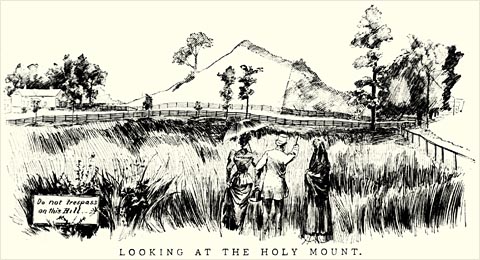
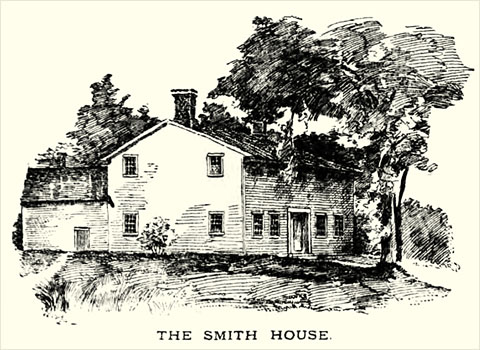
PALMYRA, N. Y., June 24, 1893. -- Mormonism is coming to the front again in this state. Influential saints from Utah have recently made prolonged visits to this town, which they call the Mormon Mecca. Among them were the Rev. Brigham Young, Jr., his brother, Seymour R. Young; Bishop Keasler, Judge Richards, of Utah; Bishop Cannon's family and wives, among them Carroll Cannon and Caroline B. Cannon. The object of their pilgrimage was to inspect the holy site where the Mormon Bible was alleged to have been given to Joe Smith by an archangel. Overtures have been made through an adroit, long headed Western real estate hustler for the purchase of Joe Smith's old homestead of Mormon Hill and the cave where the golden plates of the Bible were supposed to have been found. |
Back to top of this page.
Newspaper Articles | News Articles Index | History Vault
Oliver's Bookshelf | Spalding Library | Mormon Classics
last updated: March 22, 2013