THE HISTORY OF REV. SIDNEY S. RIGDON
The First Theologian of the Latter Day Saints
Chronology Genealogy c.1900 John Rigdon Text c.1900 John Rigdon Text (Keller's)
1931 Biography 1947 Biography 1971 Biography 1994 Biography 2000 Biography
|
Daryl Chase supplies useful insights in his unpublished 1931 dissertation, "Sidney Rigdon: Early Mormon." The first useful genealogy of Rigdon was published in The Utah Genealogical and Historical Magazine in Oct. 1936. Well-known biographer, Fawn M. Brodie, largely ignored Rigdon and his constributions to Mormonism where she researched and wrote her 1945 book No Man Knows My History. Joseph W. White wrote "The Influence of Sidney Rigdon Upon the Theology of Mormonism," an unpublished 1947 thesis on the man's religion; F. Mark McKiernan wrote a disappointing doctoral dissertation on Rigdon that was published in 1971; and Richard Van Waggoner produced what passes for the definitive Rigdon biography in 1994. Additional interesting articles on Rigdon have appeared occasionally in the pages of journals like BYU Studies, Dialogue, and Courage. Perhaps the two most imformative of these articles both appeared in BYU Studies XXI:1 (Winter 1981) pp. 37-50: "The Early Baptist Career of Sidney Rigdon" by Hans Rollmann and pp. 51-67: "Sidney Rigdon: Post Nauvoo," by Thomas J. Gregory. The authors of histories of the Mormons Kirtland have generally alloted abundant attention to Rev. Sidney S. Rigdon. Eva Pancoast gives Rigdon some consideration to the man in her unpublished 1929 Master's thesis, "Mormons at Kirtland." Max Parkin's 1966 dissertation, "The Nature and Cause of Internal and External Conflict of the Mormons in Ohio," says much about Rigdon, as does Robert K. Fielding's "Growth of the Mormon Church in Ohio," an unpublished dissertation from 1957. More recently, Milton V. Backman has told some of Rigdon's story in his 1983 book The Heavens Resound, and Marvin S. Hill has filled in a few more details of Rigdon at Kirtland, Far West and Nauvoo in his 1989 Quest for Refuge. Drs. McKiernan, Blar and Edwards in 1992 produced a compilation of historical essays called The Restoration Movement; it supplies a few glances at Rev. Rigdon, as does Warren A. Jennings' 1962 dissertation, "Zion is Fled," Robert B. Flanders 1965 Nauvoo: Kingdom on the Mississippi, Stephen C; LeSueur's 1987 The 1838 Mormon War in Missouri, and John E. Hallwas & Roger D. Launius' 1995 Cultures in Conflict. In the 21st century, the most recent contributions to Rigdon's historical literature have been Lloyd Alan Knowles 2000 dissertation, "The Appeal and Course of... Sidney Rigdon" (reprised in brief in his 2003 article, "Sidney Rigdon... Benedict Arnold") and Richard McClellan's 2003 article in Dialogue, "Sidney Rigdon's 1820 Ministry..." "Rigdon Revealed," a series of web-articles by Dale R. Broadhurst, is currently under construction at SidneyRigdon.com. John L. Smith's 2006 booklet, Did Joseph Smith Write the Book of Mormon? offered nothing new or particularly useful. Older Mormon histories, such as the 1853 biography by Lucy Mack Smith, the LDS and RLDS History of the Church, and various other "faith-promoting" historical and biographical works are as problematical as they may be occasioanlly useful. Generally speaking, the picture they convey of Sidney S. Rigdon is a sanitized, two-dimensional one, devoid of critical analysis. On the other hand, anti-Mormon offerings, such as Theodore A. Schroeder's 1901 book The Origin of the Book of Mormon and Charles B. Shook's 1914 offering True Origin of the Book of Mormon, are but better researched and better written polemics, given in the same spirit as Ellen E. Dickinson's 1885 expose New Light on Mormonism. These books only introduce Rigdon as a sort of foil againt the notion that Joseph Smith could have written the Book of Mormon all by himself. This sort of "revelation" concerning the alleged secretive activities of Sidney Rigdon draws upon the earlier literary efforts of writers like Robert Patterson, Jr's 1882 booklet and Clark Braden 1884 debate with Elder E. L. Kelley. Although these writings do occasionally introduce new bit of Rigdon history, they make no real attempt to understand the man and explain his alleged secret methods and motives. The summation of all these past efforts was put before modern readers in Wayne Cowdrey, et al.'s 1977 volume Who Really Wrote the Book of Mormon? and as the much more informative 2005 progeny of the same writers: The Spalding Enigma. LDS researcher Wade Englund has offered his on-line responses to the latter authors' work, some of which address the subject of Rev. Sidney S. Rigdon. More recently, Craig Criddle has joined the on-line debate with his Sidney Rigdon: Creating the Book of Mormon. |
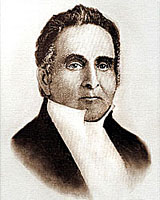
I am the only living child of Sidney Rigdon, who died in the town of Friendship, Allegany C. N Y., July 14, 1876, who was at the time of his death almost 83 years old. There were 12 children in my father's family; they are all dead except myself! |


|
|
(the remainder of this text has not been transcribed) |
|
The Voice of One Crying in the Wilderness: Sidney Rigdon, Religious Reformer 1793-1876 by F. Mark McKiernan
Copyright © 1971 First printing -- December, 1971 Second printing -- March, 1972 Third printing -- September, 1972 Fourth printing -- April, 1973 Fifth printing -- April, 1976 Sixth printing -- May, 1977 HERALD HOUSE First printing -- May, 1979 This book Copyright ©1971 by F. Mark McKiernan. The e-text presented here has been limited to "fair use" excerpts. Note: This text's original endnotes are here reformatted as footnotes. Chapter 2 The Advent of Mormonism into the Western Reserve IN 1826 SIDNEY RIGDON received an invitation to preach the funeral sermon of the Reverend Warner Goodall, Baptist minister of Mentor, Ohio, a small community near Cleveland. 1 The congregation was so impressed with Rigdon's eloquence, personality, and reputation that it invited him to become their pastor. 2 He happily accepted the offer because in 1824 the officials of the Redstone Baptist Association had forced him to resign his position as pastor of the First Baptist Church in Pittsburgh. However, the Mentor congregation belonged to the more liberal Mahoning Baptist Association in which his friend, Alexander Campbell, and his brother-in-law, Adamson Bentley, were influential ministers. Rigdon had been a member of the Mahoning Baptist Association from 1820 to 1822; thus he was returning to Baptist Congregations which appreciated both his preaching ability and his support of Campbell's doctrines. The Mahoning Association sheltered Campbell's reformers until it was dissolved in 1830, when most of the members joined the newly-formed Disciples of Christ Church. 3 At this time, however, Rigdon left the Campbellites and embraced the Mormons, a new sect which had sent missionaries into the Western Reserve. Rigdon's ability and reputation enabled Mormonism to grow rapidly in the areas surrounding Mentor. In 1826 Sidney Rigdon had added his congregation at Mentor to the churches which followed the teaching of Alexander Campbell. The previous year there had been only three congregations which accepted Campbell's idea of the restoration of the "ancient order of things"; these were in Brush Run, Wellsburg, and Pittsburgh. 4 In 1824 Rigdon had established a reformed Baptist church at Pittsburgh with the aid of a young school teacher named Waiter Scott. Rigdon, Campbell, and Scott differed in personality and ability, but were united in their desire to restore Christ's New Testament church in the nineteenth century. _______________ 1 Amos S. Hayden, Early History of the Disciples in the Western Reserve, Ohio: With Biographical Sketches of the Principal Agents in Their Religious Movement (Cincinnati, 1876), 187. 2 J. M. Kennedy, Early Days of Mormonism: Palmyra, Kirtland, and Nauvoo (New York, 1888), 66. 3 Daryl Chase, "Sidney Rigdon - Early Mormon" (MA thesis, University of Chicago, 1931), 19. 4 Ibid., 22. 36 Chapter 2 the matter, I have contemplated on the circumstances in which we may be placed, I have counted the cost, and I am perfectly satisfied to follow you; it is my desire to do the will of God, come life or come death." 66 Sheriff John Barr, a non-Mormon, of Cuyahoga County, was present when Rigdon informed his congregation of his decision to embrace Mormonism. Rigdon told the church that "he had not been satisfied in his religious yearnings until now." Previously, "at night he had often been unable to sleep, walking and praying for more light and comfort in religion." While in the midst of this soul-searching, "he heard of the revelation of Joe Smith . . . under this his soul suddenly found peace." The Mormon message "filled all his aspirations." According to Barr the audience was very much affected by Rigdon's testimony that he had found religious truth. 67 The congregation at Mentor, as well as the common stock community, once again followed Rigdon's leadership, this time embracing Mormonism. Although some members of traditional religious denominations bitterly opposed the principles which the Mormons taught, the missionaries had an opportunity to preach their new gospel in the towns of Medina, Kirtland, Painesville, and Mayfield, where Rigdon's reputation was known. 68 Pratt, who was spreading the word of Rigdon's conversion to the Book of Mormon, declared that "the interest and excitement now became general in Kirtland, and in all the region round about." Pratt and his companions were so busily engaged in preaching Mormonism that "the people thronged to us night and day, insomuch that we had no time for rest and retirement." Mormon missionary activity in the Western Reserve was such a great success that "in two or three weeks from our arrival in the neighborhood with the news, we had baptized one hundred and twenty-seven souls, and this number soon increased to one thousand." 69 Rigdon's conversion and the missionary aftermath which followed transformed Mormonism from a sect of about a hundred members to one which was a major threat to Protestantism in the Western Reserve. "One thing has been done by the coming forth of the Book of Mormon. It has puked the Campbellites effectually; no emetic could have done half as well." 70 Many important Mormon missionaries were formerly Disciples of Christ; among these were Orson Hyde, Parley Pratt, Orson Pratt, Lyman Wight, Edward Partridge, Fredric G. Williams. Thomas Campbell, the father of the founder of the Disciples, spent the winter of 1830-31 in Mentor, Ohio, and vicinity, in combat against Mormonism. 71 _______________ 66 Jaques, "Life and Labors of Sidney Rigdon," 101. 67 Mather, "The Early Days of Mormonism," 206-207. 68 Jennings, Origin and Early History of the Disciples, 295. 69 Pratt, Autobiography, 65-66. 70 William Lynn, The Story of the Mormons (New York, 1902), 62. 71 Jennings, Origin and Early History of the Disciples, 295. The Western Reserve 37 The Mormons were more than willing to baptize members of any minister's congregation. They encountered vigorous opposition from the Methodists, Baptists, and Presbyterians, as well as the Campbellites. 72 In 1834 the enemies of Mormonism in the Western Reserve circulated a rumor that the Book of Mormon was plagiarized from the manuscript of a romantic novel called "Manuscript Found," written by the Reverend Solomon Spaulding. The anti-Mormons claimed that Sidney Rigdon gave this manuscript to Joseph Smith, making Rigdon the true founder of Mormonism. This lie has been an important part of anti-Mormon propaganda for over a century. The perpetrators of the so-called "Spaulding theory" were Doctor Philastus Hurlbut and Eber D. Howe, the anti-Mormon editor of the Painesville (Ohio) Telegraph (Painesville was a small town near Kirtland). Howe hated the Mormons because his wife had joined their church, and he had been having a feud in the Telegraph with the Mormon leaders, including Rigdon, since 1831. 73 Hurlbut was excommunicated and became so enraged that he publicly threatened the life of Joseph Smith. After Hurlbut was convicted of disturbing the peace, the judge admonished him that "he be of good behavior to all of the citizens of the state of Ohio, and to the said Joseph Smith, Jr., in particular." 74 In 1833 some of Spaulding's friends in Hurlbut's home town of Conneaut in northeast Ohio read the Book of Mormon and claimed that it was really Solomon Spaulding's manuscript. Spaulding, who lived from 1761 to 1816, was a failure all his life. He became a Christian minister who lost his faith, a merchant whose trade failed, an industrialist whose iron foundry went bankrupt, and an author whose works were rejected for publication. He wrote a romantic novel called "Manuscript Found," which purported to be a record of the original inhabitants of America, their habits and customs, their migration from the Mediterranean, and their numerous wars. In Mormonism Unvailed (sic) Howe produced the testimony of eight witnesses who had known Spaulding and swore that the Book of Mormon was a fraud. John Spaulding, a brother of the author, claimed, "The book was entitled The Manuscript Found, of which he read to me many passages. It was an historical romance of the first settlers of America, endeavoring to show that the American Indians are the descendants of the Jews, or the lost tribes. It gave a detailed account of their journey from Jerusalem, by land and sea, till they arrived in_______________ 72 In 1831 the Mormons of the Western Reserve sent a religious colony of their members to Jackson County, Missouri, where in 1833 mobs led by Baptist, Methodist, and Presbyterian ministers drove them from the community of Independence. History of the Reorganized Church, I, 352. 73 Chase, "Sidney Rigdon," 38. 74 Ibid., 39. 38 Chapter 2 America, under the command of Nephi and Lehi. They afterwards had quarrels and contentions and separated into distinct nations, one of which he denominated Nephites and the other Lamanites. Cruel and bloody wars ensued, in which great multitudes were slain." 75 John Spaulding claimed, "I have recently read the Book of Mormon, and to my great surprise, I find nearly the same historical matter, names, etc., as they were in my brother's writing." He testified that "to the best of my recollections and belief, it is the same as my brother Solomon wrote, with the exception of the religious matter." Howe's seven other witnesses gave similar testimony that "Manuscript Found" was the basis of the Book of Mormon. 76 Howe accused Smith and Pratt as conspirators in fraud, and stated "that Rigdon has been the Iago, the prime mover, of the whole conspiracy." 77 Hurlbut and Howe contacted Mrs. Matilda Davison, Spaulding's widow, and obtained the "Manuscript Found," which they discovered, to their disappointment, had no relationship to the Book of Mormon. However, Howe continued to propagate the "Spaulding theory," and the "Manuscript Found" disappeared, not to be rediscovered until 1885 in Hawaii. 78 After 1834 the "Spaulding theory" became a tenet of anti-Mormonism, and as Mormonism became stronger, Rigdon's participation in the affair grew. The Boston Recorder of November 25, 1839 [[sic]] printed an article under the signature of Mrs. Matilda Davison claiming that "Sidney Rigdon was connected in the printing office of Mr. Patterson," who was the Pittsburgh printer to whom Spaulding supposedly had submitted a copy of his manuscript. According to the article, Rigdon took the manuscript from the printer's office. 79 Rigdon wrote a denial which was published in the Boston Journal [[sic]] "It is only necessary to say, in relation to the whole story about Spaulding's writings being in the hands of Mr. Patterson, who was at Pittsburgh, and who is said to have kept a printing office, etc., etc., is the most base of lies, without even the shadow of truth . . . If I were to say that I ever heard of the Reverend Solomon Spaulding and his hopeful wife until D. P. Hurlbut wrote his lie about me, I should be a liar like unto themselves." 80 Rigdon's brothers testified that he had never been a printer and had not lived in Pittsburgh until 1822; Spaulding had left the city in 1814. 81 _______________ 75 Eber D. Howe, Mormonism Unveiled or a Faithful Account of that Singular Imposition and DELUSION from its Rise to the Present Time with Sketches of the Characters of its Propagators, and a Full Detail of the Manner in Which the Famous Golden Bible was Brought Before the World to Which Are Added Inquiries into the Probability that the Historical Part of the Said Bible Was Written by One Solomon Spaulding More Than Twenty Years Ago, and By Him Intended to Have Been Published as a Romance (Painesville, 1834), 277-179. 76 Ibid., 279-180. 77 Ibid., 100. 78 Spaulding's "Manuscript Found" was discovered in a trunk in Hawaii among the papers of Lewis L. Rice, an anti-slavery editor and the state printer of Ohio, and it was given to Oberlin College. "Mr. Rice probably came into possession of the manuscript in 1839, when he succeeded Mr. Howe in the Printing Office at Painesville." Saints' Herald, August 21, 1918. 79 Times and Seasons, January, 1840. 80 Quoted in the Saints' Herald, August 21, 1918. 81 Ibid., August 21, 1918. The Western Reserve 39 Pratt, who defended Rigdon in the Times and Seasons, claimed that the article in the Boston Recorder was not written by Spaulding's widow but by a priest named Stoors of Hollinston, Massachusetts, who wanted to discredit Mormonism because it had converted several important members of his congregation. 82 However, the association of Rigdon with Patterson and the manuscript appeared in anti-Mormon books, such as The Mormons, written by Daniel Kidders and printed in 1842. Mrs. Ellen E. Dickinson, a grand-niece of Mrs. Solomon Spaulding, furthered the myth by incorporating more inaccuracies in her New Light on Mormonism: "At an early age he (Rigdon) was a printer by trade, and is known to have been in Conneaut, Ohio, at the time Spaulding read his 'Manuscript Found' to his neighbors . . . and it is easy to believe in the report that he followed or preceded Spaulding to Pittsburgh, knowing all his plans, in order to obtain his manuscript, or copy it, while it was in Patterson's printing house -- an easy thing to do, as the fact of the manuscript being left carelessly in the office for months, is not questionable. 83 In 1885 James H. Fairchild, President of Oberlin College, received Spaulding's "Manuscript Found" for his institution's library; he wrote an historiographical article for the Western Reserve Historical Society concerning the manuscript. 84 When compared, the Book of Mormon and Spaulding's "Manuscript Found" were not compatible in style, length, content, or purpose. There was no relationship at all between the two books. "Manuscript Found" was a narrative of a tribe of people who came from Rome in the days of Emperor Constantine. 85 The manuscript concerned itself with the wars and strifes of several tribes -- the Delawares, the Ohions, the Kentucks, the Sciotons, and the Chiaugans; the names, instead of being Nephi and Lehi, as John Spaulding had claimed, were Bombal, Kadocam, Lomaska, Hamboom, Ulippon, and Lamesa. 86 When published by the Reorganized Church of Jesus Christ of Latter-Day Saints in 1908 to prove there was no connection between it and the Book of Mormon, "Manuscript Found" was 158 pages long compared to 588 pages of the Book of Mormon. The purpose of the Book of Mormon was to be a second witness that Jesus was the Christ, whereas "Manuscript" was written as a historical romance. The style of the Book of Mormon was similar to that of the King lames version of the Bible, although the latter's grace of language. _______________ 82 Times and Seasons, January, 1840. 83 Ellen E. Dickinson, New Light on Mormonism (New York, 1885), 47. 84 Fairchild, who had no connection with Mormonism, claimed that "this manuscript (Spaulding's 'Manuscript Found') clearly was not the basis of the book (Book of Mormon)." He also affirmed that the Book of Mormon was not written by Rigdon, "nor could the blundering syntax of the Book of Mormon have come from Rigdon's hand. He had a gift of speech which would have made the style distasteful and impossible to him." James H. Fairchild, "Manuscript of Solomon Spaulding and the Book of Mormon: A Paper Read Before the Western Reserve Historical Society, March 23, 1886," Western Reserve Historical Society, Tract No. 77," 185-200. Quoted in the Saints' Herald, August 21, 1918. 85 Reverend Solomon Spaulding,The Manuscript Story of 'Manuscript Found' from a Verbatim Copy of the Original Now in the Library of Oberlin College (Lamoni, Iowa, 1908), 14. 86 Ibid., 154. 40 Chapter 2 "Manuscript Found" was written in the style of a nineteenth century romance. The fact that these two books have been published and publicly compared should have eliminated the belief that there was any correlation between them. However, the Spaulding theory of the origin of the Book of Mormon and Rigdon's alleged implication in it has been printed in many anti-Mormon books since 1885. 87 The myth of Sidney Rigdon as the founder of Mormonism has been most difficult to destroy. _______________ 87 Several important anti-Mormon sources have claimed since 1885 that the Spaulding theory still applies to the origin of the Book of Mormon. They either claimed without any proof that Spaulding had another manuscript on which Rigdon based the Book of Mormon or continued to use the same old arguments as if the manuscript had never been published. These anti-Mormon sources are William H. Whitsitt, "Sidney Rigdon the Founder of Mormonism" whose manuscript of over a thousand pages was written in 1908 and is in the Library of Congress, see 101-109; Charles A. Shook, Cumorah Revisited or the Book of Mormon and the Claims of the Mormons Re-examined from the Viewpoint of American Archaeology and Ethnology (Cincinnati, 1910), 25-47, borrowed Howe's and Kidder's arguments; George B. Arbaugh, Revelation in Mormonism: Its Character and Changing Forms (Chicago, 1932), 9-10; Joseph W. White, "The Influence of Sidney Rigdon Upon the Theology of Mormonism" (MA thesis, University of Southern California, 1947), 75-80. However, not all sources hostile to Mormonism and Sidney Rigdon have accepted the "Spaulding theory." Alexander Campbell, who knew Rigdon's writing style and his activities between 1821 and 1830, declared that Smith was the author of the Book of Mormon in his Delusions: An Analysis of the Book of Mormon; with an Examination of its Internal and External Evidences, and a Refutation of its Pretences to Divine Authority (Boston, 1832), 11. Fawn M. Brodie rejected the "Spaulding theory" in No Man Knows My History: The Life of Joseph Smith the Mormon Prophet (New York, 1945), 420-428. |
|
SIDNEY RIGDON A P o r t r a i t o f R e l i g i o u s E x c e s s BY Richard S. Van Wagoner SIGNATURE BOOKS -- SALT LAKE CITY 1994 Note: Because of copyright law restrictions, only limited "fair use" excerpts are presented here. (This text's original endnotes are reformatted below as footnotes.) (pages ii-x and 1-54 were not transcribed) Mentor 55 "Regular Baptist Mahoning Association died of a moral apoplexy, in less than a quarter of an hour."19 Most accounts depict Rigdon leaving the Disciple fold after his humiliation in Austintown and retreating into seclusion in Mentor.20 But this was not the case. Rigdon had not lost his world, he had not suffered an inglorious fall from power, he merely returned home and picked up his ministry where he had left it the week before. The 16 October 1830 Ashtabula Journal notes, for example, that "We are requested to state that the Rev. Mr. Rigdon, will preach at the Town House in this Borough on Friday evening next, at early candlelighting. Mr. Rigdon is a Campbellite." But Rigdon's days as a Campbellite or Reformed Baptist were numbered. A new age of promise had dawned in the East and would soon sweep into his life like an eternal wind. The Book of Mormon, a prophetic voice from the past, was at that moment being carried west in the valise of a fervent young missionary named Oliver Cowdery. The delivery of that sacred opus to Rigdon's Mentor home would prove to be the most consequential moment of his life, an event that would end his long quest for the fullness of the gospel as Jesus had taught it. Publication of the "Golden Bible," as people were calling it, had been recounted in several Western Reserve and New York newspapers as early as 1827, when Joseph Smith began working on the book. There can be little doubt that Rigdon, an enthusiastic reader of newspapers, was aware of the book before it was placed in his hands. Orson Hyde, a ministerial apprentice who lived for some time in Rigdon's Mentor home and who would later be associated with him in Mormonism, wrote that about 1827 "some vague reports came in the newspapers, that a 'golden bible' had been dug out of a rock in the State of New York. It was treated, however, as a hoax. But on reading the report, I remarked as follows -- 'who knows but this gold bible may break up all our religion, and change its whole features and bearing?'"21 Eliza R. Snow, who like Hyde was a member of one of Rigdon's congregations in Ohio, also noted that prior to 1830 she had "heard of Joseph Smith as a Prophet to whom the Lord was speaking from the heavens; and that a Sacred Record containing a history of the origin of the aborigines of America, was unearthed . . . I considered it a hoax -- too good to be true."22 One early account, no doubt referred to by Hyde and Snow, appeared in the nearby Painesville Telegraph. Although complete backfiles for that gazette do not exist, the 16 November 1830 issue, in an article entitled "The Golden Bible," noted that "Some two or three years since, an account was given in the papers, of a book purporting to contain new revelations from Heaven, having been dug out of the ground, in Manchester in Ontario Co., N.Y." Rigdon's brother-in-law and fellow Baptist minister, Adamson Bentley, recalled in a 22 January 1841 letter to Walter Scott: "I know that S[i]dney Rigdon _______________ 19 Millennial Harbinger 1 (1849):272. 20 See summarization in F. Mark McKiernan, The Voice of One Crying in the Wilderness: Sidney Rigdon, Religious Reformer„ 1793-1876 (Lawrence, KS: Coronado Press, 1971), 29. 21 Millennial Star 26 (19 Nov. 1864): 744. 22 Eliza R. Snow, An Immortal: Selected Writing of Eliza R. Snow, (Salt Lake City: Nicholas G. Morgan, Sr., Foundation, 1957), 6. She added that after she was baptized into Campbell's group, "I was deeply interested in the study of the ancient Prophets, in which I was assisted by the erudite A. Campbell, Walter Scott whose acquaintance I made, but more particularly by Sidney Rigdon who was a frequent visitor at my father's house." (pages 56-131 were not transcribed) CHAPTER 11 Book of Mormon Authorship
Antagonists have expended considerable energy attempting to discredit the Book of Mormon, which gave Joseph Smith's prophesying a concrete legitimacy that the visions and predictions of other seers of the day could not match. The Book of Mormon had a particular appeal for people emerging from a twilight of visionary dreams and folk magic, men and women looking to demonstrate their literacy and enlightenment. It fit the popular belief that what was written was a greater truism and more authentic than the spoken word. Throughout his life Joseph Smith gave one explanation for the origin of the Book of Mormon. He summed it up best in a 4 January 1833 letter to N.E. Seaton, a Rochester, New York, newspaper editor: "The Book of Mormon is a record of the forefathers of our western tribes of Indians, having been found through the ministrations of an holy angel, and translated into our language by the gift and power of God, after having been hid up in the earth for the last 1,400 years."2 Mormonism's success in Ohio, particularly among Sidney Rigdon's Reformed Baptists, spelled conspiracy in some people's eyes. While eleven of Smith's friends and relatives signed affidavits that they had examined the gold plates and seen the angel who delivered them to the prophet, many did not accept this supernatural explanation. To cynics it seemed improbable that a semi-literate farm boy could author a literary work so intricate in plot and steeped in biblical lore as the Book of Mormon. The logical explanation for the holy book was that Smith must have collaborated behind the scenes with someone better educated and more sophisticated. A _______________ 1 Charles A. Shook, The True Origin of The Book of Mormon (Cincinnati: The Standard Publishing Co., 1914), 126. 2 Joseph Smith, History of the Church of Jesus Christ of Latter-day Saints, B. H. Roberts, ed., 7 vols. (Salt Lake City: The Church of Jesus Christ of Latter-day Saints, 1902), 1:315; hereafter referred to as History of the Church. A sampling of recent scholarship dealing with possible origins of the Book of Mormon (not included elsewhere in this chapter) include: Edward H. Ashment, "The Book of Mormon -- A Literal Translation?" Sunstone 5 (Mar.-Apr. 1980): 10-14; Richard S. Van Wagoner and Steven C. Walker, "Joseph Smith: 'The Gift of Seeing,'" Dialogue: A Journal of Mormon Thought 15 (Summer 1982): 49-68; Blake T. Ostler, "The Book of Mormon as a Modern Expansion of an Ancient Source," Dialogue: A Journal of Mormon Thought 20 (Spring 1987): 66-124; D. Michael Quinn, Early Mormonism and the Magic World View (Salt Lake City: Signature Books, 1987); John W. Welch, The Collected Works of Hugh Nibley: Volume 7, the Book of Mormon (Salt Lake City: Deseret Book Co. and F.A.R.M.S., 1988); Dan Vogel, ed., The Word of God: Essays on Mormon Scripture (Salt Lake City: Signature Books, 1990); Robert N. Hullinger, Joseph Smith's Response to Skepticism (Salt Lake City: Signature Books, 1992); Brent Lee Metcalfe, ed., New Approaches to the Book of Mormon: Explorations in Critical Methodology (Salt Lake City: Signature Books, 1993); Daniel C. Peterson, ed., Review of Books on the Book of Mormon [F.A.R.M.S.] 6 (1994). Book of Mormon Authorship 133 former school teacher, Oliver Cowdery, Smith's major copyist during the project, was considerably better schooled than his prophet-cousin. Cowdery was touted in the press as co-author of the Book of Mormon in the 25 November 1830 Cleveland Herald. But as soon as Sidney Rigdon made his late 1830 trip to New York to meet Smith, rumors surfaced that he, not Cowdery, was the mastermind behind the new scripture.3 The earliest New York publication linking Rigdon with Book of Mormon authorship was the 1 September 1831 issue of the New York Courier and Enquirer, reprinted in the 29 October 1831 Hillsborough Gazette (Ohio). The article describes Smith as "the son of a speculative Yankee peddler, and was brought up to live by his wits." Rigdon is characterized as perfectly aufait with every species of prejudice, folly of fanaticism, which governs the mass of enthusiasts. In the course of his experience, he had attended all sorts of camp-meetings, prayer meetings, anxious meetings, and revival meetings. He knew every turn of the human mind in relation to these matters. He had a superior knowledge of human nature, considerable talent, great plausibility, and knew how to work the passions as exactly as a Cape Cod sailor knows how to work a whale ship. During the spring of 1833 or 1834, while visiting the home of Samuel Baker near New Portage, Ohio, Rigdon stated in the presence of a large gathering that he was aware some in the neighborhood had accused him of being the instigator of the Book of Mormon. Standing in the doorway to address the audience in the yard, he held up a Book of Mormon and said: I testify in the presence of this congregation, and before God and all the Holy Angels up yonder, (pointing towards heaven), before whom I expect to give account at the judgment day, that I never saw a sentence of the Book of Mormon, I never penned a sentence of the Book of Mormon, I never knew that there was such a book in existence as the Book of Mormon, until it was presented to me by Parley P. Pratt, in the form that it now is.5 Such was Rigdon's stance even on his deathbed. He confirmed that position repeatedly, as did his wife and at least three of his children, two of whom were non-believers in Mormonism. His oldest child, Athalia R. Robinson, in a notarized statement of 10 October 1900, said that the missionaries presented the book to her father in the presence of "My mother and myself. . . . This was the first time father ever saw the book of Mormon."6 His son Wickliffe added in a 1905 interview that during a visit with his father, then in his last yearsƒI found him as firm as ever in declaring that he himself had nothing whatever to do in writing the book, and that Joseph Smith received it from an angel. On his dying bed he made the same declaration to a Methodist minister._______________ 3 See Parley P. Pratt, Mormonism Unveiled, 2d ed. (New York: O. Pratt and E. Fordham, 1838), 2; Cleveland Herald, 15 Sept. 1831. 4 The newspaper article is available at LDS church archives and is cited in Leonard J. Arrington, "James Gordon Bennett's 1831 Report on 'The Mormonites,'" Brigham Young University Studies 10 (Spring 1970): 353-64. 5 Signed 14 Mar. 1872 affidavit of Phineas Bronson, Hiel Bronson, Mary D. Bronson, in R. Etzenhouser, From Palmyra, New York, 1830 to Independence, Missouri, 1894 (Independence, MO: Ensign Publishing House, 1894), 387-88. ---- my note: Rigdon's earliest term for the book appears to have been the "Golden Bible." not the "Book of Mormon." If so, perhaps he could testify semi-honestly of never having seen the "Book of Mormon" previous to Nov. 1830. 6 10 Oct. 1900 notarized statement. 134 Ohio . . . My mother has also told me that Father had nothing whatever to do with the writing of the book, and that she positively knew that he had never seen it until Parley P. Pratt came to our home with it.7 Nancy R. Ellis, Rigdon's most anti-Mormon offspring, recalled in an 1884 interview the arrival of the missionaries in her Mentor, Ohio, home when she was eight years old: "I saw them hand him the book, and I am as positive as can be that he never saw it before. . . . She further stated that her father in the last years of his life called his family together and told them, as sure as there was a God in heaven, he never had anything to do in getting up the Book of Mormon, and never saw any such thing as a manuscript written by Solomon Spaulding"8 This Spalding (also Spaulding) manuscript, as far as most nineteenth-century -- and some contemporary -- Book of Mormon antagonists were concerned, was the true source of the sacred Mormon book. Born in Connecticut in 1761, graduated from Dartmouth College (New Hampshire) in 1785, Spalding for a time was a Congregational minister in New York before becoming a Presbyterian. After moving to Ohio in 1809 he wrote a historical novel about aboriginal America, narrated by a shipwrecked Roman named Fabius. The work was never published and Spalding died in 1816. On 13 March 1833 a Methodist minister from Jamestown, New York, with the given name of Doctor Philastus Hurlbut (also Hurlburt or Hurlbert), visited Joseph Smith in Kirtland and embraced his message. He qualified his conversion, however, by warning the prophet that if he ever "became convinced that the Book of Mormon was false, he would be the cause of [Smith's] destruction."9 Church leaders did not seem concerned. Rigdon ordained Hurlbut an elder on 18 March and sent him on a mission to Pennsylvania. He was soon recalled and excommunicated on 3 June 1833 for making an obscene comment to a young woman.10 Angry over what he viewed as mistreatment, Hurlbut sought revenge. He returned to Pennsylvania and spent several months lecturing against Mormonism. There he became acquainted with a family named Jackson who told Hurlbut that years before, when Solomon Spalding had lived near them in Amity, Washington County, Pennsylvania, he admitted authoring a romantic, historical fiction that like the Book of Mormon contained an account of an early immigration to America. Hurlbut returned to Kirtland and announced a lecture on what he called "Anti-Mormonism." To this group he recounted his travels in Pennsylvania where "he had learned that one Mr. Spaulding had written a romance, and the probability was, that it had, by some means, fallen into the hands of Sidney Rigdon, and that he had converted it into the Book of Mormon."11 Several of Rigdon's old Campbellite nemeses -- Judge Orris Clapp, and both sons, Thomas J. and Matthew S. Clapp, and Adamson Bentley -- advanced Hurlbut a large sum to begin searching for the Spalding manuscript.12 He traveled first to New Salem (formerly Conneaut), Ohio, where Spalding was living when he wrote _______________ 7 In Elders' Journal (Chattanooga, TN) 2 (1905): 267-68. 8 Interview with Wm. H. and E. L Kelley, 14 May 1884, in Pittsburgh Leader, 18 May 1884, cited in Joseph Smith III and Heman C. Smith, The History of the Reorganized Church of Jesus Christ of Latter Day Saints, 4 vols. (Independence, MO: Herald House, 1967 reprint), 4:453. Rigdon's minister cousin, John Rigdon, also left testimony denying his cousin's involvement in producing the Book of Mormon, as recorded by Sidney Knowlton for John Page: I hereby certify that I heard Rev. John Rigdon, a member of the Church of Disciples, known by the name of Campbellites, sometime in March, 1840, at his own residence in Fulton Co., Illinois, say in answer to a question propounded to him by Elder John E. Page, as follows, to wit: Question by Mr. Page -- "Sir, what are your views in relation to Sidney Rigdon having any connection with the origin of the Book of Mormon, as it is reported, that he, Rigdon had access to the Spaulding manuscript, from which he transcribed or originated the Book of Mormon?" Answer by Rigdon -- "I do not believe from my acquaintance with him, (S. Rigdon) having known him from his infancy till after the publication of said Book of Mormon, as well as one can know another, being on the greatest terms of intimacy at the time said book was printed, and from all the circumstances connected with his life, character and conduct, that Sidney Rigdon had any thing whatever to do with it" (statement of Sidney A. Knowlton in John E. Page, The Spaulding Story, Concerning the Origin of the Book of Mormon, Duly Examined, and Exposed to the Righteous Contempt of a Candid Public [Pittsburgh: n.p., 1843], 8).9 While this reference was noted in Joseph Smith's diary under this date (Scott H. Faulring, ed., An American Prophet's Record: The Diaries and Journals of Joseph Smith [Salt Lake City: Signature Books in association with Smith Research Associates, 1989], 20), it is not mentioned in the published History of the Church. 10 History of the Church, 1:352. 11 Benjamin Winchester, Plain Facts, Shewing the Origin of the Spaulding Story, Concerning The Manuscript Found, and its Being Transformed into the Book of Mormon with A Short History of Dr. P. Hurlbert, the Author of the Said Story (Bedford, MA: [[sic]] C. B. Merry, 1841), 9. 12 Ibid., 9, 21. Book of Mormon Authorship 135 the manuscript and where several family members still resided. He called a meeting and announced to those gathered his theory of the origin of the Book of Mormon. "This idea was new to them," explained one account, "however, they were pleased with it, and Mr. H[urlbut]'s project seemed to them a good one."13 While in New Salem Hurlbut obtained a collection of affidavits from the deceased writer's brother John Spalding, John's wife Martha, and several other former friends and neighbors. The consensus of the witnesses supported Hurlbut's theory that Solomon Spalding had written a historical novel. According to their collective recall the work of fiction detailed the settlement of America, "endeavoring to show that the American Indians are the descendants of the Jews, or the lost tribes."14 Hurlbut learned from John Spalding that his brother's widow lived in Monson, Massachusetts. The sleuth set out to find her and en route stopped at Palmyra, New York, for two months where he collected derogatory depositions from more than a hundred of Joseph Smith's acquaintances. Hurlbut's activities in upstate New York were well-known that season. On 20 December, the local newspaper, the Wayne Sentinel, published the first announcement of his theory of Book of Mormon origins: The original manuscript of the Book was written some thirty years since, by a respectable clergyman, now deceased, whose name we are not permitted to give. It was designed to be published as a romance, but the work has been superadded by some modem hand -- believed to be the notorious Rigdon. These particulars have been derived by Dr. Hurlbert from the widow of the author of the original manuscript.15 When Hurlbut finally met Spalding's widow, Matilda Davison, and explained his hypothesis, she told him the manuscript he wanted was likely stored in a trunk of papers left with relatives in Harwick, New York. Securing her permission to retain the manuscript if he found it, Hurlbut traveled to Hatwick where he indeed discovered the novel and took it back to Ohio for closer examination. On his return to the Western Reserve, the successful investigator joined forces with a committee of non-Mormon Kirtland citizens who were concerned that Smith was "collecting about him an impoverished population, alienated in feeling from other portions of the community, thereby threatening us with an insupportable weight of pauperism."16 The plan formulated by the civic leaders, according to their own account, was to employ "D. P. Hurlbut to ascertain the real origin of the Book of Mormon, and to examine the validity of Joseph Smith's claims to the character of Prophet."17 To stir up additional support Hurlbut exhibited his numerous affidavits in Kirtland, Mentor, and surrounding communities, lecturing wherever he could assemble an audience. His activities caused sufficient furor for the Mormon First Presidency to write to Missouri Saints warning them of Hurlbut's speculations _______________ 13 Ibid., 10. Orson Hyde made his own study of the matter. He concluded that during the time he lived in the Rigdon home, when Sidney was his pastor and mentor, there was not a single hint that Rigdon was working on a manuscript Furthermore, he explained: "Forgery, deception, and romance formed no part of the principles which Mr. Rigdon taught me during the time that I was under his tuition, and I must say, that I should not have been more surprised if they had accused the Lord Bishop of London of the same things which they charge against Mr. Rigdon." Hyde also recalled that when he had visited New Salem in the spring of 1832 and organized a branch of the church there, he had met no one who claimed to have found similarities between the Book of Mormon and the Spalding work (Orson Hyde to George J. Adams, 7 June 1841, in Winchester, 25-27). 14 Eber Howe, Mormonism Unvailed (Painesville, OH: E. D. Howe, 1834), 279. 15 This article was reprinted in the Chardon (Ohio) Spectator, 18 Jan. 1834. 16 See 31 Jan. 1834 letter "To the Public" in the Painesville Telegraph. The group was comprised of O. A. Crary, Amos Daniels, John F. Morse, Samuel Wilson, Josiah Jones, Warren Corning, Jr., James H. Paine, Jos. H. Wakefield, Sylvester Cornwall, and Timothy D. Martindale. 17 Ibid. The editor of the Apr. 1834 Latter Day Saints' Messenger and Advocate wrote of the "celebrated committee, residing in our country . . . who have employed this Hurlbut to expose, the 'original of the book of mormon'." 136 Ohio which had "fired the minds of the people with much indignation against Joseph and the Church."18 Smith and Rigdon were quick to defend the Mormon cause. And at some point in the passion of a heated exchange, Hurlbut publicly threatened that he would "wash his hands" in the prophet's blood.19 In January 1834, Smith filed a legal complaint bringing Hurlbut to trial on 1 April. The court found him guilty, fined him $200, and ordered him to keep the peace for six months. The notoriety surrounding Hurlbut, compounded by an embarrassing incident when his wife was discovered in bed with Judge Orris Clapp, tarnished his image. He sold his research to Eber D. Howe, editor of the Painesville Telegraph, who held a long-term grudge against Mormonism for converting his wife and daughter.20 The Kirtland committee that commissioned Hurlbut's research announced in the 31 January 1834 Painesville Telegraph. that it was now making arrangements for the Publication and extensive circulation of a work which will prove the "Book of Mormon" to be a work of fiction and imagination, and written more than twenty years ago, in Salem, Ashtabula County, Ohio, by Solomon Spalding, Esq. and completely divest Joseph Smith of all claims to the character of an honest man, and place him at an immeasurable distance from the high station which he pretends to occupy. Mormonism Unvailed, published by Howe, was first advertised in the Telegraph on 28 November 1834. The volume contained a lengthy critique of the Book of Mormon, a reprint of Ezra Booth's nine letters, disparaging affidavits provided by Joseph Smith's old New York neighbors, and an introduction to the Spalding theory of the origin of the Book of Mormon. While Howe admitted he had Spalding's manuscript,21 it was obvious that the former minister's work, a secular text, was not the source for the Book of Mormon, a lofty religious tome, although the introduction, ethnological assumptions, and mystical lore were undeniably similar.22 To explain the enigmatic gaps in genre and plot, Howe wrote that his witnesses claimed Spalding had "altered his first plan of writing, by going farther back with dates, and writing in the old scripture style, in order that it might appear more ancient." Howe further purported that through some unspecified means, Rigdon must have secured this hypothetical second, revised manuscript while he was living in Pittsburgh. He concluded: "We, therefore, must hold out Sidney Rigdon to the world as being the original 'author and proprietor' of the whole Mormon conspiracy, until further light is elicited upon the lost writings of Solomon Spaulding."23 Rigdon's numerous and consistent denials to the contrary, speculation regarding his acquisition of a second Spalding manuscript dominated secular investigation into the twentieth century. It became especially useful following the 1884 rediscovery of the original manuscript Hurlbut had obtained from Matilda _______________ 18 History of the Church 1:475. 19 George A. Smith's testimony in Journal of Discourses, 26 vols. (London: Latter-day Saints' Book Depot, 1854-86), 11 (15 Nov. 1864):8; hereafter Journal of Discourses. 20 Lewis L. Rice letter to James H. Fairchild, 30 Jan. 1885, noted that Howe's wife was a Mormon, "but he was deadly opposed to it and got up and published a book purporting to show that Spalding was the orginator of the Mormon Bible" (in Dale Broadhurst Collection, Special Collections, Marriott Library, University of Utah). See also Robert C. Webb, The Real Mormonism: A Candid Analysis of an Interesting but Much Misunderstood Subject in History Life and Thought (New York: Sturgis & Walton Co., 1916), 406. 21 The title "Manuscript Found," often given to this manuscript, is not based on wording found in the original. A faint notation, "Manuscript Story -- Conneaut Creek," was penciled on the document's paper wrapper sometime before it came into the possession of Lewis L. Rice, according to his statement to James H. Fairchild, 12 June 1885 (Broadhurst Collection). 22 Spaulding's fictitious narrative described a shipload of Romans in the days of Constantine who were blown off course during a voyage to the British Isles. They safely reached the east coast of North America, after which one of them, Fabius, began writing a history of their activities. Spalding's introduction is nearly identical to the Joseph Smith story. While out for a mid-day stroll, wrote Spalding, he "hap[pen]ed to tread on a flat Stone" with a badly worn inscription. "With the assistance of a leaver I raised the Stone . . . [and found] that it was designed as a cover to an artificial cave." Descending to the bottom, he discowered "a big flat Stone fixed in the form of a do[o]r." Moving the obstacle he saw an earthen box within which were "eight sheets of parchment." Written on the pages "in an eligant hand with Roman Letters & in the Latin Language" was "a history of the author[']s life & that part of America which extends along the great Lakes & the waters of the Mississippy." If Spalding's and Smith's recountings have a common antecedent, it seems to be the Masonic "Legend of Enoch." In this saga, Enoch, the seventh patriarch, the son of Jared, and the great-grandfather of Noah, according to Masonic tradition, became disgusted with wickedness surrounding him. Fleeing to the "solitude and secrecy of Mount Moriah" he became engaged in prayer and contemplation. Here the Shekinah (sacred presence) appeared to him with instructions to preserve the wisdom of the antediluvians to their posterity. He then made a gold plate and engraved in characters the true, ineffable name of Deity. The plate was then placed in a specially prepared subterranean vault, along with other treasure, and covered with a stone door. Enoch was then only allowed to visit the site once a year. After his death all knowledge of this sacred treasure was lost. Years later when King Solomon and his masons were excavating in Jerusalem to build the great temple they discovered the treasure trove. Hiram Abif (also Abiff), a widow's son, was killed defending the spot. Solomon's temple received these treasures, including the gold plate and the Urim and Thummin. See Albert G. Mackey, An Encyclopaedia of Freemasonry and Its Kindred Sciences: Comprising the Whole Range of Arts, Sciences and Literature as Connected With the Institution (Philadelphia: L. H. Everts & Co., 1887), 255-56; Mervin B. Hogan, ed., An Underground Presidential Address [of Reed C. Durham, Jr.] (Salt Lake City: Research Lodge of Utah, F. & A.M., 16 Sept. 1974), privately circulated; Don McDermott, "Joseph Smith and the Treasure of Hiram Abiff," The Cryptic Scholar (Winter/Spring 1991); Jack Adamson, "The Treasurer of the Widow's Son," ca. 1970, privately circulated. 23 Howe, 290. Rigdon's most poignant denial of involvement with the Book of Mormon is found in his 27 May 1839 letter to the Boston Journal reprinted in Winchester, 25-27. Book of Mormon Authorship 137 Spalding Davison. The document was inadvertently located in Hawaii among papers of Eber D. Howe's Painesville Telegraph successor, Lewis L. Rice. It was eventually donated to Oberlin College (Ohio), where it remains today.24 The weight of scholarly studies since Fawn Brodie's seminal 1945 No Man Knows My History biography of Joseph Smith has all but eliminated the Spalding theory and Rigdon's complicity.25 Other options have been suggested over the years. The earliest Book of Mormon critic, Rigdon's former mentor Alexander Campbell,26 opined in 1831 that Joseph Smith, profoundly affected by the salvationist Christianity of nineteenth-century Protestant America, was, in fact, the author of the work. "This prophet Smith," speculated Campbell, through his stone spectacles, wrote on the plates of Nephi, in his book of Mormon, every error and almost every truth discussed in New York for the last ten years. He decides all the great controversies-infant baptism, ordination, the trinity, regeneration, repentance, justification, the fall of man, the atonement, transubstantiation, fasting, pennance, church government, religious experience, the call to the ministry, the general resurrection, eternal punishment, who may baptize, and even the question of free masonry,27 republican government, and the rights of man.28 For those skeptical of the supernatural, answers must be sought elsewhere (see Appendix 5 for further discussion). As William McLellin, an early Mormon leader and later apostate, affirmed years after he had left Mormonism: You seem to think S. Rigdon the bottom of all M[ormon]ism. Many people know better. He never heard of the work of Smith & Cowdery, until C[owdery] and P[arley] P. Pratt brought the book to him in Mentor, O[hio]. True enough, I have but little confidence in S. Rigdon, but I know he was more the tool of J. Smith than his teacher and director. He was docile in J. S. hands to my knowledge.29 If any one single item defined Rigdon it was his untiring belief in the authenticity of that "ancient voice from the dust." It provided him the shelf on which he rested his soul. And in the end, when he was disillusioned and bereft of faith in Joseph Smith, he still avowed that the Book of Mormon was precisely what it claimed to be -- the word of God. _______________ 24 The Spalding manuscript was first published by the Reorganized Church of Jesus Christ of Latter Day Saints in 1885 under the title, The "Manuscript Found," or "Manuscript Story" (Lamoni, IA: Herald Publishing House, 1885). 25 The best analysis of this topic is Lester E. Bush, Jr., "The Spalding Theory Then and Now," Dialogue: A Journal of Mormon Thought 10 (Autumn 1977): 40-69. Other well-known treatments include: Benjamin Winchester, Plain Facts, Shewing the Origin of the Spaulding Story, Concerning The Manuscript Found, and its Being Transformed into the Book of Mormon with A Short History of Dr. P. Hurlbert, the Author of the Said Story (Bedford, MA: C. B. Merry, 1841); John E. Page, The Spaulding Story Concerning the Origin of the Book of Mormon (Pittsburg, 1843); "Reply to Chicago Inter-Ocean on The Spaulding Story," in The Saints' Herald 24 (15 Feb. 1877): 49-52); J. E. Mahaffey, Found at Last! "Positive Proof" That Mormonism is a Fraud and the Book of Mormon a Fable. Including a Careful Comparison of rite Book of Mormon with the original Spalding MS, which shows Twenty-Two Points of Identity! (Augusta, GA: Chronicle Job Office, 1902); John Henry Evans, One Hundred Years of Mormonism (Salt Lake City: Deseret Sunday School Union, 1909), 89-103; Charles A. Shook, The True Origin of rite Book of Mormon (Cincinnati: Standard Publishing Co., 1914); Robert C. Webb, The Real Mormonism (New York: Sturgis & Walton Co., 1916), 400-26; Francis W. Kirkham, A New Witness for Christ in America: The Book of Mormon (Independence, MO, 1942), esp. vols. 1 and 2; Leonard Arrington and James Allen, "Mormon Origins in New York: An Introductory Analysis," Brigham Young University Studies 9: 241-74; Marvin S. Hill, "The Role of Christian Primitivism in the Origin and Development of the Mormon Kingdom, 1830-1844," Ph.D. diss., University of Chicago, 1968, 80-97; Richard P. Howard, "Beating Solomon Spaulding's Poor, Dead Horse One More Time," Saints' Herald, Sept. 1977, 37; and the unpublished work of Dale R. Broadhurst, especially his 1982 "The Secular and the Sacred: An Examination of Selected Parallels in the Writings of Solomon Spalding and The Book of Mormon" and [[1981]] "A New Basis for the Spalding Theory" (Broadhurst Collection). 26 The similarity between early Mormonism and some of Alexander Campbell's teachings has led some to suggest that Smith purloined his primitive gospel from the Disciples through Rigdon. But long before he met Rigdon, Smith was exposed to the Primitivism and Seekerism of his parents and other family members. See Dan Vogel, Religious Seekers and the Advent of Mormonism (Salt Lake City: Signature Books, 1988), and Marvin S. Hill, Quest for Refuge: The Mormon Flight from American Pluralism (Salt Lake City: Signature Books, 1989). 27 When Martin Harris, who had served on Palmyra's anti-Masonic vigilance committee, first arrived in Ohio he announced that the Book of Mormon is "the Anti-masonick Bible" (Geauga Gazette, 15 Mar. 1831). "The Mormon Bible is anti-masonic," added the editor of the Ohio Star the following week, "and it is a singular truth that every one of its followers, so far as we are able to ascertain, are anti-masons" (Ohio Star, 24 Mar. 1831). ---- Joseph Smith's anti-Masonic stance at the time the Book of Mormon was dictated can be explained by the fact that his father, a member of Ontario Masonic Lodge No. 23 (Canandaigua, NY) since 1817, left the craft in the aftermath of the notorious 1826 abduction of anti-Masonic crusader William Morgan and was considered a seceder Mason. See Mervin B. Hogan, "The Two Joseph Smiths' Masonic Experiences," 1987, privately circulated, and Stanley Upton Mock, The Morgan Episode in American Free Masonry (East Aurora, NY: Roycrofters, 1930). 28 Millennial Harbinger 1 (10 Feb. 1831): 93. 29 Cited in LDS Church News, 8 Dec. 1985, 10. (pages 138-462 were not transcribed) (Last two lines of page 462 were carried over to page 463) Appendices 463 [2. BOOK OF MORMON AUTHORSHIP] [LDS Seventies president Brigham H. Roberts (1855-1933) believed that] Joseph Smith, severely underestimated by his critics, needed no assistance from Solomon Spalding or Sidney Rigdon had he himself authored the Book of Mormon. According to Roberts, Smith was "superior in talentsƒ [and] in literary power of expression" to either of them. Commenting on the more than 3,000 corrections made in the Book of Mormon since 1830, Roberts added that if Rigdon, a known grammarian, had authored the work, "it would not have been so full of petty errors in grammar and the faulty use of words as is found in the first edition of the Book of Mormon.ƒ They are ingrained in it; they are constitutional faults." 1 The conjecture that Smith alone wrote the Book of Mormon, and that its purpose was to explain the origin of Native Americans, has gained recent attention. The Book of Mormon seems to distill what authors as early as the sixteenth century had been saying about American Indians, that they were of the House of Israel. Numerous books and articles were published on the topic prior to the Book of Mormon. A listing of the most significant works includes James Adair's History of the American Indians (1775), Elias Boudinot's A Star in the West; or, a Humble Attempt to Discover the Long Lost Ten Tribes of Israel (1816), Caleb Atwater's "Description of the Antiquities Discovered in the State of Ohio and Other Western States," in Archaeologia Americana (1820), Ethan Smith's View of the Hebrews (1823; 1825), and Josiah Priest's The Wonders of Nature and Providence, Displayed (1825).2 Some theorists are satisfied that the Palmyra Register and Wayne Sentinel, local newspapers available to Smith, published sufficient information about American antiquities to provide a foundation in understanding the controversy. B. H. Roberts postulated that even non-readers were privy through hearing such subjects discussed at gathering places of common people: "the village store, the wheelwright's shop, the town meeting, and post office, the social meetings of the community, the gathering and dispersing throngs in attendance upon church services -- in all such places the people hear and absorb knowledge of such subjects as are of general interest, until there is formed what I have referred to as 'common knowledge' of things."3 The prevailing theory among current secular historians, however, is that Ethan Smith's View of the Hebrews, first published seven years before the Book of Mormon, was probably a principal source -- perhaps second only to the Bible -- from which Smith and Cowdery, not Rigdon, formulated the Book of Mormon narrative. The similarities between the two works seem to be too substantial to be mere coincidence. The major thesis of each is to explain the origin of the American Indian. Chapters in each relate the destruction of Jerusalem and the scattering of Israel, then predict a regathering in the promised land. Vast portions of the Book of Isaiah are quoted extensively in each work (the Book of Mormon incorporates eighteen chapters nearly verbatim). Both discuss polygamy, seers and prophets, _______________ 1 Brigham H. Roberts, "The Origin of the Book of Mormon," American Historical Magazine 4 (Mar. 1909): 179-81, 196. In the original 1830 edition of the Book of Mormon Joseph Smith was designated "Author" on both the "Title Page" and "The Testimony of Eight Witnesses." These statements were later changed to read "Translator" in subsequent printings. 2 The most comprehensive summary of this topic is Dan Vogel, Indian Origins and the Book of Mormon: Religious Solutions from Columbus to Joseph Smith (Salt Lake City: Signature Books, 1986). 3Brigham D. Madsen, ed., B. H. Roberts's Studies of the Book of Mormon (Urbana: University of Illinois Press, 1985), 153-54. 464 Appendices and the use of breastplates and Urim and Thummim. In each account, sacred records, handed down from generation to generation, are buried in a hill, then discovered years later. The characters inscribed on the gold plates of the Book of Mormon were reportedly "Reformed Egyptian" whereas View of the Hebrews discusses evidence of "Egyptian Hieroglyphics." Perhaps the most important parallel is that both Ethan Smith's and Joseph Smith's works detail in similar fashion two classes of people in ancient America, one barbarous and the other civilized. Ethan Smith wrote that It is highly probably that the more civilized part of the tribes of Israel after they settled in America became wholly separated from the hunting and savage tribes of their brethren; that the latter lost the knowledge of their having descended from the same family with themselves; that the more civilized part continued for many centuries, that tremendeous wars were frequent between them and their savage brethren until the former became extinct. (!) Both authors identify American Indians as the "stick of Joseph or Ephraim" (the northern Ten Tribes of Israel) that are expected to be reunited with the "stick of Judah" (the Jews of the southern kingdom of Judah). Furthermore, each work defines the mission of the American (gentile) nation in the last days as a calling to gather these native American remnants of the House of Israel, convert them to Christianity, and bring them to the "place of the Lord of Hosts, the Mt. Zion."5 After years of intensive investigation into the Book of Mormon, particularly the possibility that much of the framework to View of the Hebrews can be seen in the Book of Mormon, B. H. Roberts in a 24 October 1927 letter asked, "Did Ethan Smith's View of the Hebrews, published . . . years before Joseph Smith's Book of Mormon, supply the Structural Outline and some of the Subject Matter of the Alleged Nephite Record?" After noting eighteen remarkable parallels between the two works, he commented that many others were just as "striking."6 One of the principal conclusions of Roberts's work "Studies of the Book of Mormon" was that "it is more than likely that the Smith family possessed a copy of this book by Ethan Smith, that either by reading it, or hearing it read, and its contents frequently discussed, Joseph Smith became acquainted with its contents. . . . I say this with great confidence."7 Several theories suggest how the Smith family may have come in contact with the View of the Hebrews. Josiah Priest's The Wonders of Nature and Providence, Displayed (1825) contained extensive quotations from Ethan Smith's work. This book was available in the local Manchester Rental Library when Joseph Smith lived in the village.8 Furthermore, Ethan Smith, possibly on a promotional tour for his book, was known to have visited Palmyra in late 1826 or early 1827. The _______________ 4 Ibid., 332. An excellent treatment of this subject is George D. Smith, "Joseph Smith and the Book of Mormon," Free Inquiry 4 (Winter 1983/84): 21-31. 5 Madsen, 323-44. 6 Ibid., 58-60. In 1923, B. H. Roberts warned LDS church president Heber J. Grant: "Maintenance of the truth of the Book of Mormon is absolutely essential to the integrity of the whole Mormon movement, for it is inconceivable the Book of Mormon should be untrue in its origin and character and the Church of Jesus Christ of Latter-day Saints to be a true church" (cover letter submitted with Roberts's published paper "A Book of Mormon Study," to the First Presidency, 15 Mar. 1923, in George D. Smith, "Defending the Keystone: Book of Mormon Difficulties," Sunstone 4 [May-June, 1981]: 45). 7 Madsen, 155. 8 David Persuitte, Joseph Smith and the Origins of The Book of Mormon (Jefferson, NC: McFarland & Co., 1991), 123. Appendices 465 Wayne Sentinel on 31 December 1826 and 5 January 1827 posted his name for letters remaining in the Palmyra Post Office. B. H. Roberts noted that when Ethan Smith wrote the work he was living in the next county, just fifty miles from where the Smiths had earlier lived in Sharon, Windsor County, Vermont.9 Even if "the Smiths never owned the book, never read it, or saw it," Roberts speculated, "its contents -- the materials of which it was composed -- would be, under all the circumstances, matter of 'common knowledge' throughout the whole region where the Smiths lived from the birth of Joseph Smith in 1805, to the publication of the Book of Mormon in 1829-30."10 Roberts's investigations and conclusions, because of their controversial nature, were kept from the public eye until their publication in 1985, more than fifty years after Roberts's death. Since then additional research has provided a more complete understanding of the long-suspected relationship between the Book of Mormon and View of the Hebrews. Ethan Smith, born in 1762 in Belchertown, Massachusetts, like Solomon Spalding was a graduate of Dartmouth College. Their education at the New Hampshire school overlapped for the year 1786-87.11 Ethan Smith's grandson recalled that "Solomon Spaulding was a warm admirer of Dr. Smith and when a young man studied under his tuition . . . and became interested in his theories regarding the settlement of America."12 While none of Spalding's writings were published during his life, Ethan Smith was among the luminaries of New England literati.13 View of the Hebrews, his best-known work, was published in Poultney, Vermont, where Oliver Cowdery, principal scribe during production of the Book of Mormon, also resided from 1803 to 1825. At the time Ethan Smith was writing his volume, he was minister of Poultney's Congregational church where he served from 21 November 1821 until December 1826. Cowdery's stepmother and three of his sisters were members of the congregation, according to Poultney church records.14 Presumably Oliver Cowdery, a school teacher and highly literate for his day, would have been familiar with his family minister's book. The first edition, which was advertised in the Northern Spectator, the local newspaper, quickly sold out. Although it is speculative, young Cowdery may have been even employed by Smith & Shute, the Poultney firm that printed View of the Hebrews. The editor of the Ashtabula (Ohio) Journal, on 4 December 1830, commented that he knew Cowdery seven or eight years earlier, "when he was a dabbler in the art of Printing, and principally occupied in writing and printing pamphlets, with which as a pedestrian ped[d]ler, he visited the towns and villages of eastern N[ew] York, and Canada." Although the newspaper editor does not name any of the works Cowdery sold, it is possible he was a traveling agent for Smith & Shute and had copies of the 1823 edition of View of the Hebrews nestled in his knapsack when he visited his relatives the Smiths. This may explain why Joseph Smith's mother Lucy _______________ 9 Madsen, 155. 10 Ibid. 11 George T. Chapman, Sketches of the Alumni of Dartmouth College (Cambridge, MA: n.p., 1867), 39; Howe, 279; L A. Smith, Annals of the American Pulpit II, ed. Wm. B. (Sprague, NY: n.p., 1866), 297. 12 Cleveland Plain Dealer, 24 Apr. 1887. Both Ethan Smith and Solomon Spalding likely attended classes taught by fellow Congregationalist John Smith, professor of religion and languages at Dartmouth. William D. Morain, in his unpublished manuscript "The Sword of Laban: Joseph Smith, Jr., and the Unconscious," presents compelling evidence that in John Smith's extant lecture notes for his "Natural Philosophy" class he frequently lectured on possible origins of the American Indian. 13 A number of his sermons was printed during his lifetime. He also authored or edited several books, including A Dissertation on the Prophecies relative to Anti-Christ and the Last Times and Memoirs of Mrs. Abigail Bailey (Madsen, 27). 14 These significant records, discovered and photographed by David Persuitte in 1977, were in possession of the Poultney Historical Society. The originals have since been stolen (Persuitte, 7-8n270). 466 Appendices reported that in the fall of 1823, four years before her son began his work on the Book of Mormon, Joseph Jr. provided his family with some of the most amusing recitals that could be imagined. He would describe the ancient inhabitants of this continent, their dress, mode of traveling, and the animals upon which they rode; their cities, their buildings, with every particular; their mode of warfare; and also their religious worship. This he would do with as much ease, seemingly, as if he had spent his whole life among them.15 That Cowdery was unfamiliar with Ethan Smith or View of the Hebrews seems improbable. Precisely how this presumed acquaintance with Native American ethnological and theological speculation of the day impacted the Book of Mormon text is, of course, the subject of continuing examination. _______________ 15 Preston Nibley, ed., History of Joseph Smith by His Mother Lucy Mack Smith (Salt Lake City: Bookcraft, 1958), 83. Note: VanWagoner's reasoned conclusion, that "Rigdon... was aware" of the Book of Mormon before he obtained a copy from Oliver Cowdery and Parley P. Pratt in 1830, is supported by the fact that on Sept. 22, 1829, the local newspaper in Geauga Co. (the Painesville Telegraph) printed an article describing the "Golden Bible," as "an ancient record of a divine nature and origin" containing "language and doctrines" which were "far superior" to the Biblical scriptures. Eliza R. Snow's exposure to these kinds of pre-1830 articles and reports is documented in the words of her "Shining Seraph" poem, published Feb. 14, 1829. Well before Rigdon's 1830 conversion to Mormonism, Abner Jackson (residing only two counties east of Rigdon -- in Erie Co., PA) had read printed reports of the Golden Bible in "his father's" copy of a local NW Pennsylvania newspaper (possibly the Erie Gazette or a paper published in Meadsville). VanWagoner says (on pp. 55-56) that Rigdon's "Reformed Baptist" associates Alexander Campbell, Adamson Bentley, and Darwin Atwater had all heard him speak of the discovery and coming publication of "plates" containing an account explaining the American "aborigines" and their "antiquities." Numerous other similar statements have been provided by Sidney Rigdon's old friends and neighbors saying substantially the same thing: that he was advertising the need for, and news of, the "Golden Bible," long before the Mormons ever placed the 1830 edition of the Book of Mormon in his hands. While the latter event may have marked the first time that Rigdon ever saw and read the published "Book of Mormon," he certainly knew something of the "Golden Bible" as early as 1827-1829. |
back to top of page
OPENING NEW HORIZONS IN MORMON HISTORY
SidneyRigdonDotCom Rigdon's Writings Mormon Classics E-Texts
last revised Mar. 13, 2010