
READINGS IN EARLY MORMON HISTORY
(Newspapers of New York)

New York City Papers of James G. Bennett
New York Herald
1844-1849 Articles
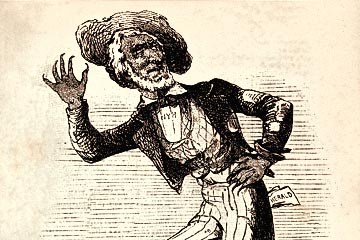
James Gordon Bennett as "Jim Crow" -- Vanity Fair
1835-1843 | 1844-1849 | 1850-1879
May 17 '44 | May 23 '44 | Jun 09 '44 | Jun 12 '44 | Jun 19 '44
Jun 26 '44 | Jun 27 '44 | Jul 01 '44 | Jul 06 '44 | Jul 7 '44
Jul 08 '44 | Jul 10 '44 | Jul 12 '44 | Jul 13 '44 | Jul 13 '44 wk
Jul 16 '44 | Jul 17 '44 | Aug 25 '44 wk | Sep 02 '44 | Sep 05 '44
Sep 07 '44 | Sep 12 '44 | Sep 15 '44 | Sep 16 '44 | Sep 21 '44
Sep 27 '44 | Sep 30 '44 | Oct 07 '44 | Oct 08 '44 | Oct 11 '44
Oct 12 '44 | Oct 13 '44 | Oct 14 '44 | Oct 16 '44 | Oct 17 '44
Nov 08 '44 | Nov 18 '44 | May 28 '45 | Jun ? '45 | Sep ? '45
Oct ? '45 | Dec 09 '45 | Jul 08 '49 | Jul 14 '49
Articles Index | Spectator/Com. Adv. | M. M. Noah's papers | misc. NYC papers
 Vol. X. - No. 138 N. Y. C., May 17, 1844. 3708 
|
Vol. X. - No. 144 N. Y. C., May 23, 1844. 3714
|
|
Vol. X. - No. 160 N. Y. C., June 9, 1844. 3730.
|
|
Vol. X. - No. 163 N. Y. C., June 12, 1844. 3733
Great Mass Meeting of the Mormons at Military Hall -- Response of the Mormonites to the Nomination of Joe Smith -- Curious Prophecy of one of the Apostles, consigning Washington, the Capital and White House to the Lower Regions -- Awful Murders in Missouri -- Van Buren -- Henry Clay -- Polk and Tyler rag-tag and bobtail annihilated. |
Vol. X. - No. 170 N. Y. C., June 19, 1844. 3770.
|
Vol. X. - No. 177 N. Y. C., June 26, 1844. 3777.
NEWS FROM NAUVOO
On Board Steamer "Osprey," |
Vol. X. - No. 178 N. Y. C., Thurs., June 27, 1844. 3778.
|
Vol. X. - No. 182. N. Y. C., Mon., July 1, 1844. 3782.
CURIOUS AND IMPORTANT Our readers have already noticed by our accounts from Nauvoo, that Jo Smith and the Mormons are again getting into exceedingly hot water. Jo has declared the city under martial law, and is preparing to defend himself against the enemy which is organizing against him at Warsaw and other places. There is every prospect now of a civil war, in which blood will be shed. As Smith is determined to run himself for the Presidency, he asks no favor of either of the great political parties of the day, and there is reason to apprehend that he and his party may suffer entire extermination from the State of Illinois. One thing may be regarded as certain, that Jo will never surrender peaceably -- he will fight to the death. |
Vol. X. - No. ? N. Y. C., Sat., July 6, 1844. ? Important from Nauvoo -- Flight of Joe Smith We have important news from the west, in a Mormon point of view. It appears that Joe Smith and his council, instead of fighting have fled. |
Vol. X. - No. ? N. Y. C., Sun., July 7, 1844. ?
Latest of Nauvoo -- Actual Surrender of Joe Smith According to St. Louis papers of the 28th ult., Joe Smith has actually surrendered himself a prisoner to Gov. Ford, of Illinois. What he will do or what will be done with him, remains to be seen. The excitement against him was very great; at Carthage, it was hard work to keep the people off him. A correspondent of the St. Louis Republican speaks of a scene which occurred at Carthage on the 25th ult. thus: -- |
Vol. X. - No. 188. N. Y. C., Mon., July 8, 1844. 3788. The Murder of Joe Smith, the Mormon Prophet. We received by the afternoon mail yesterday, and issued immediately, in an extra, the intelligence which we give in another column, of the murder of Joe Smith and his brother. This shocking piece of news, we have every reason to believe, is authentic. It excited a great deal of interest in the city. |
|
Vol. X. - No. 190. N. Y. C., Wed., July 10, 1844. 3790.
FURTHER FROM THE MORMONS. -- By the western mail we have received the following additional information relative to the murder of Jo and Hiram Smith. |
|
Vol. X. - No. 192 N. Y. C., July 12, 1844. whole 3790.
THE MORMON MASSACRE. -- Accounts confirmatory of the fact that Joe Smith and his brother were actually massacred -- murdered in cold blood, continue to reach us from the West. There can be no doubt that political feeling entered largely into the popular excitement in that region against the Mormons. It was feared by the Whigs that the Nauvoo people would give material aid to Polk. This affords another and most melancholy illustration of the pernicious, demoralizing, brutalizing influence of the party presses, which are daily inflaming the passions of the people by the vilest and most incendiary tirades against their respective opponents. |
|
Vol. X. - No. 193 N. Y. C., July 13, 1844. whole 3791. PORTRAIT OF JOE SMITH. This morning at 9 o'clock we will issue the most magnificent illustrated weekly paper ever published in this country. It will contain the most ample details of the deplorable scenes in Philadelphia and also of the massacre of the Mormon Prophet... |
 Vol. ? - No. ? N. Y. C., Saturday, July 13, 1844. ?
"JOE SMITH," THE MORMON PROPHET.
|
Vol. X. - No. 196. N. Y. C., July 16, 1844. whole 3796.
Mormon Account of the Murder of On Monday the 24th inst., after Gov. Ford had sent word, that those eighteen persons demanded on a warrant, among whom were Joseph Smith and Hyrum Smith, should be protected, by the militia of the State, they in company with some ten or twelve others, started for Carthage... |
Vol. X. - No. 197. N. Y. C., July 17, 1844. whole 3797. AFFAIRS AT NAUVOO. Having visited Nauvoo and its vicinity in person, for the purpose of getting at the true state of affairs among the Mormons and their neighbors, we are enabled to give the latest as well as the most correct intelligence. Nauvoo reposes in a state of quietude and tranquility most remarkable. During some thirty hours that we passed in the 'Holy City,' we heard but one solitary intemperate expression, and the man who uttered it was instantly checked, and made silent by more prudent spirits around him. Elders Adams and Lyne, accompanied by others, left the city on Tuesday last, their object being to call home the absent Apostles and members of the Council of Seventy. Upon the return of these, there will take place a solemn deliberation of the Twelve Apostles, who will appoint a successor to the lost Prophet, and their appointment will then be acted upon, either to be ratified or rejected by the Council of Seventy. |
Vol. X. N. Y. C., Sunday, Aug. 25, 1844. No. 236.
(For the New York Herald.)
All the liars, swindlers, thieves, robbers, incendiaries, murderers, cheats, adulterers, harlots, blackguards, gamblers, bogus makers, idlers, busy bodies, pickpockets, vagabonds, filthy persons, hireling clergy, and their followers, and all other infidels and rebellious, disorderly persons, for a crusade against Joe Smith and the Mormons. Be quick, be quick, I say or our cause will be ruined and our kingdom overthrown by that d----d fool of an imposter and his associates, for even now all earth and hell is in a stew. |
Vol. X. - No. ? N. Y. C., September 2, 1844. whole. 3844.
Carthage
Dear Sir: -- Since I had the pleasure of seeing you, last winter, in your sanctum sanctorum, from whence editorial genius spreads its brightening rays and illumines the civilized world, I have been playing the cosmopolitan, but at last returned to the country of Joe Smith notoriety in time to witness the scenes -- the glorious and inglorious achievements of the Mormon war in Hancock county -- and as many uninformed correspondents have written for the eastern papers, whose statements are erroneous, in many particulars, in relation to the causes of the death of the Smiths's at Carthage, while also many editors are severely rebuking the old citizens of Hancock county, a portion of whom are supposed to be among the perpetrators of the offence, leaving the impression upon the public mind that they are a vindictive set of cut throats, and guilty of one of the foulest murders recorded in the annals of crime. I will relate to you a few facts, being a few of the prominent causes which induced the old citizens of the surrounding country to arise in their indignation and strike the blow which cut off the head of an evil, which to them, and to every freeman within the sphere of its baneful influence, had become intolerable. |
|
Vol. X. - No. 247 N. Y. C., September 5, 1844. whole 3847.
Wonderful Discloures respecting Mormonism. Before visiting Nauvoo, I had heard much of the famous city, and the character of the inhabitants. Such was the contrariness of reports afloat, that it seemed difficult to form any settled opinion concerning the Prophet or his followers. Where I had been, however, the opinion seemed to prevail, that they were a pack of abandoned scoundrels, leagued together for the basest of purposes. |
Vol. X. - No. 249 N. Y. C., September 7, 1844. whole 3849.
Wonderful Discloures respecting Mormonism. When we got within a half mile of Montrose, Richardson who had previously, by fair promises, induced Karnes to give up the halter of his horse, which he had held in his hand during most of the journey, put spurs and ran into the town... |
Vol. X. - No. 253. N. Y. C., September 12, 1844. whole 3853 IMPORTANT FROM THE MORMON COUNTRY. We have received intelligence from Nauvoo, the capital of the Mormon country, which is rather interesting, as developing the present political and religious condition of that people -- their future prospects and the probable destination of their votes this fall. |
Vol. X. - No. 257 N. Y. C., September 15, 1844. whole 3857.
MORMON LECTURE. -- There is to be a grand display of Mormon talent to-day, at 3 o'clock, at the National Hall, Canal street. Elder Adams is to shine forth on the subject of "Restoration of all things," and Elder Wm. Smith, the only surviving brother of the Mormon Prophet, will assist in the services. Me. T. A. Lyne is to deliver some of his most celebrated sacred readings. |
Vol. X. - No. 258 N. Y. C., September 16, 1844. whole 3858. Mormon Lecture on the Restitution of all Things. Yesterday there was a display of Mormom talent on this subject at the National Hall, Canal street, by elder G. J. Adams. The service was commenced by Elder W. Smith, the only surviving brother of the Mormon prophet, offering up prayer; this was succeeded by Mr. T. A. Lyne reading the 26th chapter of the Acts of the Apostles, in a somewhat novel style. Elder Adams then proceeded to address those assembled, taking for his text verses 20 and 21 of Acts III, I Cor v. 21, and the Revekation of John, c. 21, v. 4 & 5. The gentleman then proceeded to treat on the immortality of the soul, the fall of man, the curse of the earth, the plan of redemption, the reign of peace over the earth, &c. &c. &c., to which he broached some truly original ideas, and contended that the millennium was to exist on this earth, and that hell, fire and brimstone, was only to frighten old women of the present day to follow the steps of a hireling and hypocritical priesthood, who were ten times worse than the Pharisees of old, who taught doctrines they knew were repugnant to truth for their own sordid interest and aggrandizement; and that it was not until the people opened their eyes to this fact, could the reign of the Lord commence. The gentleman, in the course of his argument, proceeded to show that man only consisted of body and soul, or spirit, not, as generally thought, body, soul, and spirit; and went to show the materiality of body and the eternity of spirit, while the former minbgled with the dyst from whence it came, and the latter returned to him who gave it; and future punishment was all moonshine. and that all spirits would enjoy eternal happiness sooner or later, and that new heavens and new earth would be the final inheritance of the saints. The gentleman then proceeded to say that he had been for a long time trying to get a place to preach in this city without success, and could only get the present for that evening, and hoped that all had got the worth of their money, which was charged to cover expenses; but hoped that in a short time he would be able to get other accomodations, and give lectures on the doctrines of the Mormons, and show that they were the only true religionists. |
Vol. X. - No. 261. N. Y. C., Saturday, Sept. 21, 1844. whole 3861.
THE SPLIT IN THE MORMON CAMP. -- The following notice appears in the Nauvoo Neighbor of the 4th inst.: -- "Notice. -- Fellowship was last evening withsrawn from Elders Rigdon, James Emmet, and Zachariah Wilson, by the Counsel of the Twelve, and on Sunday next the matter will be laid before the church for their action." |
Vol. X. - No. 267. N. Y. C., Friday, Sept. 27, 1844. whole 3867.
(From the Nauvoo Times and Seasons of Sept. 2.)
Great excitement prevails throughout the world to know "who shall be the successor of Joseph Smith?" |
Vol. X. - No. 270. N. Y. C., Monday, Sept. 30, 1844. whole 3870. INTERESTING FROM THE MORMONS. -- According to all accounts, there is a very serious split among the Mormons, and the church is quarrelling seriously among themselves. Sidney Rigdon has been cut off. The following is his curious trial from the |
Vol. X. - No. 277. N. Y. C., Mon., October 7, 1844. whole 3877.
RUMORS OF A MORMON WAR. -- By the steamer Lebanon which arrived this morning from the Illinois river, we learn that when she left Beardstown yesterday, the military ordered out by Governor Ford were still there, waiting his arrival and reinforcements under his command from the vicinity of Jacksonville. As the Lebanon passed down, a number of soldiers had assembled at Well's Landing, who were also waiting for further orders. The movements of this great Commander-in-Chief appear to be characterized by the same tardiness for which they were so peculiarly distinguished during the first Mormon Punic war. Nauvoo would be ransacked and pillaged before this renowned military chieftain could get his army together and in motion. His proclamation, we understand, called for a general rendezvous of all the forces destined for the protection of the Mormons on the 24th inst. Yesterday was the 24th, but we find his army scattered along the banks of the Illinois, not knowing whether he would come or whether they are to look for another. This grand war and protection demonstration has not been equaled since the days of the Crusades. It is indeed a campaign of surprise if not of reprisal, for it has taken the citizens of Warsaw by surprise, and we opine that the Mormons are equally as much confounded to know what all this fuss about fighting means. Our last accounts by a boat which arrived this morning, state things in the two belligerent cities, to be in a state of the utmost peace and quietude. Gov. Ford will run his State further into debt, and then retire covered with laurels gained in planning and conducting one of the smallest military campaigns, for a little political effect, which has distinguished this or any other age. -- |
Vol. X. - No. 278. N. Y. C., Tues., October 8, 1844. whole 3878.
THE MORMON WAR. -- We learn that Gov. Ford and his troops have reached Carthage. The purpose of the Governor in ordering out the troops seems to be a determination to bring the murderers of Joe and Hyrum Smith to trial. The reasons assigned by the Governor's friends for ordering out the troops in the first instance was a "wolf hunt," advertised by a portion of the people of Hancock county to come off on the 26th and 27th inst. This hunt, it was believed by the Governor, was a pretext to get the people assembled, aroused, and then to make an attack on the Mormons at Nauvoo, or some other Mormon settlement. From all we can learn, we suppose that the wolf hunt was abandoned after the orders of the Governor were issued. The Governor was at Carthage. Writs were issued and placed in the hands of the sheriff, for the arrest of Thomas C. Sharp, editor of the Warsaw Signal, and for Col. Williams, of the same place, both charged with participating in the murder of the Smiths. -- The sheriff came to Warsaw and attempted to arrest Sharp, but he refused to surrender himself, and in this resolution was sustained by the people of Warsaw. The sheriff returned and reported his inability to arrest him, when three hundred of the troops were ordered to march to Warsaw. The troops had not arrived at Warsaw before the Osprey left, but Sharp and Williams had escaped to the Missouri side of the river, and, we presume, will not be taken. -- |
|
Vol. X. - No. 281. N. Y. C., October 11, 1844. ?
MORMON WAR. -- A gentleman who came down the river informs us that the Deputy Sheriff of Hancock county came to Warsaw with a writ to arrest Mr. Sharpe and Col. Williams; the writ commanded him to take them to Nauvoo for examination. They told him that they would go before any Justice of the Peace in Carthage or Warsaw, or any Justice of Hancock county, who was not a Mormon, but that they would die before they would go in Nauvoo, or put themselves in the power of the Mormons. The Sheriff returned to Nauvoo, and came back with positive directions to seize them and take them to Nauvoo, but before he returned, Sharpe and Williams had disappeared and could not be found. He also informs us that it was reported that Gov. Ford was in Nauvoo with troops. This is probably not the case. On the same day a letter was received from Carthage informing the people that Gov. Ford had ordered three hundred troops to be at Warsaw that night for the purpose of aiding in arresting citizens of that place. It is probable that the military movement of Governor Ford will give rise to many unfounded rumors, and that it may precipitate a bloody collision between the Mormons and the citizens of Hancock county. Gov. Ford's great love for the Mormons may yet be the means of their expulsion and extermination. |
|
Vol. X. - No. 282. N. Y. C., October 12, 1844. ?
THE MORMONS. -- A letter in the St. Louis New Era states that. at Nauvoo, on the night of the 28th ult., while the guard was being relieved, at the camp of the Governor, one of the Springfield Cadets was accidently shot in consequence of a false alarm purposely given to try the men; he died instantly. His name is Norris. Next day Gov. Ford's troops marched to Warsaw, and are now encamped there. They number 420 men. -- Report says that there are 70 writs out, and that rewards are offered for Sharpe, Williams and Jackson. |
Vol. X. - No. 283. N. Y. C., October 13, 1844. ?
MORMON AFFAIRS. -- The St. Louis Republican of October 2, brings a report that Sharp, the editor of the Warsaw Signal, and Col. Williams, were prisoners in the hands of Gov. Ford. Whether they had given themselves up or had been seized at Warsaw, was not known. One of the Springfield cadets, named Norris, was instantly killed, while the guard at the camp of the Governor was being relieved, on the night of the 28th; he was shot in consequence of a false alarm purposely given to try the men. Ford's troops were scattered about in the neighborhood of Warsaw. Many of the persons who were apprehensive of arrest, had crossed the river to Churchville. It was said that seventy writs had been issued against individuals. |
Vol. X. - No. 284. N. Y. C., Mon., October 14, 1844. ?
Boston, Oct. __, 1844. |
|
Vol. X. - No. 286. N. Y. C., Wed., October 16, 1844. ?
THE MORMON WAR. -- The following letter was received yesterday, but too late for insertion: -- |
|
Vol. X. - No. 287. N. Y. C., Thurs, October 17, 1844. ?
MILLERISM AND MORMONISM. -- While Mormonism absorbs the public attention on the banks of the Mississippi -- Millerism is beginning to attract a good deal of laughable and pitiable attention the banks of the Hudson. The Millerites are mow determined to have an end to the world at once, and from a number of documents issued by these amiable fanatics, which we have received, it seems to us that the "last day" is positively set down for the twenty-second of this month, although possibly it may be on the twenty-third. In the meantime, the excitement and fanaticism are increasing to a fearful extent, and some of the strangest scenes ever recorded in the annals of superstitious enthusiasm are daily taking place. Of these we may give an account hereafter. Millerism, however, has not the elements of vitality possessed by Mormonism. Its period cannot be protracted beyond the twenty-second of the present month, when these deluded people will be brought to their senses. But Mormonism has a singular spirit of conquest and life that may yet surprise the world. |
|
Vol. X. - No. ? N. Y. C., Tuesday, November 8, 1844. ? Meeting of the Mormons last evening. Agreeable to an announcement in the papers, Elder Winchester, one of Sidney Rigdon's men, addressed a meeting of the Mormons of this city, last evening, in their hall, corner of Hudson and Canal streets. The attendance was very slim, only about thirty persons being present, two-thirds of whom were females. |
|
Vol. X. - No. ? N. Y. C., Monday, November 18, 1844. ?
... [Sidney Rigdon is] a tall, stout, elderly, gentleman looking man apparently about sixty years of age, hollow mouthed, having lost his front teeth. His delivery is rather indistinct and low, very rapid, at other times quite as loud, raising his voice to the highest pitch. He is evidently a person of but limited education... very disjointed in his manner, so as almost to defy knowing what particular object his subject had reference to. He used his left hand as if he was pumping violently, every now and then assisting with the right, and hitting the deck so violently with one or both as to make every thing on it spring upwards to a considerable height, and keeping those near him from napping if inclined... |
|
Vol. XI. - No. ? N. Y. C., May 28, 1845. ?
AFFAIRS OF THE MORMONS. -- We find the following in several of our Western exchange papers. -- There appears to be an increasing excitement against the Mormons in the vicinity of the city of Joseph. |
|
Vol. XI. - No. ? N. Y. C., June ?, 1845. ? Trouble in the Holy City. It is rumored that Bill Smith is making trouble for the Twelve, in Nauvoo, and will either compel them to quietly surrender their power, or else he will throw himself in open rebellion. In consequence of the sickness and death of his wife, Smith has been comparatively quiet since his arrival in the city; but there has been many points in which he has disagreed with the heads of the church, which has led to coldness, if not hostility. When Smith was on his way to this city, he openly declared that the Twelve should reinstate Elder Brannan, editor of the New York Prophet, who has been recently disfellowshipped, and said that if they were not willing he would compel them. By the last Neighbor we perceive that he has succeeded, for Brigham has issued a circulart announcing that Brannan is restored; but it is done with evident reluctance. -- It is gosipped about that Smith will in a decent time marry Emma, widow of his brother, the Prophet. She is known to be hostile to the Twelve, and will lend her influence for their overthrow. If this union is effected, we shall look for a complete revolution in the Holy City during the course of the summer. We do not know that such a change would at all alleviate the condition of the old settlers, but Bill Smith has some virtues which would render him less objectionable than the present rulers. He is generous, liberal and candid. -- Warsaw Signal. |
|
Vol. XI. - No. ? N. Y. C., Sept. ?, 1845. ?
... The recent outbreaks in Illinois should lead the independent press throughout the country, and all good citizens, to a united and vigorous effort against the spirit of disorganization and rebellion. Let all attempts to persecute the Mormons, or any class of people, be at once crushed with indignant rebuke... |
Vol. XI. - No. 339. N. Y. C., Oct. ?, 1845. whole 1191
The recent popular outbreaks -- the awful deeds of violence and blood -- which are daily perpetrated in Illinois, are disgraceful in the extreme. When we look at this state of things in Illinois, in conjunction with anti-rentism in this State, the conduct of the anti-abolition mob in Kentucky, and various outbursts here and every where, one would suppose that our government and the state of society amongst us were going backward. But it is not so. These local diseases correct themselves, and are inevitable in a free country, under a popular form of government. There may be some slight injustice to individual rights in all these ebullitions and explosions in particular localities, but they have a general effect on the great masses of the people, which is of a salutary character, and so they work their own cure in process of time. This is seen already in the anti-rent districts. Reaction has begun. The friends of law and order have been alarmed and aroused. The absurd doctrines of Greeley and his compatriots, about the rights of property, are now scouted by many who formerly were half inclined to swallow them. Throughout all the anti-rent region, the Tribune, and all such incendiary and revolutionary prints, are execrated by the intelligent and orderly classes. |
Vol. ? N. Y. C., Sunday, July 8, 1849. No. ?
Arrest of the Confidence Man. -- For the last few months a man has been traveling about the city, known as the “Confidence Man,” that is, he would go up to a perfect stranger in the street, and being a man of genteel appearance, would easily command an interview. Upon this interview he would say after some little conversation, “have you confidence in me to trust me with your watch until to-morrow;” the stranger at this novel request, supposing him to be some old acquaintance not at that moment recollected, allows him to take the watch, thus placing “confidence” in the honesty of the stranger, who walks off laughing and the other supposing it to be a joke allows him so to do. In this way many have been duped, and the last that we recollect was a Mr. Thomas McDonald, of No. 276 Madison street, who, on the 12th of May last, was met by this “Confidence Man” in William Street, who, in the manner as above described, took from him a gold lever watch valued at $110; and yesterday, singularly enough, Mr. McDonald was passing along Liberty street, when who should he meet but the “Confidence Man” who had stolen his watch. Officer Swayse, of the Third Ward, being near at hand, took the accused into custody on the charge made by Mr. McDonald. The accused at first refused to go with the officer; but after finding the officer determined to take him, he walked along for a short distance, when he showed desperate fight, and it was not until the officer had tied his hands together that he was able to convey him to the police office. On the prisoner being taken before Justice McGrath, he was recognized as an old offender by the name of Wm. Thompson, and is said to be a graduate of the college at Sing Sing. The magistrate committed him to prison for a further hearing. It will be well for all those persons who have been defrauded by the “Confidence Man” to call at the police court Tombs and take a view of him. |
Vol. XV. No. 28. N. Y. C., Saturday, July 14, 1849. Whole 326. "The Confidence Man" on a large Scale. During the last week or ten days, the public have been entertained by the police reports with several amusing descriptions of transactions of a certain financial genius who rejoices in the soubriquet of the "Confidence Man." It appears that the personage who has earned this euphonious and winning designation, has been in the habit of exercising his powers of moral suasion to exert almost equal to that attained by Father Matthew himself. Accosting a well-dressed gentleman in the street, the "Confidence Man," in a familiar manner, and with an easy nonchalance, worthy of Chesterfield, would playfully put the inquiry -- "Are you really disposed to put any confidence in me?" This interrogatory, thus put, generally met an affirmative answer. After all, there is a great deal of "the milk of human kindness" even in the inhabitants of great cities, and he must be a very obdurate sinner who can resist a really scientific appeal to his vanity. "Well, then," continues the "Confidence Man," just lend me your watch till to-morrow!" The victim, already in the snare of the fowler, complies, with a grin; and, jokingly receiving one of Tobias' best, the "Confidence Man" disappears around the next corner. To-morrow comes, but not with it the watch, or the charmer; and Mr. "Done Brown" finally awakes to a sense of his folly, when he tells his sad story, amid the suppressed titterings of hard-hearted policemen, in the office of Mr. Justice McGrath, at the Tombs. Fate, however, is hard. It may be true that fortune favors the brave; but sometimes, "with malicious joy," she puts the bravest in limbo. The "Confidence Man," at present occupies a very small apartment in Centre street. |
Back to top of this page.
Newspaper Articles | News Articles Index | History Vault
Oliver's Bookshelf | Spalding Library | Mormon Classics
last updated: Mar. 10, 2009