
READINGS IN EARLY MORMON HISTORY
(Newspapers of New York)

Misc. New York Newspapers
1795-1825 Articles
1795-1825 | 1826-1828 | 1829-46 (tabulated) | 1847-1869 | 1870-1899 | 1900-1999
| WEST NY | BATAVIA | ROCHESTER | PALMYRA | EAST NY |
| 1829-31 | 1829-31 | 1829-31 | 1829-31 | 1829-31 |
| 1832-33 | 1832-39 | 1832-33 | 1832-33 | 1832-39 |
| 1834-39 | 1834-39 | 1834-39 | 1840-46 | |
| 1840-46 | 1840-46 | 1840-46 | 1840-46 | Otsego Co. |
1795-1819
AReg Jun 10 '96 | ACen Aug 04 '01 | ASR May 10 '11 | BAS Dec 10 '11 | ADA Sep 28 '16 | ADA Oct 13 '17
ORp Nov 04 '17 | RReg Dec 31 '17 | PReg Jan 21 '18 | PReg Jan 28 '18 | ORp May 26 '18 | GGz Jul 01 '18
PReg Jul 14 '18 | RTel Aug 11 '18 | PReg Aug 18 '18 | PReg Dec 02 '18 | GGz Feb 17 '19 | RTel Apr 06 '19
PReg May 26 '19
RTel Jun 01 '19 | RTel Jun 22 '19 | GGz Aug 08 '19 | PlB Sep 11 '19 | PYH Sep 28 '19 | WGz Sep 29 '19
ORp Oct 19 '19 | GGz Nov 10 '19 | PReg Nov 17 '19 | PReg Dec 01 '19 | ORp Dec 14 '19 | RTel Dec 21 '19
1820-1823
GGz Jan 26 '20 | WGz Jan 26 '20 | GGz Feb 28 '20 | GGz Mar 08 '20 | PReg Mar 08 '20 | PReg Jun 28 '20
ORp Sep 28 '25 | GGz Sep 28 '25 | RAd Sep 30 '25 | WSn Oct 04 '25 | FrC Oct 05 '25 | ORp Oct 05 '25
RAd Oct 07 '25 | WSn Oct 11 '25 | ORp Oct 19 '25 | WSn Nov 08 '25 | WSn Nov 15 '25 | WSn Nov 22 '25
GAd Dec 02 '25 | WSn Dec 27 '25
News Articles Index | NY Chronological List | New York City Papers
(note: All articles from Otsego County have been moved to here)
|
Albany [ ] Register.  Vol. VIII. Albany, New York, Friday, June 10, 1796. No. 462.
F O R S A L E, at
Note 1: The British (Canadian) "prophet," Richard Brothers, was a topic of interest in both the United Kingdom and North America when the year 1800 was approaching. As that year progressed it became evident that no great supernatural events were unfolding and Brothers was dismissed as one in a series of many false prophets. For example, that same year the Salem Register compared a local latter day seer, David Austin, to the discredited Brothers. Note 2: At the time the Albany Register was advertising Brothers' new book, Solomon Spalding was residing not far away in Otsego County. His activities were reported in the Albany press -- see the Centinel of Aug, 4, 1801. |
The Albany Centinel. Vol. V. Albany, New York, Tuesday August 4, 1801. No. 11. COMMUNICATION. Richfield, July, 1801. |
Vol. XXIII. Albany, New York, Friday, May 10, 1811. No. 38.
Whereas Solomon Spalding, of Richfield, in the county of Otsego, and state of New-York, by indenture of release, by way of mortgage, bearing date of the thirteenth day of March, in the year one thousand eight hundred and three, for securing the payment of a sum of two thousand three hundred and eighty-eight dollars and forty-four cents, in the manner particularly specified in the said indenture of mortgage, did "grant, bargain, sell, alien, release and confirm" unto me, the subscriber, by the name and description of William F. Miller, of Windsor, in the county of Hartford, and state of Connecticut, my heirs and assigns forever, all his right and title in and to that certain tract of land, lying and being in the first range of townships, lot no. one, tract no. fourteen, in the printed maps of the Connecticut land company, in the county of Trumbull, and state of Ohio, which is bounded as follows, beginning at the north-east corner of said state or tract, and runs south by the Pennsylvania line two hundred and thirty-four chains, to the south-east corner of the tract; thence on the south line of the tract, one hundred and three chains to a post marked on the north-east side number two, and north-west no. one; thence north by lot no. two twenty-two chains to the Coneaught river; and thence northerly by said river to its entrance into lake Erie; and thence by said lake east to the first station, containing two thousand one hundred and fifty acres, be the same more or less.And the proportion of the above described tract of land, which said Spalding hath and doth convey by these presents unto the said Miller, is as one thousand and three acres is to two thousand one hundred, and fifty acres, be the actual quantity what it may, the remainder of said tract of land being one thousand one hundred and forty-seven acres, and was deeded by partition deed to Solomon Bond, [Squire?] Davenport, Esq. and Gideon Granger, bearing date, April 8, 1801, as tenants in common with the said Miller, then a proprietor; to have and to hold all and singular the said messuage or tenements, lands hereditaments and premises above mentioned, and every part and parcel thereof, with their and every of their appurtenances, unto the said William F. Miller, his heirs and assigns forever. And whereas it was in and by said indenture covenanted, concluded, declared and agreed by and between all and every the said parties to the said indenture, and to be the true intent and meaning thereof, that the said Solomon Spalding, his heirs, executors and administrators or assigns, do and shall well and truly pay, or cause to be paid, unto the said William F. Miller, his heirs, executors, administrators or assigns, the full sum of the following notes, as they annually become respectively due, and the interest which may at any time arise thereon, at said Miller's dwelling-house in Windsor; namely, one of nineteen hundred and twenty-six dollars, payable five years after date, one note of one hundred and fifteen dollars and thirty-six cents, also in five years after date, one note of the said sum in four years after date, one of the said sum in two years after date, and one of the same sum in one year after date; said notes being signed jointly and severally by Solomon and Josiah Spalding, that then and from thenceforth those presents and every thing therein contained, and the said indenture of mortgage shall cease and be void, any thing therein contained to the contrary thereof notwithstanding. And in case the said note or notes, or part or parts of them, or any thereof, shall remain unpaid at the time above limited for payment thereof, then and in such case, it shall and may be lawful for the said William F. Miller, his agent, heirs and assigns, and the said Solomon Spalding doth hereby empower and authorise the said Miller, his agent, heirs and assigns, to grant, bargain, sell, alien, release and convey the aforesaid premises, with their appurtenances, at public auction, or venue, and on such sale to make and execute to the purchaser or purchasers, his or their heirs and assigns, a good, ample and sufficient deed or conveyance in the law, pursuant to the acts in that case made and provided, in the state of New-York, which is the foundation of this security, rendering and paying the surplus money if any there be, to the said Solomon Spalding, his heirs, executors or administrators, after deducting the costs and charges of such auction or vendue, as aforesaid; which vendue is to be held on said tract of land, in said state of Ohio. And whereas default has been made in the payment of the principal and interest intended to be secured by the said indenture of mortgage -- Notice is therefore hereby given, that by virtue of the power contained in the said mortgage, and in pursuance of the statutes of the state of New-York, in such case made and provided, the premises described in the said mortgage, will be sold at public auction, on the said premises, on the fourteenth day of October next. Dated this 1st day of April, 1811. |
ns Vol. I. Albany, New York, Tuesday, December 10, 1811. No. 50.
Miscellany.
|
Vol. ? Albany, New York, Saturday, September 28, 1816. No. ?
The old story of the Welch Indians is once more going the rounds in the newspapers. The present account of them is said to have been given by a Capt. Isaac Stewart, who having been taken a prisoner by some of the Indians living westward of Fort Pitt, was carried across the Mississippi to the Red river, and after having travelled seven hundred miles up that river came to this tribe, who he described to be "remarkably white, with reddish hair." He says there was a Welchman with him who understood their language, and that they had rolls of parchment tied up in Otter skins, but as his companion could not read, he was not able to ascertain what they contained. |
Vol. ? Albany, New York, October 13, 1817. No. ? VERMONT PILGRIMS! A correspondent informs us that five wagons loaded with the household goods, men, women, and children of this sect, passed through Cherry Valley, Otsego county, on the 25th ult., on their way to the State of Ohio. The men and women were dressed in the same style of those who passed through Sussex, (N. J.) and were, as they alledged, followers of the same prophet. They call themselves the true followers of Christ -- Their pretended prophet came from Canada, a few months since, and is a man of "austere habits," and a great fanatic. His followers are not yet numerous, but it is thought he will increase them. He rejects sirnames [sic], and abolishes marriage and allows his followers to cohabit promiscuously. |
 CANANDAIGUA, PUBLISHED BY JAMES D. BEMIS & CO.
Vol. XV. Tuesday, November 4, 1817. No. 30.
|
 Vol. I. Palmyra, N. Y., Wednesday, December 31, 1817. No. 6. Hymen's Court. ==> Merry Christmas. -- MARRIED |
|
Vol. I. Palmyra, N. Y., Wednesday, January 21, 1818. No. 9.
From the North American Review.
Indian Antiquities. -- The following account, which we take from the Western Gazetteer, adds something to our former knowledge of those hitherto inexplicable wonders, that are found in such abundance in our western country. We have not room to examine any of the speculations, which have entered the heads of our philosophers and antiquarians on the subject; and if we had, we should hardly expect, where all is conjecture and uncertainty, to afford much amusement or profit to our readers. There is something, however, extremely curious in the inquiry itself; although we cannot hope, that any very important or certain results can be drawn from the few facts, which have as yet been given to the world. We can safely infer from them nothing more, than that this immense tract of country, which has every mark of having been for centuries past a desolate wilderness, has been thickly inhabited at some former period by a warlike people, who had made much greater advances in the arts of civilized life, than any of the aboriginal inhabitants of North America, who have been. known since its discovery by Europeans. The mounds described below are situated in the town ot Harrison, Indiana Territory. |
|
Vol. I. Palmyra, N. Y., Wednesday, January 28, 1818. No. 10.
Extract from the Western Gazeteer.
The author of this interesting and valuable work, in speaking of the antiquities of the state of Indiana that now exist near Vincennes, County of Knox, says that |
|
CANANDAIGUA, PUBLISHED BY JAMES D. BEMIS & CO. Vol. XVI. Tuesday, May 26, 1818. No. 7.
|
|
Vol. X. Geneva, N. Y., Saturday, July 11, 1818. No. 4.
APPOINTMENTS.
Ontario -- Gideon Gates, Elisha Ely, James Parmelee, Jeremy S. Stone, Jared Boughton, Samuel Rawson and Enos Giles, justices. |
|
Vol. I. Palmyra, N. Y., Tuesday, July 14, 1818. No. 34.
APPOINTMENTS.
Ontario ...Warren A. Cowdry, Joshua Lee and George Hosmer, Commissioners... |
|
Vol. I. Rochester, New York, Tuesday, August 11, 1818. No. 6.
PROPOSAL Of all publications, a newspaper so conducted as to be a vehicle of general intelligence, will ever be most interesting to all classes of mankind. To what other source does the philanthropist, the statesman, the philosopher, and every man of enterprise look for instruction? No publication is more worthy of encouragement than a well executed newspaper -- in the diversified columns of which we are enabled to "catch the manners living as they rise." Herein, from the hoary age to the lisping school boy, all may find instruction, amusement, or interest. |
|
Vol. I. Palmyra, N. Y., Tuesday, August 18, 1818. No. 39.
Nashville, July 27.
It has long been a desideratum with the learned, to know by whom the numerous old fortifications, &c., in the western country, were erected. It is now in our power to add one fact that may serve to direct inquirers a little further. A short time since a cellar was dug in the town of Fayetteville, on Elk river, in this state, not far from the lines of those ancient fortifications so common in the western states; and in the dirt was found, corroded with a kind of rust, a small piece of metal, which, being disrobed of its covering, was ascertained to be a Roman silver coin, issued about 150 years after Christ, and in a good state of preservation.It is in the possession of a merchant of Nashville, and has been seen by hundreds, many of whom are satisfied it is a genuine coin, and one gentleman who was lately in Italy, and saw the busts of the persons represented on the coin declared the heads to be very good likenesses. |
|
Vol. II. Palmyra, N. Y., Tuesday, December 2, 1818. No. 2.
Somnium preacher.
When Miss Rachel Baker first commenced her somnium or hallucian exercises, she was considered by many people as a gross imposter, and her conduct during those exercises, as a libel upon her own understanding. But, with her life and character, such strong and convincing proof has been laid before the public, that every rational mind must be satisfied, that her conduct was not that of a deceiver, but the result of a misfortune beyond her control. |
|
Vol. X. Geneva, N. Y., Wednesday, February 17, 1819. No. 37. From the N. Y. Columbian. Several ancient pieces of aboriginal writing have lately reached New-York from Mexico. They are such as have been described and figured by many of the authors that have treated of the men who were the rulers of that important region of North America at the time of its invasion by the Spaniards -- being partly imitative, by pictures, and partly significant, by hieroglyphics... |
Vol. I. Rochester, N. Y., April 6, 1819. No. 40.
From the Religious Intelligencer. It has long been the enquiry among people of reading and observation, from what nation the Aborigines of this country descended. Some, who have been well acquainted with the customs and usages observed among them, are of the opinion that they sprang from the ancient Israelites. I have lately been led to think this conjecture is correct; and that the scripture history affords probable evidence, that the North American Indians descended from the tribe of Dan, in particular... [a lengthy list of evidence follows] ... |
 Vol. II. Palmyra, N. Y., Wed., May 26, 1819. No. 21. AMERICAN ANTIQUITIES.
|
Vol. I. Rochester, N. Y., Tuesday, June 1, 1819. No. 48.
Franklin Coudery and Benjamin F. Smead,
|
Vol. I. Rochester, N. Y., Tuesday, June 22, 1819. No. 51. A new Paper. Messrs. Coudery and Smead have recently commenced the publication of a weekly paper at Hamilton village (Olean point) entitled the Hamilton Recorder. -- The proprietors are industrious and worthy young men and we hope their laudable undertaking will be encouraged. |
Vol. XI. Geneva, N. Y., Wednesday, June 23, 1819. No. 3.
A newspaper is commenced at the village of Hamilton, (Olean, N. Y.) by Messrs Coudery & Smead, under the title of the "Hamilton Recorder." |
Vol. XI. Geneva, N. Y., August 8, 1819. No. 11.
From the St. Louis Enquirer.
It seems that a society in the state of New-York has sent out persons to ascend the Missouri in search of Welch Indians. |
Vol. I. Albany, N. Y., Saturday, September 11, 1819. No. 15. Weekly Summary. Antiquities of Marietta. -- In levelling a street in that town an ancient mound was levelled. when the remains of a human skeleton were discovered, and what appeared to have been a sword was found by him. Lying immedately over the forehead was found a large circular bossus or ornament for a sword belt or buckler: they were composed of copper, and overlaid with a thick plate of silver. The copper was nearly reduced to an oxide or rust. The silver appeared quite black, but not corroded, and on rubbing, it became quite brilliant. -- The mound must have been raised more than six hundred years ago; for when the ground where it was situated was cleared there were trees on it of 500 years growth, and the remains of others apparently as ancient, were found on the ground in every stage of decay. Here then is conclusive evidence that a people formerly inhabited the country who must have made considerable proficiency in the arts, with which the present natives were found totally unacquainted when Europeans first came among them. What has become of this people? |
Vol. ? Penn-Yan, N. Y., Tuesday, September 28, 1819. No. ? JEMIMA WILKINSON. In the National Intelligencer of the 11th of September, we notice a communication, signed "A Neighbor," and dated from this county, which is not only "very incorrect," but, in many particulars, false. The writer of that communication begins as follows: |
|
Vol. III. Waterloo, N.Y., Wednesday, September 29, 1819. No. 19.
From the National Intelligencer.
Messrs. Gates and Seaton. |
|
CANANDAIGUA, PUBLISHED BY JAMES D. BEMIS & CO. Vol. XVII. Tuesday, October 19, 1819. No. 28.
LIST OF LETTERS
... |
Vol. XI. Geneva, N. Y., November 10, 1819. No. 23.
Evacuation of Grand Island. -- The inhabitants of this Island, with few exceptions, have been removed therefrom previous to the day appointed by law for their expulsion. The Island is said to contain about 60 log houses, and more than 100 acres of land cleared, fenced and improved. --Niagara Pat. |
Vol. II. Palmyra, N. Y., Wed., November 17, 1819. No. 52.
From the Pittsburgh Mercury
|
Vol. III. Palmyra, N. Y., Wed., December 1, 1819. No. 2.
From the Pittsburgh Mercury
|
|
CANANDAIGUA, PUBLISHED BY JAMES D. BEMIS & CO. Vol. XVII. Tuesday, December 14, 1819. No. 36.
MARRIED -- At Moscow. Mr. Franklin Coudery, of Hamilton, to Miss Amantha Munger... |
Vol. II. Rochester, N. Y., Tues., December 21, 1819. No. 25.
MARRIED -- ... In Moscow, Genesee County, Mr. Franklin Coudery, of Olean, a propietor of the Hamilton Recorder, to Miss Amanda Munger... |
 Vol. XI. Geneva, N. Y., January 26, 1820. No. 34.
Moses Manassah Noah, Esq. has presented a petition to the Legislature, praying that the state would authorize the sale to him of Grand Island, lying in the Niagara river, for the purpose of "causing a town or city to be erected thereon, to be inhabited by s community of Jewish emigrants." When built, Mr. Noah will doubtless transfer his "National Advocate" to this new city of moonshine, for the instruction of his Jewish brethren. |
|
Vol. III. Waterloo, N.Y., Wednesday, January 26, 1820. No. 36.
Silver Mine. -- Letters from Zanesville, Ohio, received at Philadelphia, appear to confirm the discovery of a silver mine near the former place. |
Vol. XI. Geneva, N. Y., February 28, 1820. No. 38.
Kid's long-secreted Money found! -- Died -- In the city of New York, J____ D____, one of the crew of the noted Captain Kid. He was supposed to be at the time of his death, one hundred and three years of age. His general occupation for the last 30 years or more, was stowing away vegetables... Having no relations, he willed to a woman who attended him, the whole of his property, amounting from 12 to 18,000 dollars. (Here's a discovery of Kid's hidden money, so much the object of search and research for many years.) -- Columbian. |
Vol. XI. Geneva, N. Y., March 8, 1820. No. 40.
Grand Island. -- The house went into committee of the whole on the bill granting Grand Island to Mordecai M. Noah, Mr. M. in the chair, A short debate took place -- in which the speaker[s], Messrs. Fox, Ruggles, Tibbits and Williams took part, & opposed the passage of the bill. Mr. Ulshoeffer defended it, and advocated its passage -- Mr. Crolius said a few words in answer to Mr. Fox; when a motion to strike out the first clause, or in other words to reject the bill, was made and carried by a large majority. -- Alb. Adv. |
Vol. III. Palmyra, N. Y., Wednesday, March 8, 1820. No. 16. CHRONICLES -- Chapter I. 1. And it came to pass that as I journied from the great city of Philadelphia, and to a far distant land, that after the seventh day near mid day we came near unto the end of our journey. |
Vol. III. Palmyra, N. Y., June 28, 1820. No. 32.
Effects of Drunkenness. -- DIED at the house of Mr. Robert M'Collum, in this town, on the 26th inst., James Couser, aged about forty years. The deceased, we are informed, arrived at Mr. M'Collum's house the evening preceding, from a camp-meeting which was held in this vicinity, in a state of intoxication. He, with his companion who was also in the same debasing condition, called for supper, which was granted. Both stayed all night -- called for breakfast next morning -- when notified that it was ready, the deceased was found wrestling with his companion, whom he flung down with the greatest ease, -- he suddenly sunk down upon a bench, -- was taken with an epileptic fit, and immediately expired. -- It is supposed he obtained his liquor, which was no doubt the cause of his death, at the Camp-ground, where, it is a notorious fact, the intemperate, the lewd and dissolute part of the community too frequently resort for no better objewct, than to gratify their base propensities. |
Vol. III. Palmyra, N. Y., July 5, 1820. No. 33.
“Plain Truth” is received. By this communication, as well as by the remarks of some of our neighbors who belong to the Society of Methodists, we perceive that our remarks accompanying the notice of the unhappy death of James Couser, contained in our last, have not been correctly understood. "Plain truth" says, we committed "an error in point of fact," in saying that Couser "obtained his liquor at the camp-ground." By this expression we did not mean to insinuate, that he obtained it within the enclosure of their place of worship, or that he procured it of them, but at the grog-shops that were established at, or near if you please, their camp-ground. It was far from our intention to charge the Methodists with retailing ardent spirits while professedly met for the worship of their God. Neither did we intend to implicate them by saying that "the intemperate, the dissolute, &c. resort to their meetings." -- And if so we have been understood by any one of that society, we assure them they have altogether mistaken our meaning. |
Vol. I. Ithaca, N. Y., Wednesday, October 18, 1820. No. 7.
A new paper, called the Angelica Republican, has recently been established in Angelica, Allegany county, by F. Coudery, one of the publishers of the late Hamilton Recorder. |
Vol. III. Rochester, N. Y., Tues., October 31, 1820. No. 18.
A newspaper entitled "The Angelica Republican" is commenced in Angelica, Allegany county, by F. Coudry. |
Vol. VI. Geneva, N. Y., January 17, 1821. No. 263.
M. M. Noah, Esq., the patriotic editor of the N. Y. National Advocate, having failed in his attempt to obtain Grand Island for a company of European Jews, now recommends Rhode Island to their attention. He says the Jewish bankers can transmit to this country specie enough to pay our national debt. |
 Vol. I. Palmyra, N. Y., Wednesday, July 4, 1821. No. 16.
Extract of a letter published in the Kentucky Gazette.
The Chickasaw women have discovered that our forms of matrimony are more binding than the Indian forms; but what is of still more importance, a marriage with a citizen of the United States exempts them from raising corn, a service they are obliged to render an Indian husband; and as they have become very careful, they prefer white husbands... |
Vol. I. Palmyra, N. Y., July 11, 1821. No. 17. Note Lost. LOST in the town of Ontario sometime in the month of January, a note of hand, of two hundred dollars, payable in horses, signed by Abraham Cook, and given to the subscriber, dated November 6th, 1820. The maker of said note is hereby forbid paying paying the amount to any person but the subscriber. Whoever will return said Note to the subscriber, shall be handsomely rewarded. |
Vol. I. Palmyra, N. Y., July 18, 1821. No. 18.
A Curiosity. -- Among the additions just made to Dr. Mitchell's collection is a letter from the Chippewa tribe of Indians, to the Sioux, with the answer of the Sioux to the Chippewas, done during the summer of 1820. Both are executed with the point of a knife or some other hard body upon the bark of the birth tree. They are examples of picture writing, bordering upon the symbolic or hieroglyphic, and show the manner in which the aborigines of North America communicate their ideas at the present day. After having served the purpose for which they were produced by Capt. Douglass from the Mississippi, where they had been placed by their authors and brought home by that gentleman as specimen of the way pursued by those people to transact their public business. |
Vol. I. Palmyra, N. Y., September 19, 1821. No. 27. DISCOVERIES ON THE CANAL. The operations on the eastern section of the grand canal have advanced to Schenectady flats, within about two miles of the city. The work is progressing with remarkable spirit, and promises completion much sooner than its warmest friends had originally expected. |
Vol. I. Palmyra, N. Y., October 17, 1821. No. 31. Our Village ... we have been led to these hasty reflections, by witnessing the happy change that has recently taken place among the inhabitants of this village. Science and religion are beginning to claim their tention, and to receive that support which they so richly merit at their hands. Our school has already become an ornament in our village. Our youth begin to vie with each other in the improvement of their minds, and to requite their parents for their exertions to render them useful members of society [and] an honor to their connexions. But this is not all -- Instead of strutting up and down our streets on the Sabbath, going from one tavern to another, twirling the rattan and puffing the cigar, those necessary appendages of a dandie, Our young gentlemen are set in the sanctuary, attentively listening to that [Word]. which can make them wise unto salvation. And instead of riding out in parties of giddy, unmeaning and unsatisfying pleasure, the young ladies are seen to grace the church with their presence, on this holy day... Such a change we could not forbear publishing to the world |
Vol. I. Palmyra, N. Y., January 23, 1822. No. 45.
NOTICE. -- The young people of the village of Palmyra and its vicinity are requested to attend a Debating school at the school house near Mr. Billings' on Friday next. |
Vol. I. Palmyra, N. Y., January 30, 1822. No. 46.
A most extraordinary change within two or three weeks past, has taken place in regard to the religious state of this village... [Lyons, east of Palmyra] This change from one extreme to another, has been so powerful, and universal as scarcely to admit of a precedent in all this western region. Such hath been and is still the manifest power of God, through the overwhelming influence of the Divine Spirit, that the whole place exhibits the aspect of a house of mourning. Large collections assemble every evening in the week at the house of God for worship and various religious exercises. These meetings are solemn beyond description. Persons who had formerly opposed awakenings, and persons of every other character are struck with amazement -- and exclaim, this must be the work of God. A large number of [hopeful] converts are now rejoicing in the Saviour, and scarcely an individual can now be found in the place whose mind is not, in a considerable degree, solemnized." |
No. 1. Canandaigua, Friday, March 8, 1822. Vol. I.
"Let the best course of life your choice invite, In presenting the first number of PLAIN TRUTH to the public, we will remark, that the work is undertaken merely to expose the many errors now existing in the Christian world which are passed off on the undiscerning, for "pure and undefiled religion." |
|
Vol. XIII. Geneva, N. Y., Wed., March 13, 1822. No. 41.
6 Cents Reward.
DESERTED my employment, an apprentice BOY, by the name of HERVEY NEWCOMB, between 18 and 19 years of age, and somewhat fickle & high minded. This notice is given, not to injure the boy -- but to forbid all persons harbouring or trusting him on my account; and to caution Printers not to employ him; as he left me, a week since, under pretence of going to visit his parents, in Almond, and has since, by letter, refused to return -- thereby, without provocation, violating a most solemn engagement. |
Vol. II. Palmyra, N. Y., March 27, 1822. No. 2. SIX CENTS REWARD. DESERTED my employment, an apprentice BOY, by the name of Hervey Newcomb, between 18 and 19 years of age, and somewhat fickle and high minded. This notice is given, not to injure the boy -- but to forbid all persons harbouring or trusting him on my account; and to caution PRINTERS not to employ him; as he left me, a week since, under pretence of going to visit his parents, in Almond, and has since, by letter, refused to return -- thereby, without provocation, violating a most solemn engagement, |
|
CANANDAIGUA, PUBLISHED BY JAMES D. BEMIS & CO. Vol. XX. Canandaigua, N. Y., Tuesday, May 28, 1822. No. 8. Nominations. -- Franklin Caudery, "editor, printer and publisher" of the Angelica News-Record, offers himself to the electors of Allegany county as a candidate for Clerk. Henry Torrey has niminated himself to the same office. Mr. C. advertises "self nominations, if not more than a square, at two dollars a candidate!" |
 By D. C. Miller. Batavia, N. Y., July 5, 1822. Vol. 11, No. 543.
A very extraordinary discovery was a few years since made in Guatimala, (Mexican Isthmus) of the ruins of an extensive city, which had for ages been covered with herbage and underwood. It has been accurately surveyed by a learned Spaniard, & drawings made of curiosities. The originals of them have arrived in London, and will soon be presented to the world. |
 Vol. II. Palmyra, N. Y., Wednesday, July 24, 1822. No. 19.
From the Montpelier (Vt.) Watchman.
Every country has its money-diggers, who are full in the belief that vast treasures lie concealed in the earth. So far from being a new project, it dates its origin with the first man who ever weilded a spade. 'Tis as old as Adam. Even in these latter days, we find men so much in love with the "root of all evil," and so firm in the belief that it may be dug up, that they will traverse hill and dale, climb the loftiest mountain, and even work their way into the bowels of the earth in search of it. Indeed, digging for money hid in the earth, is a very common thing; and in this state it is even considered an honorable and profitable employment. We could name, if we pleased, at least five hundred respectable men, who do, in the simplicity and sincerity of their hearts, verily believe that immense treasures lie concealed upon our Green Mountains; many of whom have been for a number of years, most industriously and perserveringly engaged in digging it up. Some of them have succeeded beyond their most sanguine expectations. One gentleman in Parkerstown, on the summit of the mountain, after digging with unyielding confidence and untiring diligence, for ten or twelve years, found a sufficient quantity of money to build him a comodious house for his own convenience, and to fill it with comforts for weary travellers. On stopping lately to refresh, we were delighted with the view of an anchor on the sign, emblematical of his hope of success, while we left him industriously digging for more. Another gentleman on the east shore of Lake Champlain, we are credibly informed, has actually dug up the enormous sum of fifty thousand dollars! The incredulous and unbelieving may stare at this assertion, but it is nevertheless true, and we do not hesitate to declare our belief that digging for money is a most certain way of obtaining it. Much, however, depends on the skillful use of the genuine mineral rod. Don't dig too deep, is an appropriate maxim, with all who are versed in the art. Wood's Iron Plough, skillfully guided, is sure to break the enchantment, and turn up the glittering dust in every furrow. Countless treasures yet remain hid in the earth. Speed the plough -- ply the hoe -- 'twill all come to light. |
By D. C. Miller. Batavia, N. Y., August 2, 1822. Vol. 11, No. 547.
From the Montpelier (Vt.) Watchman.
|
|
Vol. XIV. Geneva, N. Y., August 7, 1822. No. 10.
A Mound, of extraordinary dimensions, has been recently discovered & opened in the southeast part of this county. It is about fifty feet in length and eighteen in breadth at one extremity, and gradually terminating to a complete point at the other. Within this space large quantities of human bones have been dug up, apparently of all ages. Some of the skull bones are very large, and one thigh bone in particular is said to be much too large for the present race of men. The bodies appear to have been thrown in without any order or regularity, as the bones are found cross-wise and in every form. No relics of utensils or implements have been found with them, and whether they were the victims of a battle, or from what cause they were disposed of in this manner, we pretend not to say, but from the works in the vicinity of the mound resembling fortifications, we should judge that to have been the case. Large trees have grown directly over the mound, and the bones on being exposed to the air soon become calcareous. After giving this statement, we leave it to the curious, and those better skilled on this subject, to make such speculations as these facts render deductible. |
|
Vol. XIV. Geneva, N. Y., September 18, 1822. No. 16.
Circleville, O., Aug. 20. |
|
Vol. II. Palmyra, N. Y., October 2, 1822. No. 29.
List of Letters
|
|
By D. C. Miller. Batavia, N. Y., October 18, 1822. Vol. 11, No. 553.
AMERICAN ANTIQUITIES.
Gentlemen: -- |
|
Vol. XIV. Geneva, N. Y., January 3, 1823. No. 32. D i e d. In Canandaigua, the 31st ult. the Hon. Gideon Granger, aged 55. His death was sudden, although he had been confined most of the time for several months, and scarcely a hope was entertained of his restoration to health. |
|
Vol. XIV. Geneva, N. Y., February 12, 1823. No. 37.
ANTIQUITY.
A gentleman in Pompey, N. Y. writes to his friend in this place that the following is a fac simile of an inscription on a stone found in that town, in Nov. last. The stone being 14 inches long, breadth 12, and depth 9, with the figure of a tree and a serpent climbing it, between the De and the L., together with a cross. |
Vol. II. Palmyra, N. Y., February 12, 1823. No. 48. PLAIN TRUTH. We have received several numbers of this publication. It continues to toil, with fierce zeal, in its thankless vocation, casting obloquy and contempt on missionaries and all their abettors; lauding, with enthusiasm, the virtues of savages, and the charms of the uncivilized state; deploring the disasterous influence of missionary efforts on the morals and happiness of the heathen; and yet, with marvelous consistency, pleading the cause of benevolence in our own country. Some of our friends, have expressed a wish, that our STAR might chase away, with pure and solutary light, the lurid gleams of this torch of discord, which serve only to make darkness viable. We conceive, however, that our time would be rather unprophitably occupied, in exposing the falsehoods and hallucinations of a work, which is little known, and which carries in its shameless profligancy, an effectual antidote to the maliquity of its aims. -- Star. |
Vol. VI. Ithaca, N. Y., February 26, 1823. No. 29. Dissolution. The partnership heretofore existing between the subscribers under the firm of Cowdry & Semour, is this day dissolved by mutual consent. Those having any accounts with them, unsettled, are requested to attend immediately in the settlement of the same, with R. L. Cowdry. |
|
CANANDAIGUA, PUBLISHED BY JAMES D. BEMIS & CO. No. 2 Vol. XXI. Tuesday, April 15, 1823. Whole No. 1042. {From the Detroit Gazette} |
Vol. V. Rochester, N. Y., April 23, 1823. No. 41. Detroit, March 14. The Manuscript. -- The singular volume recently discovered by Col. Edwards, has been compared with more than thirty different alphabets, ancient and modern, and although the characters in which it was written bear a slight affinity to several of them, it is very clear that they belong to neither. They bear more resemblance to the Phenician alphabet than any other with which they have been compared, though a number of the letters differ but little from the Saxon. There is no doubt, from the Latin sentences interspersed through it that it is a religious work, and it is probably the production of some learned theologian of the seventeenth century, written in a peculiar cipher. |
Vol. XIV. Geneva, N. Y., May 14, 1823. No. 50? CURIOUS MANUSCRIPT. The public has been much amused of late, with an account of the discovery of a curious manuscript at Detroit, which not a little puzzled the learned. It was determined that it was not Chinese, Arabic, Syriac, French, Spanish, or English, &c., but what it was no one could tell. Four pages of the book being sent to major general Macomb, at Washington, he submitted it to the examination of the professors at Georgetown college, where it has been discovered to be Irish, and, with a few exceptions, "truly classical." Some "strange abbreviations" make it difficult to unravel it, but a part has been translated, and it is evidently a treatise on some of the doctrines of the catholic church. -- Niles. |
|
CANANDAIGUA, PUBLISHED BY JAMES D. BEMIS & CO. No. 7 Vol. XXI. Tuesday, May 20, 1823. Whole No. 1047. Curious Manuscript. -- The public has been much amused of late, with an account of the discovery of a curious manuscript at Detroit, which not a little puzzled the learned. It was determined that it was not Chinese, Arabic, Syriac, French, Spanish, or English, &c., but what it was no one could tell. Four pages of the book being sent to major general Macomb, at Washington, he submitted it to the examination of the professors at Georgetown college, where it has been discovered to be Irish, and, with a few exceptions, "truly classical." Some "strange abbreviations" make it difficult to unravel it, but a part has been translated, and it is evidently a treatise on some of the doctrines of the Catholic church. -- Niles. |
|
CANANDAIGUA, PUBLISHED BY JAMES D. BEMIS & CO. No. ? Vol. XXI. Tuesday, July 1, 1823. Whole No. ? Masonic. -- At the June communication of the Grand Lodge of the State of New York, held in the city of New York, on Wednesday June [18?], 1823, the following named gentlemen were duly elected and installed grand officers of the said Grand Lodge: -- |
Vol. XV. Geneva, N. Y., Wednesday, July 9, 1823. No. 5. COLONY OF JEWS. Some weeks since we published a notice to landholders, from the society for meliorating the condition of the Jews, proposing to purchase land for the formation of a colony, to be located in the state of New York: We now understand that it is probable the society will purchase 20,000 acres of township No. 5, about 25 miles west of Plattsburgh, and near the military turnpike. An agent has been on to view the premises, and is satisfied with the soil and situation. The society has in view "the establishment of an asylum for the oppressed of that people, who profess faith in Christ, or desire to be instructed in the doctrines of the Christian religion." -- Plattsburgh Repub. |
Volume II. Lyons, N.Y., Wed., September 3, 1823. Number 15. THE WESTERN INDIANS. Mr. James, in his Account of Major Long's Expedition, furnishes a very detailed and interesting picture of savage life, as it now exists among the numerous tribes inhabiting the country traversed by the expedition, which extends from the Platte to the Canadian, one of the branches of the Arkansas river. The characters and habits of those Indians have a general similarity -- they differ not much in size, shape and complexion; and from the pecularities of the country, their employments and habits are much alike. The rivers are usually known by the names of the tribes which inhabit them; and this fact is found of no small advantage to the reader, who is thus able to accompany the narrative with greater clearness and satisfaction. There is great reason for considering these various tribes as originally derived from the same stock; though, as has often been remarked before, their mysterious predecessors, the builders of the ancient fortifications in their country, were doubtless of another race; and their works remain as much a subject of admiration and doubt to the Indians as to the white men.... |
Volume I. Palmyra, N. Y., Wednesday, October 22, 1823. Number 4.
LIST OF LETTERS.
... Hannah Hurlburt |
Volume I. Palmyra, N. Y., Wednesday, November 5, 1823. Number 6.
We have been obligingly favored with the numbers of a new paper lately established at Albany, entitled "THE NATIONAL DEMOCRAT. It is edited by Solomon Soutawick, Esq. who is well known as the editor of the late Albany Register, a paper which for a great number of years, maintained a high standing among the republicans of this state. We think it must be a source of gratification to every republican of the " Old School," that Mr. Southwick has resumed an occupation for which he is so eminently qualified. |
|
CANANDAIGUA, PUBLISHED BY JAMES D. BEMIS & CO. Vol. XXI. Wednesday, December 17, 1823. No. 17. The following extract of a letter from Niagara, U. C., Nov. 9, to a gentleman in Albany, gives a particular account of the apprehension of a gang of counterfeiters, a few weeks since, near Kingston. |
Vol. V. Saratoga Springs, N. Y., Tues., December 23, 1823. No. 32. For the Saratoga
Sentinel.
The Rev. Ethan Smith, of Poultney, (Vt.) already known as the author of A Dissertation on the Prophecies, Sermons on Baptism, and other productions, has published a new and highly interesting work on THE STATE OF THE HEBREWS. It is with a view to calling publick attention to this valuable little book, as much as to express an individual opinion, that a few strictures are about to be hazarded on one of its principal positions. The subject is one, which derives peculiar interest from exertions now making in favour of the Jews. There are many points in it much needing discussion; and certainly, if we may judge from our own feelings, such a collection of facts and details, as is presented by our author, must secure for his book an unusual degree of popularity... |
Vol. VI. Rochester, N. Y., February 17, 1824. No. 34.
Progress of Improvement. -- We have received the first number of the Newport Patriot, published at Newport, Genesee county, by Mr. F. Coudery. The village where the Patriot is located is on the canal, about forty miles west of Rochester, and about two miles from the great Ridge Road. It is of recent growth, and bids fair, from the enterprise of its inhabitants, to become a place of some importance. This is, we believe, the fourth press which owes its establishment to the great internal improvements which are going on, and the time is probably not far distant, when the [benign] influence of the press will be extended from one end of the canal to the other, in a tract of country which was recently a vast and uncultivated wilderness. The circumstances under which Mr. Coudery commences his paper, and the difficulty of procuring suitable materials at this season of the year, is a sufficient apology for the ordinary appearance of the Patriot, which he promises to improve in a few weeks. We must sincerely wish the publisher success in this undertaking, and hope he will find that encouragement which is due to his industry and enterprise. |
Volume I. Palmyra, N. Y., Wednesday, Feb. 18, 1824. Number 21.
Counterfeit money. -- In consequence of disclosures made by one of the criminals at Canandaigua last week, a house in this village, occupied by a Mrs. Weston, was visited by the officers of justice, and after some time spent in a search, a painted keg was found in the celar having a false bottom, in which was deposited a quantity of counterfeit bills amounting to about $1600, on various banks. The family was examined on Monday [-------] and Mrs. Weston committed for trial. It is believed that persons are now travelling the county, vending bills issued from this depository. It behooves every one to be on their guard. -- |
Vol. XV. Geneva, N. Y., Wednesday, February 25, 1824. No. 38.
More Counterfeiters. -- Another nest of these villains has been discovered in the town of Farmington, Ontario county. John Forbes, who formerly resided in the east part of Farmington has been arrested at Geneseo, as one of the gang, and on consideration of being admitted to bail, has disclosed the names of his confederates, and the place of their retreat, which was at the home of a Mrs. Butler in Farmington. At this depository were found dies for counterfeiting dollars and half dollars, and receipts and chemical preparations for altering bills. The company consists of 15, none of which have yet been apprehended. Forbes says the bills were procured from Canada, at a place called Slab Village. The coins are extremely well executed but are lighter than the genuine. Some of the bills are also well executed. |
Vol. II. Binghampton, N. Y., Friday, May 14, 1824. No. 47.
Murder and Robbery. -- On the afternoon of Tuesday last, Mr. Oliver Harper of Windsor, in this county, was robbed and murdered on the public road between Mount Pleasant, and Ocquago. Mr. Harper had been down the Delaware river to Philadelphia, with a large quantity of lumber, and was returning with a considerable sum of money in his possession. He had arrived within eight or ten miles of his home, when he was shot down, and robbed by some person or persons unknown. The deceased was a son of George Harper, Esq. and about [40] years of age. He was an enterprizing and industrious citizen, and his death will be sincerely mourned by a numerous circle of relatives and friends. -- His money, the fruit of successful industry, no doubt prompted the commission of this horrible crime. No circumstances have yet transpired which tend to fix suspicion upon any particular person, but we hope and trust that the perpetrators of this foul deed will not be permitted to escape punishment. |
Vol. I Moscow, New York, Thursday, June 3, 1824. No. 22.
Murder and Robbery. -- |
Volume 1. Palmyra, N. Y., Wednesday, June 16, 1824. Number 38.
__________________________________ At a quarterly communication of the Right Worshipful Grand Lodge of the State of New-York, held on the 2d of June, A. L. 5824, at the Lodge Room in Tammany Hall, city of New-York, the following persons were elected Grand Officers for the ensuing year, viz: |
 Vol. III. Fredonia, N. Y., July 7, 1824. No. 14.
Grand Lodge. -- At a quarterly communication of the Right Worshipful Grand Lodge of the state of New-York, held on the 2d of June, A. L. 5824, at the Lodge Room in Tammany Hall, city of New-York, the following persons were elected Grand Officers for the ensuing year, viz: |
By D. C. Miller. Batavia, N. Y., July 16, 1824. Vol. 13, No. 649.
The following address, delivered at the celebration of the Nativity of St. John on the 24th June, at Bethany, by B. Powers, Esq. is, at the request of a number of his audience, not of the fraternity, published in this number; and it is more cheerfully done, as it is calculated to make an impression, on such as are prejudiced against Masonry, that it is based on the firm and immutable principles of Religion and Morality. -- Adv. |
Vol. I Geneseo, N. Y., Wednesday, September 1, 1824. No. 35.
Jason Tredwell has been tried and convicted of the murder of Oliver Harper, of Windsor, Broome county. The evidence, although circumstantial, was irresistably conclusive. -- Ovid. Gaz. |
|
CANANDAIGUA, PUBLISHED BY JAMES D. BEMIS & CO. No. ? Vol. ? Wed., September 8, 1824. Whole No. ?
The Famous M. M. NOAH, having been expelled the editorship of the "National Advocate," has issued a pamphlet giving a history of his grievances, and exposing the hypoctirical and treacherous conduct of those with whom he has heretofore acted, and who have been his party friends and advisers. |
Vol. III. Binghampton, N. Y., Friday, September 10, 1824. No. ?
Trial for murder. -- At the Court of Oyer and Terminer held at Montrose last week, by the Hon. Edward Herrick, Jason Treadwell was tried on an indictment for the murder of Oliver Harper, in May last. The trial commenced on Wednesday morning, and was very ably conducted by Messrs. Eldred, Mallory and Read, on the part of the Commonwealth, and Messrs. Case and Williston for the prisoner. After argument of counsel, and a clear and lucid charge, the case was submitted to the jury on Saturday evening. On Sunday morning; the jury returned a verdict of Guilty. |
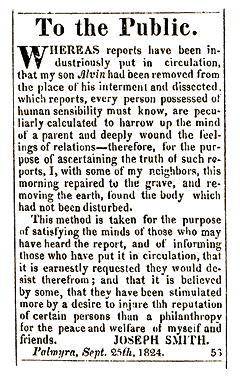
Volume II. Palmyra, N. Y., Wednesday, September 29, 1824. Number 1.
__________________________________
|


|
see the 1824 New York City articles for complete notes, etc.) NEW-YORK RELIGIOUS CHRONICLE. Vol. II. New York City, November 20, 1824. No. 39.
From the Christian Secretary.
"In the month of February last [1824]. the Church generally arose, and made public confession of their stupidity and coldness. From that time an unusual zeal and engagedness was manifest in some of our brethren. Soon solemnity was depicted on the countenances of some of our youth. |
 Vol. I. Published by Franklin Cowdery., Friday, November 26, 1824. No. 42.
PATRONS,
For the better arrangement of my business, and in order to manage my affairs in the most economical and least hazardous manner, I have resolved to make the following new arrangement, in regard to the terms of subscription of the Newport Patriot. |
|
Vol. I. Published by Franklin Cowdery., Friday, December 3, 1824. No. 43. Commissioner's Office. The subscribed is ready, at all times to attend to the business appertaining to the appointment, at his Printing Office on Village Street, Newport. |
|
Vol. II. Auburn, N.Y., Wednesday, January 5, 1825. No. ?
Proposed New Work. -- Mr. Josiah Priest, of Albany, has issued proposals for a new work to be entitled "The Wonders of Nature and Providence." The object is to comprise in one volume, those remarkable facts, with which nature and history are signalized and diversified; and if it be judiously compiled, it will be one of the best forms in which the unextinguishable love of the marvelous can be gratified, and which will be gratified either by fact, or fiction. |
 ns Vol. III. Rochester, N.Y., Saturday, January 15, 1825. No. 2. MORAL AND RELIGIOUS. More than two hundred souls have become the hopeful subjects of Divine grace in Palmyra, Macedon, Manchester, Phelps, Lyons and Ontario, since the late revival commenced. This is a powerful work; it is among old and young, but mostly among young people. -- Many are ready to exclaim, ["What God hath wrought!" It is the Lord's doing, and is marvellous in our eyes.] The cry is yet from various parts, "Come over and help us." There are large and attentive congregations in every part, who hear as for their lives. Such intelligence must be pleasing to every child of God, who rightly estimate the value of immortal souls, and wishes well to the cause of Zion. |
|
WESTERN NEW-YORK Baptist Magazine. Vol. IV. Morrisville, Madison Co., New York, Feb. 1825. No. 9. REVIVALS. ... Considerable additions have been made to one of the Baptist churches in Cincinnati, Ohio. October 9, 16 were baptized. |
|
Vol. I. West Bloomfield, Ontario Co., New York, Feb. 1825. No. 2.
...We learn that a powerful reformation has been spreading for several months past, in the towns of Palmyra, Williamson and Ontario. The work we are informed still continues in those places. -- In Mendon, God has poured out his Spirit among the christian brethren of late, several have been hopefully converted and some backsliders reclaimed... |
|
CANANDAIGUA, PUBLISHED BY JAMES D. BEMIS & CO. No. 45 Vol. XXII. Wed., February 9, 1825. Whole No. ? Windsor, Vt. Jan. 17. |
|
Vol. II No. 21 Palmyra, N. Y., Friday, February 16, 1825. Whole No. 73. From the Windsor, (Vermont) Jour. Jan. 17. |
|
Vol. II. Palmyra, New York, Friday, March 2, 1825. No. 23.
Religious. -- An article in the Religious Advocate gives the pleasing fact that a revival of religion had taken place in the towns of Palmyra, Macedon, Manchester, Phelps, Lyons and Ontario, and that more than 200 souls had become hopeful subjects of Divine Grace, &c. It may be added, that in Palmyra and Macedon, including Methodist, Presbyterian and Baptist Churches, more than 400 have already testified that the Lord is good. The work is still progressing. In the neighboring towns, the number is great and fast increasing. Glory be to God on high, and on earth, peace and good will to all men. Communicated. |
|
CANANDAIGUA, PUBLISHED BY JAMES D. BEMIS & CO. Vol. ? Canandaigua, N. Y., Wednesday, April 6, 1825. No. ?
Counterfeit Bills. -- Several persons wrre apprehended in the west part of Macedon last week for passing counterfeit money. They had been suspected of dealing in this trash, as we are informed, for several years, but they managed their affairs so ingeniously that they succeeded in evading the eye of the public, until an honest neighbor was imposed upon, who, on being accused of roguery, commenced a search and found in the possession of Abraham Salisbury, an innkeeper in that town, (and the same person who had deluded him,) spurious bills corresponding with those which he had received of him. This led to a further search, when a small wooden box containing $115 in counterfiet bank notes, was found concealed in a hollow tree near the house. What added to the evidence of Salisbury's guilt, was the circumstances of several boxes being found in his house of the same description as that found in the tree. Salisbury was committed to jail to await his trial -- the others were acquitted. |
|
Vol. II Palmyra, N. Y., Wednesday, April 6, 1825. No. 28.
LIST OF LETTERS.
... |
|
CANANDAIGUA, PUBLISHED BY JAMES D. BEMIS & CO. Vol. ? Canandaigua, N. Y., Wednesday, April 20, 1825. No. ?
Miscellaneous.
Mountains of Israel! rear on high |
Vol. I. Gaines, County of Orleans, N. Y. May 17, 1825. No. 14.
Sale of Grand Island. -- We would wish the public to note that pursuant to the advertisement of the Surveyor General, under act of the fegislature, the sale of Grand Island, together with other islands in the Niagara river, is [to] take place in this city on the 3d of June next. No portion of the public lands of this state have ever offered such a chance for vesting money with a certainty of a liberal profit. The time is not far distant when these premises will be the very center of vast commercial transactions. -- |
Vol. ? Geneseo, N. Y., Wednesday, May 25, 1825. No. ?
Election in Orleans County. -- We learn from the Batavia Times, that the late election held in the new county of Orleans has resulted in the choice of William Lewis, Esq. for sheriff, Orson Nicholson, for Clerk, Ithamar Hibbard, Franklin Cowdery, Joseph Rickey and Shobael Lewis, for Coroners. Self-nominations appear to be somewhat below par in the county of Orleans. |
Vol. II. Lyons, N. Y., Wednesday, June 1, 1825. No. 2.
Orleans County. -- An Election was held in this county for the first time, on the 10th May, and the two succeeding days, at which the following officers were elected -- William Lewis, Sheriff; Orson Nicholson, Clerk; Franklin Cowdry, Ithamar Hebard, Joseph Rickey, and Shubael Lewis, Coroners. |
|
CANANDAIGUA, PUBLISHED BY JAMES D. BEMIS & CO. Vol. ? Canandaigua, N. Y., Wednesday, June 15, 1825. No. ? Maj. Noah, editor of the New York National Advocate, has lately made a trip to the Niagara Falls. We cut the following from the paper of the 17th inst. |
By D. C. Miller. Batavia, N. Y., June 17, 1825. Vol. 14, No. 697. G O L D. Is a metal distinguished by its yellow color; by its being next in weight to platina, softer than silver, but considerably more hard than tin; and being more easily melted than Copper. |
Vol. VII. Rochester, N. Y., June 21, 1825. No. 364.
From the Albany Daily Advertiser, June 6.
This valuable possession of the state, formerly the property of the Creek Nation, was sold in lots on Friday last, at the Capitol, pursuant to law. |
|
CANANDAIGUA, PUBLISHED BY JAMES D. BEMIS & CO. No. ? Vol. ? Wednesday, June 22, 1825. Whole No. ? Grand Island. -- The names of the following gentlemen are given as the purchasers of this, and the smaller islands, in the Niagara river, which were sold at auction at Albany, on the 3d inst. viz. -- M. M. Noah, New York, Cornelius Masren, Penn-Yan, Yates county, Herman H. Bogert, Geneva, John G. Camp, Buffalo, Peter Smith, Schenectady, John Knowles, Sullivan, Madison county, Alvin Stewart, Levi Beardsley, James O. Morse, Cherry Valley, S. R. Warren, Troy, C. R. Webster, Dudley & Gregory, and James Carmichael, Albany. |
Vol. I. Batavia, N. Y., June 25, 1825. No. 3.
GRAND ISLAND in the Niagara river is a beautiful body of thickly timbered land, about 12 miles in length, and from 3 to 6 in width. From the New-York and Canada shores, it presents a fine appearance. White oak, hickory, ash, maple, and other valuable trees, are in clusters throughout the Island. At the north end, and almost in view of the Falls of Niagara, is a small bay, called Burnt-Ship Bay, which takes its name from the hulks of several vessels sunk on that spot during the old French War; and tradition says, they were sunk with all their military chests and munitions of war, the enemy coming so sudden upon them, as to leave no time to escape. The island was formerly the property of the Seneca Indians, which, with Strawberry, Snake, Squaw and Bird Islands, were sold to the state for $1,000, and an annuity of $500. At one period it contained several hundred squatters, who settled on it from Canada and New-York, erected shanties, declared themselves independent, and formed a government of their own -- levied taxes, and passed laws. O'Higgins was the first Governor; and he was succeeded by the celebrated Gen. Clarke. Their rifles, cows, and fishing apparatus were exempted from seizure for debt. Squire Wilkinson, of Buffalo, committed O'Higgins to jail, for not carrying his laws into effect. The state, alarmed at the formidable increase of this body, and perceiving an utter disregard for the constitutional power, as well as a disposition to destroy the valuable timber of the island, authorized Gov. Clinton to order a sufficient military force, and drive them off. This duty was performed in 1820, and their cottages were burnt, since which time but few have returned to the island.... |
Vol. VII. Rochester, N. Y., June 28, 1825. No. 365.
Celebration at Lockport. -- The ceremony of laying the Cap Stone of the combined Locks at Lockport, took place according to previous arrangement, on the 24th inst. The occasion called together a respectable number of the masonick fraternity, from different parts of the country, which, together with the citizens and strangers who were present, formed a numerous assemblage... |
Vol. ? Geneseo, N. Y., June 29, 1825. No. ?
The newspapers in this state, in speaking of the late sale of Grand Island, &c. in the Niagara River, uniformly say, that these lands were bought by this state, of the Creek Indians. This is certainly a mistake; this purchase was made by the state of New York since the 1812 war, of the Seneca Indians; and what is more, we have no reason to believe that the Creeks ever owned these or any other nearer than the state of Georgia. There are living in this neighborhood, several old Indian warriors, who tell me, that many years ago they went a long way to fight the Creeks in their own country, but deny their ever having has any possession here. |
Vol. I. Batavia, N. Y., July 23, 1825. No. 7. (From the New-York American.) All the money diggers, and believers in Capt. Kidd's hidden treasures, in the upper part of the city, were put in motion last evening by a report that a vast treasure of gold had veen found by some laborers digging the foundation of a house in the vicinity of Chatham square. |
Vol. I. Batavia, N. Y., August 6, 1825. No. 9. BATAVIA ACADEMY. The Rev. James Cochran, A.M. from the University of Glasgow, in Scotland, Most respectfully announces that he has undertaken the charge of this Institution. The Academy has been closed for a short period, but is now re-opened, with a fixed determination on the part of its Conductor, that in all its concerns Moral and Literary, the best satisfaction shall be given to Parents and Guardians of youth. Patronage is solicited. |
 "We Love Him Because He First Loved Us." Vol. III. Buffalo, New York, September 9, 1825. No. 35. THE MONITOR. The following article we copy from the Religious Inquirer of the 27th of August last. -- This paper is printed at Hartford, Con.; and in reply to the Editor's remark that he shall be happy to publish Mr. Fillmore's retraction of the slander, we can assure him that as yet, he shows no disposition to make any; although we have never ceased to importune him and his Methodist brethren on the subject. |
Vol. V. Fredonia, N. Y., September 14, 1825. No. 24.
CITY OF ARARAT -- Grand Island. -- We learn that the corner stone of the new Jewish City, on Grand Island, to be called ARARAT, is to be laid on the 15th inst, in Masonic order. M. M. NOAH, Esq. of New-York, will deliver an Address on the occasion. -- Buffalo Journal. |
 Extra - Buffalo, NY, September 15, 1825. - Extra
REVIVAL OF THE JEWISH GOVERNMENT.
It was known at the sale of that beautiful and valuable tract called Grand Island, a few miles below this port, in the Niagara River, that it was purchased in part by the friends of Major Noah, of New-York, avowedly to offer it as an asylum for his brethren of the Jewish persuasion, who in the other parts of the world are much oppressed; and it was likewise known that it was intended to erect upon the Island a City called Ararat. We are gratified to perceive, by the documents in this day's Extra, that coupled with that colonization is a declaration of Independence, and the revival of the Jewish government under the protection of the United States, after the dispersion of that ancient and wealthy people for nearly 2000 years -- and the appointment of Mr. Noah as first Judge. It was intended, pursuant to public notice, to celebrate the event on the Island, and a flag staff was erected for the Grand Standard of Israel, and other arrangements made; but it was discovered that a sufficient number of boats could not be procured in time to convey all those to the Island who were desirous of witnessing the ceremony, and the celebration took place this day in the village, which was both interesting and impressive. At dawn of day, a salute was fired in front of the Court House, and from the terrace facing the Lake. At 10 o'clock, the masonic and military companies assembled in front of the Lodge, and at 11 the line of procession was formed as follows: |
By D. C. Miller. Batavia, N. Y., September 16, 1825. Vol. 14, No. 710.
Mr. Noah, Editor of the New-York National Advocate, passed through this village, in company with several of his Jewish brethren, on Tuesday last, on his way to Grand Island for the purpose of presiding at the laying of the corner stone which is to constitute a part of the foundation of a New City to be called 'Ararat.' We shall, probably, be favored in due season, from some source, with the observations that the occasion may elicit from this singular genius, and shall, with pleasure, present them to our readers. It is said, that after the performance of the ceremonies, connected with this interesting and important event, on his return home, he intends spending a day or two in our village. We can assure him of a hearty reception in our cities; and that however much we may war with the politician, we admire the man: and we can further assure him, that he will not find in this village, or its vicinity, any tall, gigantic, raw-boned gentleman, from the land of steady habits, or from any other land, desirious of 'ducking' him in the "Canawl." |
Vol. III No. 1. Palmyra, N. Y., Tuesday, September 27, 1825. Whole No. 105. REVIVAL OF THE JEWISH GOVERNMENT. (We gather from the Buffalo papers, the following sketches relative to founding the new city of Ararat, on Grand Island, intended as an asylum for the persecuted Jews.) |
|
CANANDAIGUA, PUBLISHED BY BEMIS, MORSE & WARD. No. 26 Vol. XXIII. Wed., September 28, 1825. Whole No. 1170. (From the Buffalo Patriot, Extra, Sept. 15, 1825.) Revival of Jewish Government -- appointment of a Judge of Israel -- foundation of a city of Refuge. -- |
Vol. XVII. Geneva, N. Y., September 28, 1825. No. 18.
From the Buffalo Patriot, September 15, 1825.
|
By D. C. Miller. Batavia, N. Y., September 30, 1825. Vol. 14, No. 712.
A D D R E S S
|
Vol. III No. 2. Palmyra, N. Y., Tuesday, October 4, 1825. Whole No. 106.
|
Vol. V. Fredonia, N. Y., October 5, 1825. No. 27.
Masonic Celebration. -- The celebration of the installation of Stephen Van Rensselar, Grand Master elect of the Grand Lodge of the state of New-York, by the past Grand Master, De Witt Clinton, took place in this city yesterday. The procession and the ceremonies, which were joined in by a numerous body of Masons of various orders and degrees, and witnessed by a large concourse of citizens and strangers, were highly imposing, and calculated to impress those who were of the Craft and those who were not, with the extent and strength, and whenever excited, the moral influence of the institution. Aside from its ceremonies, the principles of Masonry, if we, being one of the uninitiated, at all understand them, are such as can scarcely fail to receive the assent of rational and free men everywhere. We are prevented from giving any of the particulars of the ceremonies, in consequence of the late hour at which they were concluded. -- Some account of them will be given on Tuesday. -- Albany Argus. |
|
CANANDAIGUA, PUBLISHED BY BEMIS, MORSE & WARD. No. 27 Vol. XXIII. Wed., October 5, 1825. Whole No. 1171. The following is the entire speech of M. M. Noah, delivered at the laying of the Corner Stone of the city of Ararat, to be located on Grand Island. It will probably be read with interest by all persons feeling a desire to become acquainted with the ancient and modern history of the Jewish nation. |
By D. C. Miller. Batavia, N. Y., October 7, 1825. Vol. 14, No. 713.
Newspaper changes. -- H. P. Brainard has disposed of the "People's Advocate," printed at Norwich, Chenango Co., to Mr. Wm. G. Hyer. who has enlarged the Advocate to the imperial size. |
Vol. III No. 3. Palmyra, N. Y., Tuesday, October 11, 1825. Whole No. 107.
__________________________________
|
|
CANANDAIGUA, PUBLISHED BY BEMIS, MORSE & WARD. No. 29 Vol. XXIII. Wednesday, October 19, 1825. Whole No. 1173. Extract of a letter from a correspondent of the New-York Spectator, dated "Lower Canada, Sept. 1825." |
Vol. III No. 7. Palmyra, N. Y., Tuesday, November 8, 1825. Whole No. 111.
|
Vol. III No. 8. Palmyra, N. Y., Tuesday, November 15, 1825. Whole No. 112.
|
Vol. III No. 9. Palmyra, N. Y., Tuesday, November 22, 1825. Whole No. 113.
|
|
"We Love Him Because He First Loved Us." Vol. III. Buffalo, New York, December 2, 1825. No. 47.
From the U. S. Literary Gazette.
|
Vol. III No. 14. Palmyra, N. Y., Tuesday, December 27, 1825. Whole No. 118.
|
Back to top of this page
Articles Page | Articles Index | History Vault
Oliver's Bookshelf | Spalding Library | Mormon Classics
last updated: Feb. 18, 2015